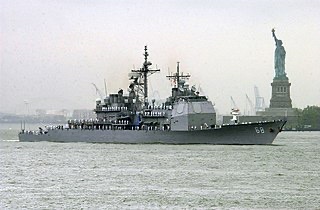
It’s Fleet Week!

The first “Fleet Week” took place in 1899, when a large number of US Navy vessels sailed in to New York Harbor in celebration of Commodore George Dewey’s success at the Battle of Manila Bay and the end of the Spanish-American War. There were similar events over the years, though the first Fleet Week celebration took place in June,1935. One hundred and fourteen ships and 400 military planes arrived in San Diego as part of the California Pacific International Exposition. A total of 3,000 officers and 55,000 enlisted men spent a week allowing visitors to tour parts of some of the vessels and for many of the men to visit the city and enjoy some shore leave.

USS Forrestal passes the Statue of Liberty during Fleet Week, 1989

Over the years both the Atlantic and Pacific Fleets have participated in specific celebrations, such as the US Bicentenary in 1976, and the Centenary for the Statue of Liberty in 1986. However, the first official Fleet Week took place over Memorial Weekend in 1982. The aircraft carriers USS Coral Sea with cruisers, destroyers and other vessels sailed under the Golden Gate Bridge, with Navy and Marine helicopters watching from above. In New York, ships passed under the Verrazano Narrows Bridge and sailed by the Statue of Liberty to dock at the New York Passenger Ship Terminal on the Hudson River. In 1988, the Navy allowed people to take tours of certain areas of specific ships.

Aircraft carrier USS Anzio with cruisers during Fleet Week, 2004

Since 1982, ships have also spent Memorial Day/Fleet Week in a number of cities including Los Angeles, San Diego, Portland, Seattle, New London, Norfolk, Boston, Baltimore, Port Everglade and Ft. Lauderdale. The ships include naval vessels and aircraft, Marine aircraft and occasionally landing craft, and Coast Guard ships and aircraft. In addition to tours, all three branches of the services provide a variety of demonstrations, from ways various gear is used to methods of hand to hand combat.

Special US Marine provides demonstrations during Fleet Week 2010

One of the things my adult children still talk about is when I took my four-year-old son to tour a cruiser that was moored in Seattle one Fleet Week. He had a great time dashing up and down the ladders (stairs to landlubbers) and actually learned a lot. Several years later, my father, a Marine officer, took both children to see an aircraft carrier moored in New York City for Fleet Week. My daughter was amazed at the side of the ship. And being able to see how the planes are moved onto the deck was the highlight of their Memorial Day!

In 2020, Fleet Week was suspended, like most everything else, because of Covid-19. Last year there was a virtual version, and while it was very well done, it wasn’t the same. Thankfully this year there will be a real Fleet Week. I hope you can visit one of them, because it’s a wonderful way to celebrate Memorial Day.

NATO Here We Come 🇫🇮 🇸🇪

Finland and Sweden (those are their flags) have just requested entrance into NATO. If they do ultimately join, they will be the 31st and 32d members. Most of us know something about NATO, but how did it come about? Well, you really need to go all the way to the meeting at Yalta in February 1945.

Churchill, Roosevelt and Stalin at Yalta, February 1945

At the meeting of the Big Three (Churchill, Roosevelt, and Stalin) the Soviet leader demanded, and the other men finally gave in, that at the end of the war, Poland would be under Soviet control. The Polish Government-in-Exile had worked side by side with the Allies, and had treaties with both Britain and France, but at that point, with Soviet tanks barreling through Poland on their way to Germany, there was little that the US or UK could do. However, neither Churchill not Roosevelt, and later Truman, were happy with the Soviet takeover. They were even more concerned with the way a Soviet-backed coup turned Czechoslovakia into a communist underling, and how the USSR set up the Berlin Blockade. Western European states feared that the Soviets would try to take over more nations that were still on their knees after the war. So in 1947, the United Kingdom and France signed a defensive pact known as the Treaty of Dunkirk.

President Harry S. Truman signing the NATO treaty

The Benelux countries–Belgium, The Netherlands, and Luxembourg–are small nations and, concerned with possible Soviet inroads, wanted additional military support from other major nations. On March 17, 1948, they joined with Britain and France and signed the Treaty of Brussels, which was a mutual defense pact which would last for fifty years. That was an excellent first step, but as most of Eastern Europe remained under the control of the Soviet Bloc, many in the West felt that they ultimately needed to work together with the US to stand up to Stalin.

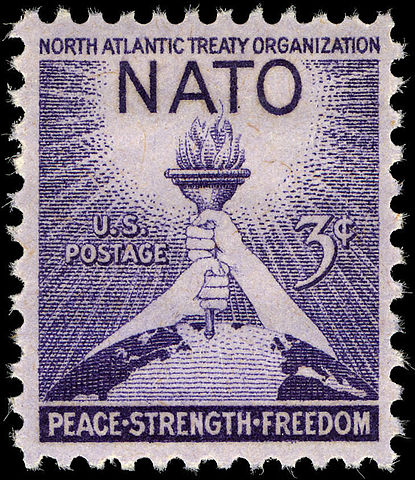
After another year of consultations, the US signed the North Atlantic Treaty Organization–NATO. In addition to the UK, France and the Benelux countries, Canada, Italy, Portugal, Denmark and Iceland joined the Organization. Greece and Turkey joined in 1952, and West Germany did so in 1955. So, during the peak of the Cold War, NATO faced the Warsaw Pact. Spain became a member of NATO in 1982. But it wasn’t until the breakup of the Soviet Union in 1991 that former members of the Warsaw Pact joined NATO. The Czech Republic, Hungary and Poland joined in 1999. Bulgaria, Estonia, Latvia, Lithuania, Romania, Slovakia and Slovenia entered in 2004. NATO accepted Albania and Croatia in 2009 while Montenegro joined in 2017 and North Macedonia in 2020.

Shortly after the fall of the USSR, it seemed to be possible that the West and Russia would be able to work well. But with Mr. Putin’s attacks in Georgia, Chechnya, and early forays into Ukraine, it’s no wonder that Sweden and Finland, both of whom had fought Russia to a stalemates in the past, would want to join an organization that could stand up against possible aggressions to come from Russia.

Masada or Mariupol?

Some good news! Apparently a significant number of elderly civilians, women and children who have spent months in tunnels under the Azovstal Steel Plant in Mariupol have finally been allowed to leave under the protection of the United Nations and the International Red Cross. Unfortunately, some of them do remain, along with hundreds of Ukrainian Marines and other military personnel. They have made it clear that they will fight to the end. This has happened before–from Japanese caves in Iwo Jima, to the Alamo, to the 1842 retreat from Kabul (Massacre of Elphinstone’s Army) and back through millennia. I could give you a very long list, but the one that immediately came to mind was Masada.

Aerial view of Masada c. 2013 Photo by Andrew Shiva

Masada stands on a plateau about 1,300 feet above the Dead Sea between Sodom and Ein Gedi, Israel. It was build by Herod the Great (37-4 BC) as a winter retreat, and a way to avoid enemies. It included a castle, cisterns, numerous massive storerooms and huge walls. After his death, it was used for a short time by a small Roman garrison. However, when the Great Revolt erupted in 66 AD, a group of Jews known as Sicarii, led by Eleazer Ben Yair took over the largely abandoned Masada. With the destruction of Jerusalem by the Romans in 70 AD, a large number of rebels fled to Masada and joined Ben Yair’s group.

Realizing that a large number of Jews were holed up in Masada, 8,000 Roman legionaries surrounded the complex from 73 to 74 AD. The Romans began building siege weapons as well as using massive amounts of wood and earth to establish a siege wall and ramp at the western side of the plateau. Finally, the Romans had had enough. They built a tower on top of the ramp in order to get into the fortress. Knowing that the Romans would easily overpower everyone, all but two women and five children died. Some fought but most of them preferred to die rather than becoming slaves. We don’t know what happened when the Romans got into the fortress, but we do know that they abandoned Masada shortly after.

In the 5th century a small group of monks build a monastery at Masada, though it was ultimately deserted. Masada was taken over again during early Islam, but it too was abandoned. It wasn’t until 1828 that researchers rediscovered Masada and began exploring the area. Archeologists led by Shmariya Gutman started excavating Masada in 1953 and by the 1980s and 90’s they had found a number of structures. Additional investigation suggests that the story of Masada as written by Josephus, was not accurate. Based on remains they have found, some researchers suggest that only 25 to 30 people were involved. But whether it was 30 or 900, the story of Masada remains.

A Ukrainian Marine during training in 2914

As of this morning, May 11th, the men and women holed up in the Azovstal Steel Plant remain defiant, despite increased Russian bombardment and missile attacks–eerily similar to what happened at the Stalingrad Tractor Plant, the epicenter of the Battle of Stalingrad.

Slava Ukraini

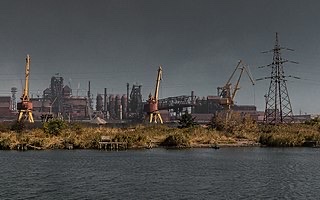
The Azovstal iron and steel factory C. 2018

UPDATE

For a serious update on events in Mariupol and the Azovstal factory, take a look at “Dispatches From the Mariupol Siege” in the Wall Street Journal, May 12th, A17.

Disinfor. . . WHAT???

Yup–the “Disinformation Government Board,” is a new section of the Department of Homeland Security. After listening very carefully to the comments made by the Secretary of Homeland Security both in Congress and his later comments, it sounds more like Animal Farm than the First Amendment. Did you ever read the Constitution? The Amendments? We read both texts when I was in high school, college, and grad school. The First Amendment is quite short and if you haven’t ever read it, or if its been a while since you have, take a look.

Congress shall make no law respecting an establishment of religion, or prohibiting the free exercise thereof; or abridging the freedom of speech, or of the press; or the right of the people peacefully to assemble, and to petition the Government for a redress of grievances.

There’s been plenty of so-called “disinformation” over the years, both spoken and written, going back even before the Revolution and the Constitution, yet even then both speech and the press were protected. One of the first trials which became and integral part of US law involved John Peter Zenger, who was born in Germany in 1697. He and his family emigrated to New York in 1710 where he became an apprentice to William Bradford, the first printer in New York City. Eventually Zenger set up his own printing business on Smith Street in the City.

Page from the New York Weekly Journal, January 7, 1733

At that time, the new colonial Governor, William Cosby, was having an argument with the Council of the Colony over his salary. Cosby removed the current Chief Justice, Lewis Morris, and put in his own pick, James Delancy. That escalated the dispute, leading to a great deal of discussion in the press, particularly in Zenger’s New York Weekly Journal. Cosby condemned the newspaper for “divers, . . . false and seditious” comments, charged Zenger with libel, and put him in jail.

Illustration of Andrew Hamilton speaking at Zenger’s trial in the book Wall Street History (1883)

Andrew Hamilton of Philadelphia and William Smith, Sr., of New York, took Zenger’s case. At the end of the trial, the jury took just 10 minutes to return with a “not guilty” verdict. During Hamilton’s closing arguments he said that “a statement, even if defamatory, is not libel if it can be proven.” That remains judicial precedent to this day.

Personally I’m horrified at this new “Disinformation” board. With very few exceptions, Americans can say basically anything we want. The Framers made that part of their FIRST Amendment for a reason and we should be extremely concerned to that the Executive branch is setting up a Big Brother/Sister is watching group. While there has been a bit of walk-back of this, I’m not certain that I’m convinced.

Shouldn’t we learn from the past? Maybe not🤨

Last April, I wrote the following blog about the 81st anniversary of the Katyn Massacre, in which the Soviet Army murdered 20,000 Polish military officers, politicians, doctors, lawyers, priests and intellectuals, leaving them in shallow graves. Who would have thought that on the 82d anniversary of the Katyn Massacre we would be horrified at another Russian massacre. This time, with the use of aerial photography, we can see that up to 10,000 men, women and children have been left in a shallow grave in the outskirts of Mariupol–to say nothing of the hundreds of others who have been killed in Buchi, Irpin, and too many other towns.

Why? Initially President Putin told his people that it was because Russia wanted to demilitarize and denazify Ukraine (interesting when you remember that President Zelenskyy is Jewish.) Then it was to free Ukraine from oppression. (There’s plenty of oppression in Russia–maybe deal with that first? Just a thought.) Finally this week a Russian general in charge of the southern front made it clear that the goal of the Russian government is to take all of southern Ukraine–from Crimea, Donbas and Luhansk to Odessa and on toward Moldova. I have the horrible feeling that we are headed to World War II 2.0 being played out in Ukraine. It’s worth rereading the Katyn Massacre to remember what happens in this magnitude of warfare.

(Because of the graphic photos, there will be not pictures in the blog.)

Most of us know that Germany attacked Poland from the east on September 1, 1939. Just 16 days later, because of the Molotov-Ribbentrop Pact, the Soviet Union attacked Poland from the west. It’s difficult to know how many Poles were initially captured by the Soviets–estimates go between 250,000 and 455,000 men. In a relatively short time, many escaped and others were allowed to leave after interrogations, but by November 1939, Laeventia Beria, head of the Russian NKVD (precurser of the KGB) held about 40,000 men in prisons around Kozelsk and Karkiv,(sound familiar?) inside the USSR. On March 5, 1940, Stalin agreed with Beria, and they, with six other members of the Politburo, signed execution orders for over 25,000 “counter-revolutionaries.” During April and May, members of the Polish military, pilots, government officials, police, lawyers, doctors, engineers, professors, writers, journalists, large landowners and priests were killed, and thrown into unmarked graves, most of them in the Katyn Forest. Stalin hoped to get rid of individuals who could oppose the Soviet Union at the end of the war.

The “fog of war” regarding the missing Poles continued until June 1941, when Germany turned on its “friend” with Operation Barbarossa–the attempt to take over the Soviet Union. Despite their recent war with the Soviets, the Polish government-in-exile in London headed by President Wladyslaw Sikorski, signed the Sikorski-Mayski Agreement against Germany. The government-in-exile expected that the Polish POWs held in Russians would be released and fight with the Polish government. Sikorski asked Stalin where they were. The answer was that they had escapes, and the Russians had “lost track” of them, but they were probably in Manchuria. No one believed that, but the Soviets insisted that they simply didn’t know anything else.

However, when Germany pushed deep into the USSR around Smolensk in April 1943 they found a mass grave of thousands of men. Josef Goebbels, Hitler’s Minister of Propaganda and closed confident, was thrilled. He could tell the British, French, Poles in exile, and Americans that their ally, Stalin, had killed thousands of Poles. He brought in members of the “Katyn Commission” of the International Red Cross (IRC), with 12 forensic examiners, and even a number of Allied POWs, to examine the site. Now Sikorski demanded an explanation. Stalin replied that the Germans had actually massacred the Poles, and then cut all diplomatic relations with the Polish government-in-exile. Throughout the rest of the war, Stalin maintained that it was Germany which had massacred the Poles, regardless of the IRC’s extensive information.

In 1952, the US conducted a congressional enquiry about Katyn. It, too, found that the massacre had be done by the Soviets, but very little was said or done about it. And after the war, when Poland came under the controlled by the Kremlin, little more was said about it . . . in public. But behind closed doors, and among the Polish diaspora people continued to ask questions about what happened in the Katyn forest.

Over the decades, the questions of the massacre festered under the surface. In the 1970s, the Flying University in Poland, and the Workers Defense Committee started openly asking questions. Despite arrests and beatings, more and more people demanded that the documents be unsealed. In 1981, Solidarity took a significant step when it set up a Katyn memorial. The Polish Communist Party took it down, but every Zaduszki Day (All Souls Day) Poles would set up crosses with the same silent questions. Not until 1989, when real cracks appeared throughout the Warsaw Pact, did the USSR admit that Stalin had authorized the massacre. The following years, Mikhail Gorbachov explained that Stalin had agreed with Beria and had authorized the NKVD to exterminate so many of Poland’s elite. That year, the Kremlin also turned over a number of formerly top-secret documents to the Polish President, Lech Walesa.

Even so, it was another 20 years before Russia finally provided Poland with 81 volumes of material, though they still hold 35 more volumes of classified documents. On the 70th anniversary of the Massacre, the Polish Prime Minister, Donald Tusk, and the Russian Prime Minister Vladimir Putin attended a memorial service near the actual site. Yet, to this day, there are still many, many questions to be answered
We’ve Seen this Before

Sadly this is not the first time that Russia has attacked a sovereign nation. There’s a long history going back a millennium. Just in the past fifteen years it’s happened in Georgia, Chechnya, and Syria. The utter devastation, towns turned into rubble and civilians killed in horrifying ways, is unimaginable. What we’ve been seeing in Ukraine–in Mariupol, Bucha and other cities–is more reminiscent of Tamerlane than even World War I. What’s different about this war is that Ukraine decided to stand and fight. Thinking about that, there are definite parallels with the Poles who did the same in the Polish-Bolshevik War of 1920-1921.

Remember, Russia, Prussia and Austria-Hungary had dismembered Poland between 1772 and 1796. There was no “Polish State” for more than 150 years, despite a significant Polish underground network, riots, petitions and millions who resettled overseas, many in the US, who still wanted to see a true Poland. It wasn’t until the end of World War I that the Poles in exile, headed by the famed pianist, Ignace Jan Paderewski, managed to convince Woodrow Wilson to include an independent Poland as the 13th of his 14 Points. The Big Four (Wilson, Clemenceau, Lloyd George and Orlando) discussed a reconstituted Poland during the Paris Peace Conference, which finally became Article 82 of the Treaty of Versailles.

Photos from the Polish-Bolshevik War c. 1920

Despite the Treaty of Versailles, and the fact that the Western Allies opposed the Soviets, the new Bolshevik government wanted to keep the Polish territory that the Czars had held for 150 years. Initially the Red Army took over Ukraine, and in June 1920, began forcing the Polish Army west, all the way to the capital, Warsaw. The second Polish Republic was on the verge of complete collapse in mid-August 1920. But led by General Jozef Pilsudski, the new Polish Army, with volunteers, and contingents of the Blue Army (Haller’s Army) that transferred from France to Warsaw, the Poles won the Battle of Warsaw, (sometimes known as the Miracle on the Vistula). By August 25, the Reds were in retreat, and they continued to fall back to the east until the cease-fire on October 18, 1920. Poland and the Soviet Union signed the Treaty of Riga on March 18, 1921, which established the eastern border until World War II.

Polish soldiers in the Battle of Warsaw

However, World War II was very different. Again, the Poles fought bravely–and it wasn’t romantic cavalry charges. The Germans had to deal with Polish aircraft, tanks, infantry and an outstanding intelligence service. What they thought would be a quick run to Warsaw ended up being a real fight. But there were problems. Though the Poles had treaties with both the UK and France in which the two promised to join Poland if Germany attacked, neither France nor Britain were able to did anything. And then, on September 17, 1939, the Soviets attacked Poland from the east. With no assistance at all, there was little the Polish Army could do. Crushed between Germany and the Soviet Union, Poland became a wasteland.

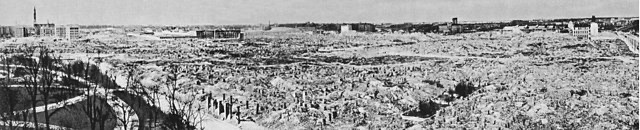
The rubble that was Warsaw c. 1944

Does any of this sound familiar? Russia has always wanted a buffer from the West. And that’s understandable. But decimating a nation, carrying out war crimes, pulverizing whole cities into submission is NOT the way to do it. That is why Poland, along with Moldova, Hungary, Romania, Estonia, Lithuania and other Central European nations are assisting Ukraine in every way possible. They’ve seen this before, and they understand that if it Russia is not stopped now, they will be next.

The Lady was a Sniper

In honor of Woman’s History Month, I thought we could take a look at an amazing Ukrainian woman, Lyudmila Pavlichenko. She was born on July 12, 1916, in Bila Tserkva in the Kyiv Oblast of what was then Russia. Her family moved to Kyiv in 1930 where she worked as a grinder at the Kyiv Arsenal Factory. She admitted that she was extremely competitive and a bit of a tomboy, and was delighted to join a shooting club in Kyiv, where she became an excellent sharpshooter. In 1937 Lyudmila entered the Kyiv University (studying history🥰). But life changed on June 22, 1941, when Germany invaded the Soviet Union.

Lieutenant Lyudmila Pavicenko, Hero of the Soviet Union

Like so many others, she immediately volunteered, and ended up in Odessa, where she was ordered to Nurses Training. She refused, insisting that she would be more useful as a marksman. She was assigned to the Red Army’s 25th Rifle Division. Weapons were in short supply, but when a sniper in her unit was wounded, she took his Mosin-Nagant 189 bolt-action rifle and immediately shot two Germans. With that, she officially became a sniper. Pavlichenko spent the next ten weeks at the siege of Odessa, during which she accrue 187 kills and quickly was nicknamed “Lady Death.”

As the Romanians wrested Odessa from the Soviets in October 1941, the Russians withdrew toward Sevastopol, in Crimea, which also came under siege. By May 1942, the new Lieutenant was cited by the Southern Army Council for having another 257 kills. In June, she was hit with shrapnel from a mortar. She was evacuated via submarine and spent a month in a hospital in Moscow.

Lyudmila Pavlichenko c.1942

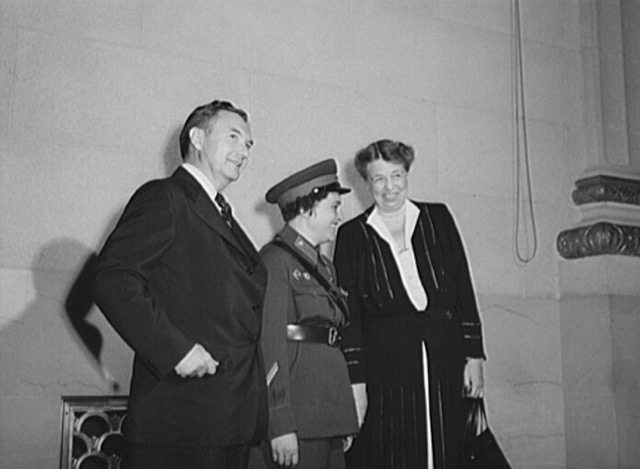
With a total of 309 kills, Pavlichenko was more important to the Soviets as a spokesman than sending her back to the front. Instead, she went on a propaganda tour throughout the country. She then was out a tour to both Canada and the US where she met both Franklin and Eleanor Roosevelt at the White House, and spoke in both Chicago and New York City. On returning to the Soviet Union, she trained new sharpshooters and snipers until the end of the war.

Justice Robert Jackson, Lt. Lyudmila Pavlichenko and Eleanor Roosevelt

After the war, she went back to Kyiv and graduated from the University with her history degree. Ultimately she became the Senior Researcher for the USSR’s Navy Headquarters. After dealing with what we now understand to be PTSD for years, she died of a stroke at the age of 58 in 1974.

Airlift 2.0 ?

Anyone who has paid even a smidge of attention to the news knows that cities in Ukraine like Mariupol, Kharkiv, Lviv, and Kyiv are in desperate straits due to Russian bombing and laying siege to them. Just look at Mariupol–no heat, light, food, medicine, or water, and no way out. I’m not going to discuss why a civilized country would to something like that. I have some thoughts, but it’s probably well above my pay grade. My question is–now that it’s happening, what can be done? For that I only look back to 1948 and the Berlin Blockade, and the Airlift.

U.S. Army Garrison Wiesbaden file photo.C-54s stand out against the snow at Wiesbaden Air Base during the Berlin Airlift in March 1949.

At the end of World War II, Germany was partitioned by the US, UK, France and the USSR. And sitting well inside the part of the country held by the Soviets was the city of Berlin. It too was divided into four zones. In June 1948 the three Western powers were considering setting up the new West Germany, much to the consternation of Stalin. In addition, he wanted to control all of Berlin. To make his point, on June 24, 1948, the Soviets blockaded all the roads, trains and rivers in and out of Berlin–a city of 2.5 million people. The only way to get there was by plane.

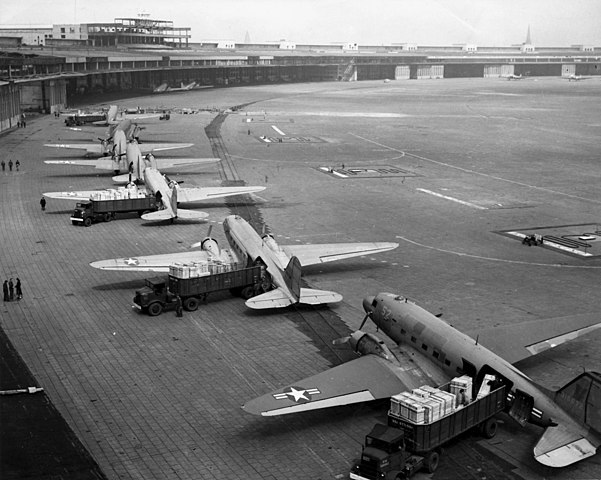
C-47s at Tempelhof Airport, c. 1984

President Harry Truman immediately placed General Lucius Clay in charge of and airlift. Two days later, the United States and Great Britain started Operation Vittles to deliver food, fuel, and medicine to the besieged city. Pilots who had returned to civilian live were called back into service, though many returned voluntarily. The airlift ramped up quickly, and soon the C-47s were landing at Tempelhof Airport every 45 seconds. On Easter Sunday, April 17, 1949, tons of cargo arrived, including 85,800 tons of coal. Every day, many of Berlin’s children stood at the gates, watching the planes land and take off. Occasionally some of the flyers handed out candy while they waited for their planes. Lieutenant Gail Halvorsen (known as Berlin’s Candy Bomber) started putting together tiny parachutes made out of handkerchiefs carrying candy for the children–a very rare treat in a shattered city. Before long thousands of Americans were sending all kinds of candy for operation Little Vittles for the children of the airlift.

1st Lt. Gail Halverson aka the Berlin Candy Bomber

By May of 1949, Stalin realized that the world was riveted watching the airlift, and the Soviet Union was being condemned throughout the world. The siege wasn’t going to work. On the 11th of May he ended the blockade. However, the planes continued to bring in additional supplies until September to start building up a stockpile “just in case.”

Milk delivery during the Berlin Airlift

So what do we do now? We set up an airlift 74 years ago in a matter of days because millions of people were going to run out of food and fuel. There were no bombs dropping. But Josef Stalin wanted to take Berlin and was perfectly happy to try to wait it out. It didn’t work. Seventy-four years later, Vladimir Putin wants to take over an entire free nation. 44.3 million people. And dropping bombs will take the country faster than a siege. We’ve provided humanitarian relief all over the work. Yes, there are serious issues involved, but there are some very smart people who could get this done if there was a will to do it. Really, where are Harry Truman and Lucius Clay when you need them?

God Bless Ukraine

In Ukraine, everything old is new again–review of book BLOODLANDS

Watching the news these past days has been horrifying. War is bad enough. But there’s a huge difference between a military campaign and indiscriminate carnage and war crimes. Turning thriving cities into rubble is very similar to what the Russians did in Aleppo, Syria, and Grozny, Chechnya. It’s understandable that the Ukrainians are willing to fight to the end. It’s only been thirty years since the end of the Soviet state, and the Ukrainians well remember being under the boot of the Communists. Even more, they understand what happened when the USSR took control of Ukraine 90 years ago. If you haven’t heard about the Holodomor–the Terror-Famine–which decimated Ukraine, take a look at Bloodlands: Europe Between Hitler and Stalin by Timothy Snyder.

Starvation in Kyiv c. 1935

Snyder’s book covers the years 1930-1945, focusing on Ukraine, Poland, Belarus and the Baltic states. After the victory of the Red Army in 1921, the Soviets were in such dire straits that Lenin set up the New Economic Policy which allowed the peasant farmers, called Kulaks, in Ukraine to provide food for the country. It worked well and Ukraine was again the breadbasket of their nation. Unfortunately, by 1927 General Secretary Josef Stalin decided it was more important to exterminate the “capitalist” kulaks than it was to allow them to feed his people. He deliberately confiscated all of the food grown in Ukraine for several years. In the mid-1930s, over 4 million Ukrainians died of starvation, while many of those kulaks who managed to survived were simply shot because of their “capitalist tendencies.” At the same time, there were numerous rounds of purges in Ukraine. to finish the job

Starvation in southeastern Ukraine c. 1935

After World War II, Ukraine remained part of the Soviet Union with everything that goes with a communist country. However, Ukrainians have long memories, particularly memories of the Holodomor and purges of the ’30s and the disasters of the war. They were eager to break away when the USSR disintegrated in 1991. It’s been a difficult 30 years, with the country growing in fits and starts, but always with the goal of developing a stable democracy. When Vladimir Putin’s army crossed into their country, it’s an updated effort to take the country. Rather than starvation, it’s tanks and MIGs. But this time, Ukrainian civilians have joined the military to save their country. They need all the help we can give them!

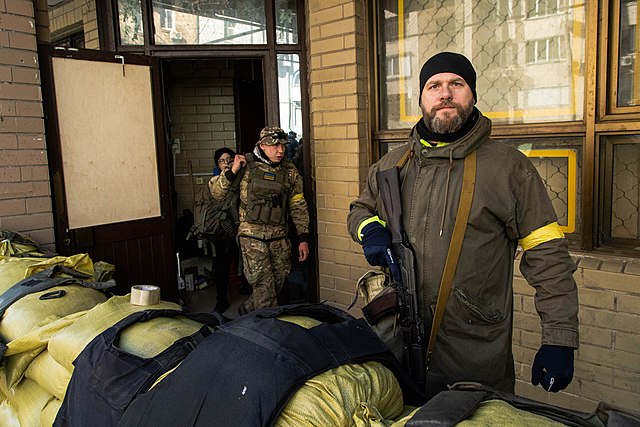
Armed civilians in Kyiv February 2022

If you don’t know much about Central Europe other than the chilling photos of bombs hitting maternity hospitals and cities with no food, heat, light, medical supplies or even water, take a look at Bloodlands. It becomes crystal clear why the Ukrainians are willing to fight for their freedom, and why the Poles and the Baltic states. are doing everything they can to help.

http://Timothy Snyder. Bloodlands: Europe Between Hitler and Stalin

Do you have photos in your office?

Do you have any photos in your office? Many of us do. I have four–not huge ones–just two small pictures of my children and two equally small ones of my parents. They definitely keep me grounded. If I ever have a question of what to do, one look at their photos gives me the right answer.

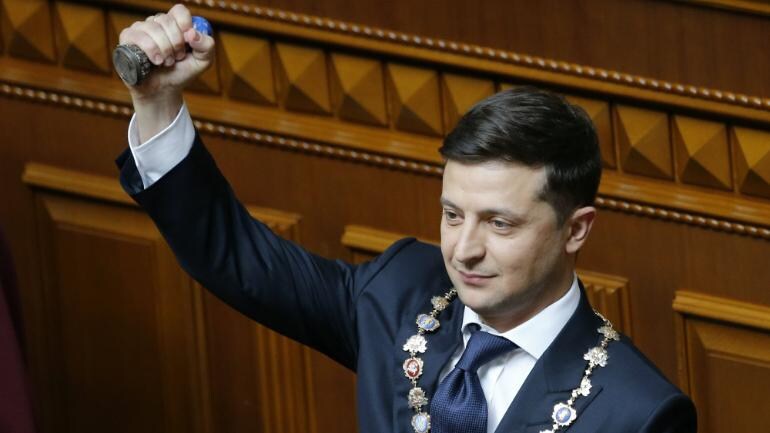
Apparently I’m not the only person who thinks that way. During his inauguration on May 20, 2019, President Zelensky of the Ukraine said:

I really do not want my pictures in your offices, for the President is not an icon, an idol or a portrait. Hang your kids’ photos instead, and look at them each time you are making a decision,”

That probably explains why so many Ukrainians have decided to stay and fight. It must be the hardest decision they’ve ever had to make, but they are trying to do what’s right for their family.

God Bless Ukraine

Ukrainian new President Volodymyr Zelenskyy

Ukrainian new President Volodymyr Zelenskyy holds the Ukrainian symbols of power during his inauguration ceremony in Kiev, Ukraine, Monday, May 20, 2019–India Today