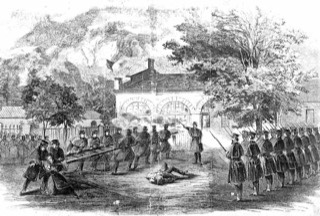
As an historian, I spend a lot of time reading military history, particularly Marine Corps history. It’s fairly easy to find a lot of great books on the American Revolution, the Civil War, World Wars I and II, and an amazing number of books on our current military. What’s hard to find is information on what happened between the end of the Civil War, when the Marines were basically a small constabulary, and World War I, when the Marines were an elite fighting force of 72,000 men.
Well, actually several things changed after the Civil War. The U.S. went from sail to steam meaning larger, faster ships which needed additional sailors—and Marines (often called “soldiers of the sea.”) Marines also received several new and improved weapons like the Maxim gun, precursor of the machine gun. After 1865, the country began growing at a massive rate, as did our foreign trade. And with that foreign trade went both the Navy and Marines. Even so, the Marines were different by the beginning of the Great War—and I recently read a book which, at least in part, explained why.
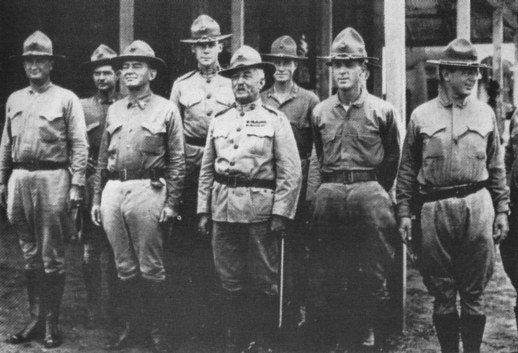
Leaders of Men by Dr. A.C. Venzon discusses 10 Marine officers who overlapped the years 1861 to 1923 and explains how their natural leadership abilities gradually changed the attitudes, training, and morale of the Marine Corps. From Col. Robert Huntington, who joined the minuscule 3,000-man Marine Corps in June 1861 and started his career at First Manassas, to Col. Fritz Wise, who fought with his men at Belleau Woods in 1918, each of these men learned from their elders and, in turn, trained those who followed them.

It’s a fascinating, eclectic group. In addition to Huntington and Wise, there’s the indomitable Smedley D. Butler. But Venzon includes other men who’s names have been shoved into dusty corners of libraries. These men, like Littleton W.T. Waller, Joseph (Uncle Joe) Pendleton, Wendell (Buck) Neville, “Hiking” Hiram Bears, John (Handsome Jack) Myers, and George Thorpe, fought in Egypt, Alaska, Panama, China, Ethiopia, Djibouti, Honduras, Nicaragua, Cuba, the Philippines, Mexico and Haiti. One was an absolute martinet. One or two drank too much. Some were wounded. Some dealt with malaria or dengue fever. One had a breakdown. All had their foibles. But well after they retired, the men they had trained and fought with would tell anyone who would listen that they had become better Marines, real Marines, because of these men.
The author has used extensive, little-known documents and rare photographs to reintroduce these men who had such an important part of the USMC in the 20th century and beyond. A relatively short book has given the reader a much better understanding of what actually made the Marine Corps what it is today.
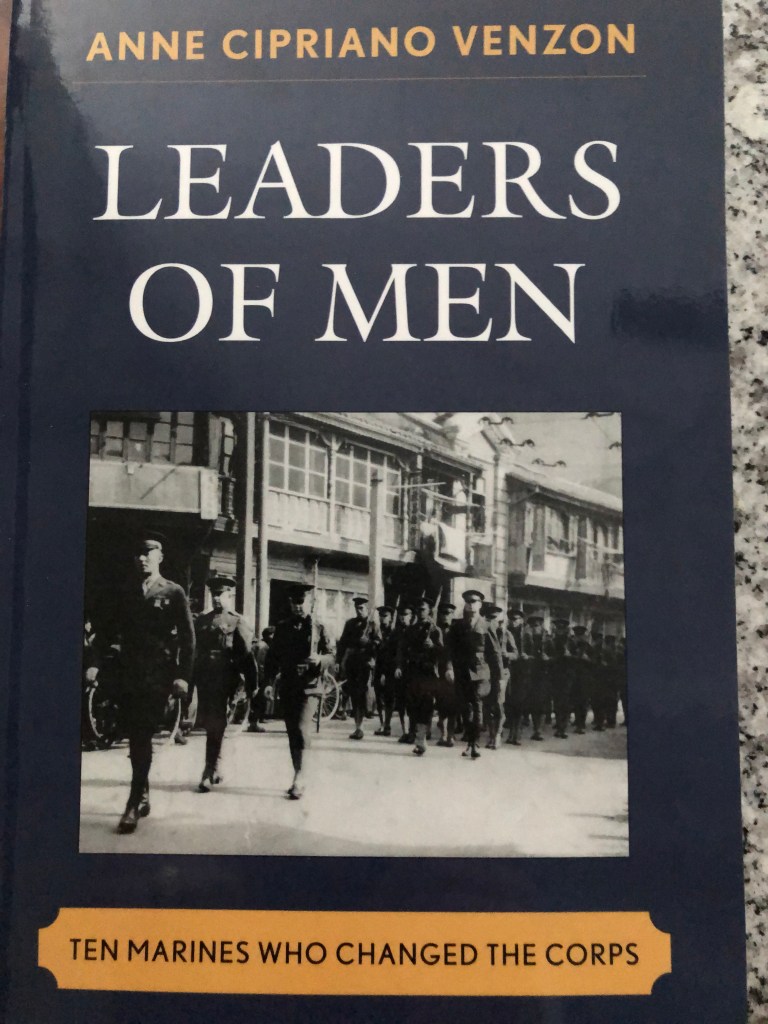
Anne Cipriano Venzon. Leaders of Men: Ten Men Who Changed the Corps. Latham, MD: Roman & Littlefield, 2008.
 Historical Lense