The year 2020 has been an Annus Horribilis (horrible year for those of us who didn’t take Latin.) Things were almost too good to be true in January and February. They were! By April, everything was wrong—and then it got worse. There’s a lot I could discuss both as an historian and as a human being, but I’ve learned that there are times when the best thing to do is take a little while to really think and get some perspective. I’ve particularly been thinking about the ‘60s and early ‘70s.
In the spring of 1970, I was talking to Dr. Richard Welch, the best professor I ever had, who surprised me when he said that it was fine to be involved, but possibly more important than looking at the big picture was to do a little introspection. He went on. “Each of us needs to think about what we can do in our own little corner of the world. It would be a better place if each of us did what we know is right, and lived with fortitude.” He gave me a high five and walked back toward his office. I’ve been thinking about fortitude on and off since then.
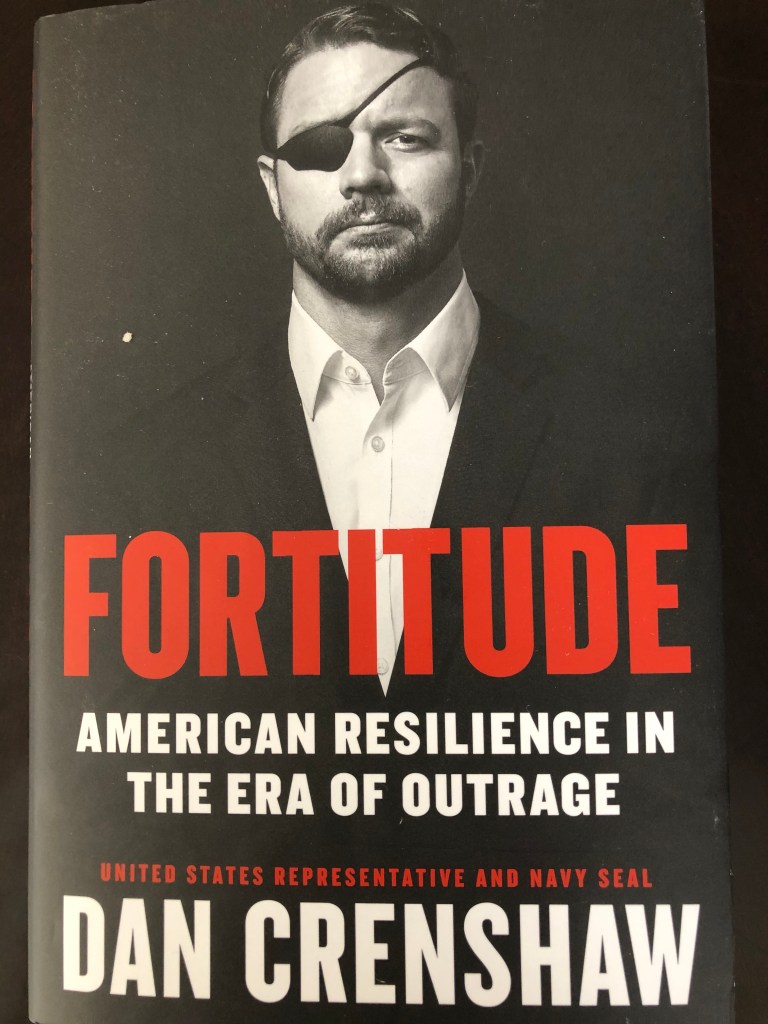
Fast forward 50 years. I was watching a C-SPAN Homeland Security Committee hearing that included Congressman Daniel Crenshaw. I did a quick search (not Google). Among other information, I found his book, Fortitude: American Resilience in the Era of Outrage. In deference to Dr. Welch, I put aside what I was reading and started Fortitude as soon as it arrived. I thought it would be interesting. I’ve reread it twice in the past two weeks because it isn’t interesting, it’s necessary.
Before he was Congressman Crenshaw he was Lt.Cmdr. Crenshaw, a Navy SEAL. On his third tour in Afghanistan he was blinded by an IED. After what his doctors consider miraculous work, he regained partial sight in his left eye, and went on to two more tours before being medically discharged from the Navy. It’s a fantastic story in its own right, but he only uses it as a foil. He suggests that we all have our own problems—not as extreme as a roadside bomb, but problems nonetheless. It’s what we do with them that matters. We can wallow in self-pity or overcome our issues. He provides us with some very concrete ways to go about it.
Crenshaw is a problem-solver and he uses parts of his own story to discuss life-lessons useful for all of us. In chapters like Perseverance, Be Still, Sweat the Small Stuff, Do Something Hard, he proposes ways to master our own unique issues. He’s not suggesting that we should try to become SEALs. He DOES suggest how we can, we should, be more resilient than we are. He’s showing us ways to engage in thoughtful debate rather than finding comfort in victimhood. How to take a joke rather than be outraged. (And his discussion of the current “outrage culture” is painfully honest.) How to toughen up a bit. He used psychology, history and his own life to show us that we really are in charge of our own lives. Are his suggestions easy? Not really. But face it, LIFE isn’t easy. However, living with fortitude makes a significant difference in the quality of our lives. There are many extremely interesting books which I have read and reviewed over the years. This is different. Read it and really think about what he’s saying. Even some small changes will make a big difference.
 Historical Lense