Sometimes, removing a statue makes sense. Removing Stalin’s or Lenin’s or Saddam Hussein’s statues–fine. They were universally loathsome men. I can also understand removing statues of men like General Nathan Bedford Forrest, a slave-holder and Grand Imperial Wizard of the KKK. Slavery is horrific! (Yes, “is,” not “was.” Slavery continues in many parts of the world to this day). However there are procedures that cities and states must follow to do that in an orderly manner. As an historian, my personal preference is to put those statues in museums, where we can teach people what happened, because if we forget what happened in the past, we’ll end up doing it again! Erasing history is the worst thing we could do!
But here’s a question. What about people who fought for the Confederacy, but had NOTHING to do with slavery—in fact vigorously opposed it? What about people who spent all but 1861-65 being honest, hard-working people opposed to slavery? We need to remember that that was still a time when you were a member of your state first, then the US. You were a Pennsylvanian or a Georgian first. States rights were front and center at that time. Should we pillory every single one of them? A case in point–Matthew Fontaine Maury.
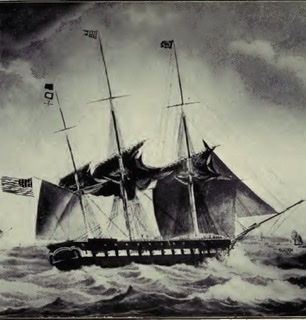
Maury was born in Spotsylvania County, Virginia, in 1806, and grew up in Tennessee. In 1825 Sam Houston, Congressman from Tennessee, gave him an appointment as a midshipman on the USS Brandywine which was taking the elderly Marquis de Lafayette back to France after his tour of the US. Maury then moved to the USS Vincennes, the first US naval vessel to circumnavigate the globe. Maury quickly realized that the navigation available at that time was seriously wanting. Back on shore in 1834, he put together A New Theoretical and Practical Treatise on Navigation, printed in 1836. Unfortunately, he badly broke his right leg while riding in a stagecoach, ending his career at sea. Instead, he was assigned to run the Depot of Charts and Instruments in Washington D.C.
He began by organizing the massive number of log books that had just been stashed “wherever,” and developed a logical system for keeping the records. He’d been fascinated with winds and currents since he first set sail on the Brandywine, and by using the data in the Depot’s charts and logs, wrote the important book, Wind and Current Charts of the North Atlantic in 1847. (It turned out that the information in his book cut more than 45 days sailing from the east to the west coast.) He then began charting the migration of whales, which had never been properly catalogued. Shortly after he’d published Wind and Current, Maury became one of the founders of the American Association of the Advancement of Science (AAAS) in 1848.

The United States Naval Academy opened in 1845, and by the time the Depot was renamed the US Naval Observatory and Hydrographical Office in 1854, midshipmen and young naval officers were trying to earn a spot at the Naval Observatory to study under Maury. In 1853, he was one of the Americans to attend the International Maritime Conference in Brussels. After discussions with most of the representatives at the conference, they started sending him their oceanographic information to check, and possibly correct it, and then distribute the information internationally. At home, he keep very careful watch on information coming from Lt. Otway Berryman, USN, who was conducting a number of soundings from Newfoundland to Ireland aboard USS Dolphin.

In early March 1854, Maury got a letter from Cyrus Field, asking for the Lieutenant’s thoughts on a transatlantic cable between the US and Britain. Field specifically asking for any suggestions on where the cable should be laid. Maury gave Field specific information and explained that during the soundings last year, they found a long submerged plateau that would be very useful for a “Telegram Plateau.” It turned out to be perfect for the first transatlantic cable. The following year Maury published The Physical Geography of the Sea and It’s Meteorology which is still a standard text.
Though he had grown up in Tennessee, Maury and his family did not own slaves, and were anathema to the whole idea, though he wouldn’t demand that others in Tennessee free their slaves. In the 1850s he tried to come up with a way to free slaves by helping them move to South America, but nothing came of it. While on a speaking engagement in Great Britain in 1860, he wrote to his daughter that he feared for the safety of the Union. When he returned to the Naval Observatory, he wrote to the governors of New Jersey, Pennsylvania, Delaware and Maryland explaining why then should work together to avoid secession. He HATED the idea of secession. Yet here, too, his letters fell on deaf ears. In 1861, Virginia, where he was then living, seceded. He resigned his commission (remember he was a Virginian first) and joined the Confederate Navy.
In 1862 the Confederacy sent him to Great Britain to purchase and fit out several ships. He did his job well, but what was more important to him were his speeches and writing in an effort to get European powers to mediate an end to the Civil War. That, too, failed. At the end of the war he remained in England, only going home after all the Confederates were pardoned. He became the Chair of the Physics Department at VMI, completed a physical survey of Virginia, wrote The Physical Geography of Virginia, and lectured extensively. Maury died at home in Lexington, Virginia, on February 1, 1873 and is buried at Hollywood Cemetery in Richmond.
Maury is known as the “Pathfinder of the Sea,” as well as “Scientist of the Seas,” and “Father of Modern Oceanography and Naval Meteorology.” That is, until about six weeks ago. At that point, there were calls for his statues to be removed, and Maury Hall at the Naval Academy to be renamed. Maybe his statues should be removed. Maybe not. But before anything is done, I’d suggest that we learn something about him (and the same goes for many other statues of other people.) There’s a difference between a BAD man and a FLAWER man. (Aren’t most of us flawed?) Today people are trying to rid us not only men like Forrest and Lee, and J.E.B. Stuart, et al., but also people like Maury, and John Muir, and Sir Francis Drake, and Father Junipero Serra. I’m expecting the Statue of Liberty to be next.🤯 LEARN what you’re talking about before you react. And remember, “Let he who is without sin cast the first stone.”

 Historical Lense