
Last week was the first time in five month that I got on a train to visit family. There were about 25 people on the entire train so I had immense “social distancing.” But would you believe that two people plopped down about 30 feet away from me and started a LOUD discussion on, of all things, mail-in ballots? According to both Ajax and Lysol (names have been changed to protect the stupid!!!) mail-in and absentee ballots are the same thing. 🤯 No, no, no! Did they learn nothing in 5th grade–or any time since then?
Mrs. H. Fifth grade. Steel grey glasses, steel grey hair, steel grey dresses–the only thing that wasn’t steel grey was the brown wooden ruler that she held as she walked around the classroom. On Monday, November 7, the day before elections, we were learning about voting. She took us–quietly and in a straight line–down to the gym where the election officials were putting up the Diebold voting machines. Each of us got a turn to go into the booth, close the curtain and push the various buttons. Then we went back upstairs and Mrs. H. continued.

Many of us had elderly relatives. Some of our fathers were in the military, and others worked in different states. She asked us how they would vote. Paul raised his hand (NO ONE shouted out in that class!) The mail? Well, close. She explained how to use an absentee ballot. You have to write or call (or go online today) the state election board and ask for one. They send you a form. You fill it out and send back. Then they send you the ballot, which you fill out, sign (on the ballot and on the envelope) and send it back so it arrives by Election Day. Each state has different rules, but you have to ASK for an absentee ballot. It doesn’t just arrive like junk mail and catalogues.
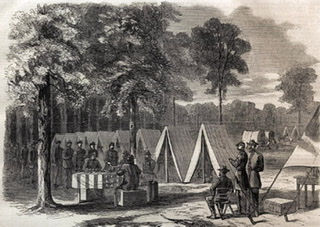
It wasn’t always done that way. Prior to the Civil War, people went to town and simply told the election officials who they were voting for. Nothing was private. During both the American Revolution and the War of 1812 a few men in New Hampshire, New York, Pennsylvania and New Jersey asked if they could vote in absentia, but they were challenged in court and lost. It wasn’t until the election of 1864, in the middle of the Civil War, that individual states decided that men in the military could vote absentee. It was largely done by the Union states, many of whom sent election commissioners with the ballots so that the soldiers could vote in their camps or hospitals.
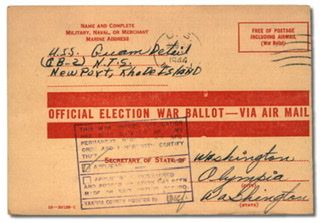
During World War I, many soldiers and sailors were able to get absentee ballots in the US–it was hit or miss for the men overseas. World War II was different. With 5 million men and women in the military, the Soldier Voting Act passed by Congress in 1942 required all states to provide special postcards to all servicemen, at home or overseas, so they could request an absentee ballot. The ballot would arrive, along with free postage. In fact I remember my father telling us that in October, 1944, when he was on Guadalcanal getting ready for Iwo Jima, he and most of his men voted by absentee ballots. Absentee ballots for anyone in the military is standard to this day.
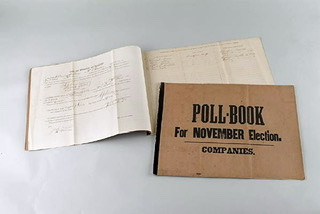
After the war, most states passed legislation allowing anyone in the military and their dependents, and anyone with a good reason–someone who was elderly, sick, or working out of state–to easily get an absentee ballot. It wasn’t until the ’70s that some states allowed people to get “no-excuse” absentee ballots–though they still have to request one and fill out the form. There’s a very good reason for that. As we discussed in the May 20th post, a 2005 bipartisan Election Reform Commission (remember Jimmy Carter?) found that absentee-ballots are safe and effective–plain mail-in ballots cause very serious problems. Let’s take a quick look at just a few.
1) Last May, the state of Maryland sent out ballots for the primary. One million ballots didn’t arrive. The governor demanded the state Electoral Commission show him how the ballots will arrive in November.
2) Mail-in ballots for New York had to be in on or before June 23–and they just finished counting the ballots on August 4. Roughly 20% were thrown out because they weren’t postmarked, weren’t properly signed, or arrived too late.
3) Parts of Pennsylvania ballots are still being counted.
4) Nevada recently passed both all-mail-in ballots as well as ballot-harvesting, while not requiring postmarks that will show that they were send in on time.
5) 500,000 Virginia voters received absentee ballot application with the wrong information–and they came from an outside group, NOT from the Department of Election.
6) Charges have been brought against four people due to voter intimidation and ballot theft in New Jersey.
NOT GOOD
When we look deeper, we find that only California, Colorado, Hawaii, Iowa, Utah, and Washington State have done what they needed to do to make actual mail-in ballots safe. Arizona, Florida, Montana and Oregon are just about there. They have spent the past TEN YEARS carefully purging the voter rolls so that they don’t send ballots to people who are dead, have moved, children, even pets–all of which happens much more frequently than you think!
So here’s a thought. 1918 was a year for Congressional and Senatorial elections. It was also in the middle of the Spanish Flu which killed 675,000 Americans. There was a lower turnout, but people still voted. But they didn’t have the absentee ballots that we have today. Go online, or call your state Department of Elections and ask for an absentee ballot. It may take five minutes to fill out. When you get the ballot it may take you, what, ten minutes, to carefully fill it out and send it in. You don’t even need a stamp! But your vote will count, and that’s the whole point, isn’t it?

 Historical Lense