First of all, why am I asking? Because the Cuban Missile Crisis started on October 16, 1962–58 years ago this Friday. I remember where I was (but then I old🧓.) I was in the sixth grade as Wyoming School. Though it started on the 16th, the nation didn’t hear about it until Monday the 22nd, when President Kennedy delivered an address to the nation.

By early 1962, US intelligence found that Soviet advisers, missiles and aircraft was arriving in Cuba, and by May it was clear that Fidel Castro was allowing up to 60 medium and intermediate nuclear missiles, along with tons of equipment, to set up in Cuba. The missiles were carried on the decks of transport ships–all nicely covered to prevent detection. Of course, the 42,000 troops had to stay below-deck, where it was sweltering in the summer Caribbean heat, lest the American see them.

Soviet Premier Nikita Khrushchev was hoping that he could have the missile batteries up and running before the Americans found out. At the height of the Cold War it would have been a signifiant coup for the USSR to have a toe-hold so close to the US. Khrushchev also hoped that it would help pivot the West away from Berlin, where less than a year ago East Germany and the Soviet Union had build the Berlin Wall. And we shouldn’t forget that Castro was still furious over the aborted Bay of Pigs invasion, and would be happy to assist the Soviets.
However, a Russian defector, Colonel Oleg Penkovsky, had provided significant intelligence to the CIA. In addition, aerial reconnaissance, and information from people on the ground indicating that MIG-21 fighters and Il-28 bombers were already in Cuba. The first group of missiles arrived on September 8. CIA Director John McCone sent a memo to President Kennedy describing that they had found. It would have been useful to send a U-2 to get additional data, but the US had decided to pause the spy planes because the Soviets had caught sight of them. The five-week “Photo Gap” from September 8 to early October came at a bad time, since it became clear that the Russian troops were setting up batteries of SS-4 and SS-5 medium-range nuclear missile.
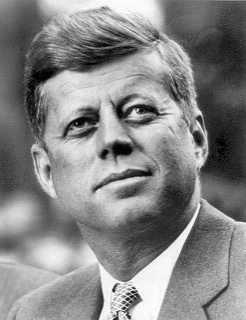
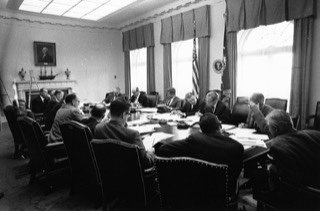
Early in October, JFK and his Executive Committee (ExComm) concluded that a total of 40 missiles was standing up in southern Cuba. Some members of ExComm tended to be Hawks, suggesting that the US should make a first strike against the missiles immediately, followed by an invasion of Cuba, making sure the missiles were disarmed, and possibly end Castro’s reign at the same time (remember this was little more than a year after the Bay of Pigs). On the other hand, the Doves of the ExComm wanted to be extremely measured. Kennedy decided to follow what he called Flexible Response. US Navy ships quietly moved toward Cuba. As US ships took up their positions, they were ordered to use a warning shot if Soviet ships approached. If the warning shot didn’t stop them, the Americans would foul the rudder of any oncoming ships. Later US intelligence found that Soviet vessels were told to return fire if the Americans got too close.
On the evening of Monday, October 22, the President spoke to the nation explaining that the Soviets had brought nuclear missiles to Cuba, just 90 miles from Florida. They must leave. He imposed a quarantine (really a blockade, but the word “blockade” technically can mean war). The US went on DEFCON 2, (defense readiness condition) the second highest alert status, and 550 B-52 bombers from Strategic Air Command (SAC) were on high alert. You can imagine school the next day! We were the “big kids” and understood at least the main issue. Several parents kept their children home. Looking back, it might have been nice to be one of the little kids–they were blissfully running around playing tag, and thought that the air aid drills were fun.
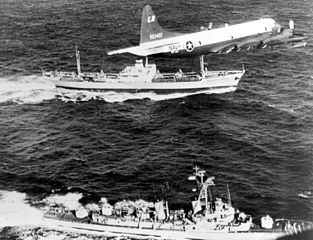
Both Kennedy and Khrushchev were micro-managing the situation, trying to avoid a nuclear war. It didn’t take long for the Soviets to see that the US wasn’t going to budge. Ninety miles from Florida was too close for the US to ignore. Late in the evening of the 24th, Khrushchev sent a message saying that Soviet vessels would move out of the quarantine area. The following day, he sent a personal message to JFK saying that the USSR would remove the missiles from Cuba if the US promised not to attack Cuba. Later that day, Khrushchev followed up by saying again that they would remove the missiles from Cuba, as long as the US wouldn’t attach Cuba, AND remove the Jupiter missiles which the US had in Turkey. Which was it? Was the USSR going to remove the missiles and sail away? Or would they need that quid pro quo (see… like I’ve said before, quid pro quos are used all the time!!) that they would only remove their missiles in Cuba if the US removed the Jupiters from Turkey.
Black Saturday, October 27th, was the height of the Crisis. One of the Soviet missile shot down a U-2 plane.

At that point, Kennedy simply ignored the Soviet’s second letter and agreed that the US would not attack Cuba as long as the missiles were removed. However, in truth the Jupiters were obsolete and were going to be removed fairly soon anyway, so the US used back-channel discussions to agree to remove them.
Kennedy’s popularity went through the roof. In the Soviet Union, Khrushchev seemed to have also achieved a victory, but behind the Kremlin walls it was clear that his days were numbered, and he “retired” in 1964. Both sides had scared themselves in starting talks for nuclear disarmament. Tensions in Berlin slowed, though they didn’t truly end until the fall of the Berlin Wall. And on August 30, 1963 the US and USSR announced a direct phone line called the “Hotline,” making it possible for Cold War leaders to be in touch quickly, and hopefully avoid another Crisis like that of October ’62.
 Historical Lense