During the holidays I visited some of my family in New Jersey. Believe it or not, the state is much more than the Turnpike, the Parkway, and run-down cities. There are also rolling hills, gorgeous lakes, great hiking trails, pine barrens, working farms, historic battlegrounds and homes and churches dating back to the American Revolution. I used to take my kids to the Ford Mansion and Jockey Hollow in Morris County, where George Washington and his troops spent the winter of 1777. While I was there last week we drove past the old Speedwell Ironworks where Samuel F.B. Morse worked on his new invention–the telegraph. The Ironworks are a museum now, but it’s also where, on January 11, 1838, that Morse first demonstrated his telegraph to the local families who lived in Morristown.

Morse was born on April 27, 1791, in Charlestown, MA, to Elizabeth Ann Finley Breese and Jedidiah Morse, an eminent Calvinist cleric. After graduating from Phillips Academy in Andover, Samuel attended Yale University. In addition to studying religious philosophy and mathematics, he was extremely interested in lectures by Benjamin Silliman and Jeremiah Day on electricity. Morse graduated Phi Beta Kappa from Yale in 1810.
To pay their way through school, many young men worked for their professors or merchants in New Haven, CT. Others took a variety of odd jobs. However, it turned out that Morse was an accomplished painter (portraits, not houses), and earned his tuition with his brushes. After his graduation, he made his living as an artist. His first major work was Landing of the Pilgrims in 1811. He then sailed to Great Britain where he worked with Washington Allston, a major British artist of that time. Morse’s important work, Dying Hercules, was well-known in the Royal Academy. Returning home, he had numerous commissions including those for Presidents John Adams and James Monroe, the Marquis de Lafayette, and the U.S. House of Representatives. In 1826, Morse became one of the founders of the National Academy of Design in New York City.

Morse’s first wife, Lucretia, died in February 1825. He was devastated, not only because of her death, but also because he had been away when she became ill. By the time the mail telling him of her illness arrived, she was already gone. In addition to being a serious painter, Morse had remained fascinated by electricity. With his wife’s death, he put away his brushed. In the late 1820s he started work on electromagnetism and developed the single-wire telegraph. No longer would it take weeks to receive urgent mail. Though William Cooke and Charles Wheatstone developed a similar telegraph in the UK, their equipment required multiple lines. Ultimately Morse’s single-wire method became the standard throughout the world.
The next issue was how to send a telegram more than 10 feet. Morse began working with Professor Leonard Gale of New York University and they developed a system of relay circuits that would send a message up to 10 miles from where the original information was sent. (At the same time, he developed Morse Code, which is still in use today.) Much of their work was done at the Speedwell Ironworks in Morristown, NJ. On January 11, 1838, after laying an very long cable, Morse made his first demonstration of the telegraph to members of the community, sending them a message saying “A patient waiter is no loser.” In 1842, Congress invited Morse and his telegraph to the Capital, where he strung a number of cables to different committee rooms, and sent messages back and forth to them. Members saw that the telegraph could be a true game-changer. Two years later Morse tapped out “What hath God Wrought,” on the line linking Washington, D.C. with Baltimore, MD.
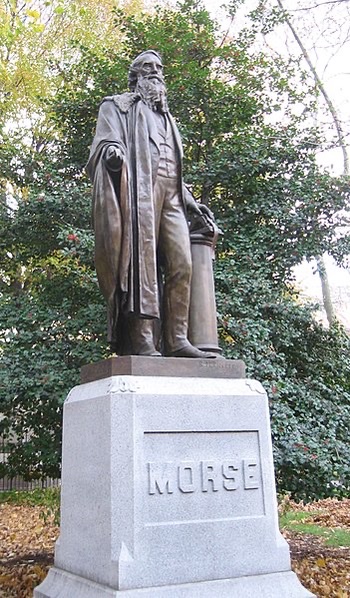
Similar to inventions like the telephone and radio, the telegraph started slowly, but gradually picked up speed, constantly moving messages further and faster. Eventually it was used for everything from troop movements to congratulations for wedding parties. After an illustrious career, and world-wide accolades, Morse died on April 2, 1872–truly a man of many talents.
 Historical Lense