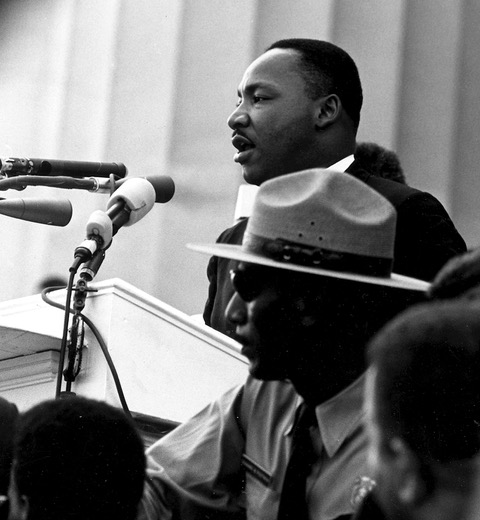
January 17 is Rev. Martin Luther King Jr.’s Day–a day when we celebrate one of America’s guiding lights who helped changed the direction of our country for the better. We can learn a great deal about Dr. King’s life and work, but as a teacher, I though it might be interesting to take a look at Morehouse College, Dr. King’s alma mater and one of the first historically black men’s colleges.
In 1867, just two years after the end of the Civil War, Willian J. White, with help from James Tate, Rev. Richard Coulter and Rev. Edmund Turner, established the National Theological Institute in Augusta, Georgia. With assistance from the American Baptist Home Mission, the Institute moved to Atlanta, GA, in 1879 where Rev. Joseph Roberts served as its first President. The Institute also changed its name to the Atlanta Baptist Seminary.

Eight years later, Samuel Graves became its second President. With the help of John D. Rockefeller, the industrialist and a Baptist himself, the Seminary moved to what is now its main campus in Atlanta. George Sale served as it’s third President from 1890 to 1906, when John Hope became the fourth President, and the first African-American President of the Seminary. It wasn’t until 1913 that the Atlanta Baptist Seminary changed it name to Morehouse College in honor of Henry Morehouse who had been the secretary of the American Baptist Home Mission and who had worked closely with Rockefeller to expand the college. Samuel Archer became the sixth President during the nadir of the Depression from 1931 to 1940.

In 1940 Benjamin Mays became the sixth president of Morehouse. During his tenure he expanded the number of students, including international students. Dr. King entered Morehouse in 1944, following his father’s and maternal grandfather’s footsteps. Years later he commented that Mays was “one of the greatest influences in my life.” Mays preached every Tuesday morning at the chapel. It was there that he explained Gandhi’s methods of non-violence. In addition, Mays made a number of speeches during the 1950s that helped students and faculty decide what direction they would follow in the emerging Civil Rights issues.
Dr. King was graduated in 1948, and we all know how his work improved, and continues to improve, our nation. Morehouse has also grown into an important institution. There have been 11 Fulbright scholars, five Rhodes scholars and five Marshall scholars, and in addition to Dr. King there have been men like Julian Bond, Spike Lee, Samuel L. Jackson, and countless scientists, doctors, state and federal officials and important industrialists and entrepreneurs. The next century at Morehouse should be a bright one.
 Historical Lense