Sadly this is not the first time that Russia has attacked a sovereign nation. There’s a long history going back a millennium. Just in the past fifteen years it’s happened in Georgia, Chechnya, and Syria. The utter devastation, towns turned into rubble and civilians killed in horrifying ways, is unimaginable. What we’ve been seeing in Ukraine–in Mariupol, Bucha and other cities–is more reminiscent of Tamerlane than even World War I. What’s different about this war is that Ukraine decided to stand and fight. Thinking about that, there are definite parallels with the Poles who did the same in the Polish-Bolshevik War of 1920-1921.
Remember, Russia, Prussia and Austria-Hungary had dismembered Poland between 1772 and 1796. There was no “Polish State” for more than 150 years, despite a significant Polish underground network, riots, petitions and millions who resettled overseas, many in the US, who still wanted to see a true Poland. It wasn’t until the end of World War I that the Poles in exile, headed by the famed pianist, Ignace Jan Paderewski, managed to convince Woodrow Wilson to include an independent Poland as the 13th of his 14 Points. The Big Four (Wilson, Clemenceau, Lloyd George and Orlando) discussed a reconstituted Poland during the Paris Peace Conference, which finally became Article 82 of the Treaty of Versailles.

Despite the Treaty of Versailles, and the fact that the Western Allies opposed the Soviets, the new Bolshevik government wanted to keep the Polish territory that the Czars had held for 150 years. Initially the Red Army took over Ukraine, and in June 1920, began forcing the Polish Army west, all the way to the capital, Warsaw. The second Polish Republic was on the verge of complete collapse in mid-August 1920. But led by General Jozef Pilsudski, the new Polish Army, with volunteers, and contingents of the Blue Army (Haller’s Army) that transferred from France to Warsaw, the Poles won the Battle of Warsaw, (sometimes known as the Miracle on the Vistula). By August 25, the Reds were in retreat, and they continued to fall back to the east until the cease-fire on October 18, 1920. Poland and the Soviet Union signed the Treaty of Riga on March 18, 1921, which established the eastern border until World War II.

However, World War II was very different. Again, the Poles fought bravely–and it wasn’t romantic cavalry charges. The Germans had to deal with Polish aircraft, tanks, infantry and an outstanding intelligence service. What they thought would be a quick run to Warsaw ended up being a real fight. But there were problems. Though the Poles had treaties with both the UK and France in which the two promised to join Poland if Germany attacked, neither France nor Britain were able to did anything. And then, on September 17, 1939, the Soviets attacked Poland from the east. With no assistance at all, there was little the Polish Army could do. Crushed between Germany and the Soviet Union, Poland became a wasteland.
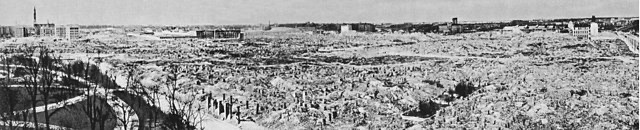
Does any of this sound familiar? Russia has always wanted a buffer from the West. And that’s understandable. But decimating a nation, carrying out war crimes, pulverizing whole cities into submission is NOT the way to do it. That is why Poland, along with Moldova, Hungary, Romania, Estonia, Lithuania and other Central European nations are assisting Ukraine in every way possible. They’ve seen this before, and they understand that if it Russia is not stopped now, they will be next.
 Historical Lense