One of the tragedies of war is the death of so many soldiers and sailors. Even worse is the fact that there are so many who are unknown. Going back to the Peloponnesian War, there have been monuments for soldiers who remained unknown. In many wars, large numbers were buried in mass graves, often with monuments with the appropriate dates. Things changed during World War I.
At that time, most nations started requiring their men to wear ”dog tags” of some sort. (The Americans tags were made of aluminum and literally held the person’s name, rank and serial number.) The armies also set up new units which would keep track of those who had died. (Graves Registration Services in the US) At the end of the war, many of the deceased were re-interned in their own nation. However, there were so many who had died during the war, that it would have been impossible to repatriate everyone. Many families decided to allow their service member to remain with their brothers-in-arms and are buried in national cemeteries in France.
In 1920, Great Britain brought one of the Unknown Soldiers home and solemnly re-interned the soldier in Westminster Abby. Similarly, an Unknown Soldier is guarded at the base of the Arc de Triomphe in Paris. In early 1921, Hamilton Fish, Jr., a World War I veteran and member of Congress offered legislation ”To bring home the body of an unknown American warrior who in himself represents no section, creed or race in the late war and who typifies moreover, the soul of America and the supreme sacrifice of her heroic deeds.” The legislation passed, and it was decided that the Soldier would be placed in a tomb in Arlington National Cemetery.
Work began on the tomb that spring, and in October, 1921, four bodies of unknown soldiers were exhumed from four different cemeteries in France. On the 23th they arrived at Chalon-sur-Marne. The following day, Maj. Robert Harbord, USA, with a group of French and US soldiers, placed each casket on top of a shipping case. The Major then asked Sgt. Edward F. Younger to select one of the men. Younger walked gravely around the four caskets several times, then stopped and put a spray of white roses on one. The others were returned to the cemeteries they had left, while the fourth casket was placed in its shipping case and was moved on a caisson, and later by train, to the port of La Havre. From there it boarded the USS Olympia bound for the US.
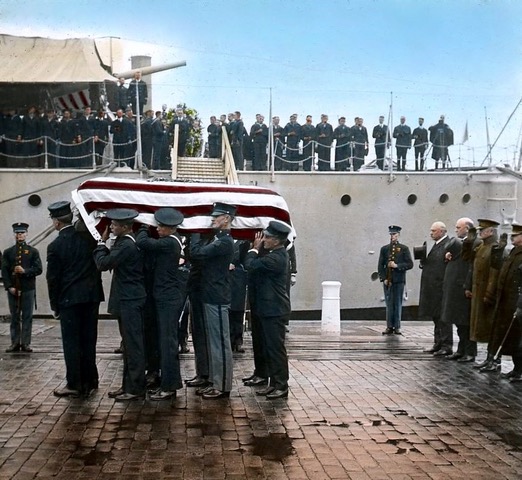
The Olympia arrived at Washington D.C. on November 9th. From there the coffin moved to the Capital where it lay in state at the Capital Rotunda. Over 90,000 people paid their respect on the 10th. The following day, the Unknown Soldier was placed on another horse-drawn caisson and slowly wended its way through Washington, D.C., crossed the Potomac, and moved on to the Arlington National Cemetery. President Warren G. Harding presided at the state funeral at the Arlington Memorial Amphitheater which included the two minutes of silence to commemorate the end of the War (Known as Armistice day–the 11th hour of the 11th day of the 11th month.)
Soldiers from Ft. Myers began guarding the Tomb in March 1926. They only did so during the day to make sure that family members didn’t become distraught, and that others remained respectful. In 1937 soldiers began guarding the Tomb 24/7, and in 1948 the 3d US Infantry Regiment, known as the ”Old Guard” took charge of the Tomb. Since then, the US has added men from both World War II and the Korean War to the Tomb. It can be the dead of night, in blazing sun or two feet of snow, the Old Guard is on duty.

Thursday, November 2021 is the 100th anniversary of the Tomb of the Unknown Solder—Never Forget!

 Historical Lense