The first “Fleet Week” took place in 1899, when a large number of US Navy vessels sailed in to New York Harbor in celebration of Commodore George Dewey’s success at the Battle of Manila Bay and the end of the Spanish-American War. There were similar events over the years, though the first Fleet Week celebration took place in June,1935. One hundred and fourteen ships and 400 military planes arrived in San Diego as part of the California Pacific International Exposition. A total of 3,000 officers and 55,000 enlisted men spent a week allowing visitors to tour parts of some of the vessels and for many of the men to visit the city and enjoy some shore leave.
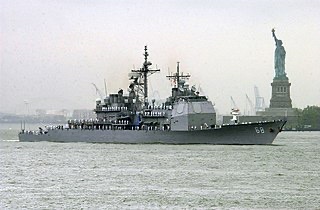
USS Forrestal passes the Statue of Liberty during Fleet Week, 1989
Over the years both the Atlantic and Pacific Fleets have participated in specific celebrations, such as the US Bicentenary in 1976, and the Centenary for the Statue of Liberty in 1986. However, the first official Fleet Week took place over Memorial Weekend in 1982. The aircraft carriers USS Coral Sea with cruisers, destroyers and other vessels sailed under the Golden Gate Bridge, with Navy and Marine helicopters watching from above. In New York, ships passed under the Verrazano Narrows Bridge and sailed by the Statue of Liberty to dock at the New York Passenger Ship Terminal on the Hudson River. In 1988, the Navy allowed people to take tours of certain areas of specific ships.
Aircraft carrier USS Anzio with cruisers during Fleet Week, 2004
Since 1982, ships have also spent Memorial Day/Fleet Week in a number of cities including Los Angeles, San Diego, Portland, Seattle, New London, Norfolk, Boston, Baltimore, Port Everglade and Ft. Lauderdale. The ships include naval vessels and aircraft, Marine aircraft and occasionally landing craft, and Coast Guard ships and aircraft. In addition to tours, all three branches of the services provide a variety of demonstrations, from ways various gear is used to methods of hand to hand combat.
Special US Marine provides demonstrations during Fleet Week 2010
One of the things my adult children still talk about is when I took my four-year-old son to tour a cruiser that was moored in Seattle one Fleet Week. He had a great time dashing up and down the ladders (stairs to landlubbers) and actually learned a lot. Several years later, my father, a Marine officer, took both children to see an aircraft carrier moored in New York City for Fleet Week. My daughter was amazed at the side of the ship. And being able to see how the planes are moved onto the deck was the highlight of their Memorial Day!
In 2020, Fleet Week was suspended, like most everything else, because of Covid-19. Last year there was a virtual version, and while it was very well done, it wasn’t the same. Thankfully this year there will be a real Fleet Week. I hope you can visit one of them, because it’s a wonderful way to celebrate Memorial Day.
I live in a big city and it’s interesting what you hear when people walk around town speaking on their phones. A few days ago on my way to the gym (best trainer EVER!) a lawyer was telling his partner that they really should take a case, even though it was going to make a lot of people very angry, and might even lose a few clients. “. . . Look, is it more important that we do what’s right, or virtue signal? Hell, everyone’s entitled to a solid defense even if he’s an @%*# !” I don’t know who they were talking about, but the first thing that popped into my head was”I know what John would do.” That is, John Adams, who even before the American Revolution, believed that in a democratic society even the most despised people were entitled to a vigorous defense.
In 1768, British troops landed in Boston and the surrounding area to deal with the Townshend Acts, passed by Parliament to try to pay for the French and Indian War (1755-1763). The colonists felt that it was up to Great Britain to pay for it, and as the months when on, tensions between the soldiers and colonists were on a hair trigger. Around 9 pm on a very snowy night of March 5, 1770, a sentry was standing near the Boston Customs House, when a boy came over and started harassing him. We have no idea what was said, but the boy ran home to his father who, with at least 50 colonists returned and attacked the sentry with snow and ice balls, sticks, clubs and stones.
At that point the Redcoat called for help, and Captain Thomas Preston and a squad of eight soldiers arrived double quick with muskets and bayonets. More colonists arrived when a church bell started ringing. In short order several hundred colonists, many of them members of the Sons of Liberty, surrounding the soldiers. The scene was turning into a melee. It’s still unknown which of the soldiers fired. In the end, five men, including Crispus Attuck, were dead, and six were wounded.
Portrait by Paul Revere of the Boston Massacre
British law took over, and the colonists were fine with that because they still considered themselves members of the British Empire. Three weeks later, a Grand Jury indicted Captain Preston and all eight soldiers for murder. The Sons of Liberty provided broadsheets and pamphlets, and spoke to everyone they could to put the colonial “spin” on the trial. It didn’t seem that anyone wanted to take the mens’ case, and while the British were good soldiers but they were not JAGs (Judge Advocate General in the military). Who would take their case?
At that time, John Adams was a 34-year-old lawyer who happened to be working near the Customs House. He was already very involved in the patriot cause, but had been following the case closely. Whoever took the case could have become extremely unpopular, could have lost his livelihood, and possibly put his family , including his pregnant wive, Abigail, in danger. The problem was that he fervently believed that anyone living in a free country should have a solid defense. He also hoped that defending the men would show the British that the colonies were equal to those in the Mother Country, not a bunch of country bumpkins from the backwater. Besides, as he really looked at the evidence, he wasn’t convinced that it was as clear as the colonists thought it was.
Joh Adams, c. 1766. From the Massachusetts Historical Society. Not to be reproduced without permission.
Preston’s trial took place on October 24th and 30th. He had been accused of telling his men “Fire.” However, while there was a number of witnesses, everyone had a different understanding of what happened. There was no way to know if he had, in fact, told his men to fire. Adams was not a wonderful public speaker, be he was a brilliant jurist. This was the first time a lawyer had discussed the term “reasonable doubt,” but the jury believed him, and acquitted Captain Preston.
The soldiers’ trial took place in late November, ending on December 3. Adams maintained that they shot in self defense. Again, there were numerous different accounts of what happened. The one which was the most compelling came from Dr. John Jeffries who had cared for one of the victims. Before the man died, he told the doctor that the soldiers had shot in self-defense. The fact that the man gave that as his “dying utterance” gave significant gravity to what was said. Ultimately, six of the soldiers were acquitted, and the last two were convicted of manslaughter, not murder. For that, they were branded on their thumps.
It’s very interesting that, despite the rage of so many colonists, they accepted both of the verdicts. They didn’t harass Adams’s family, or Adams himself, who had defended the soldiers. There were some angry editorials in the Boston Gazette, and he did loose some of his practice, but even the Sons of Liberty moved on with a degree of calm which is so difference from what frequently happens when people disagree with some verdicts today.
Long after the Boston Massacre, the American Revolution and his presidency, Adams commented that he believed his defense of the British soldiers “was one of the most gallant, generous, manly and disinteresting action of my whole life, and one of the best pieces of service I ever rendered my country.” Following the law, and making sure that everyone in a free society receives a vigorous defense ultimately made him one of the most respected men in Massachusetts—ultimately in the US. Something to think about—I hope the men I heard during my walk came to the same conclusion.
If you’re interesting in finding more about Adams or the Boston Massacre see two great books. David McCullough, John Adams, and Dan Abrams, John Adams Under Fire.


 Historical Lense