Today, rather than discussing a particular issue, I want to explain why I believe that history matters—today more than ever!
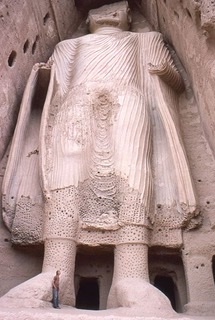
This was one of the Buddhas of Bamiyan. There were two of them, both made in the 6th century, carved out of sandstone on the cliffs of the Bamiyan Valley of Hazarajat about 140 miles from Kabul, Afghanistan. The smaller of the two statues was 115 feet high. The larger was 174 feet high. The statues remained there for 1400 years.
Between the 2d and 6th centuries, a thriving Buddhist community, including numerous monasteries, lived around Bamiyan, along the Silk Road. By the 10th century, Islam had become the main religion in Afghanistan. In 1221 Genghis Khan barreled across Afghanistan, but spared the statues. Babur, in 1528, and King Nader in the 17th century, took pot shots at the statues, but most of the time they were ignored or seen as curiosities. Then during the Afghan Civil War in the late 1990s, the Taliban, ultra-conservative fundamentalist militia, decided that they had to get rid of the Bamiyan Buddhas. The Talibans considered the statues idolatrous and evil. Even UNESCO and the 54 members of the Organization of the Islamic Confederation protested. It didn’t matter. The statues were reminders of a part of their history that was anathema to the Taliban. Look below, to see what’s left of that the Bamiyan Buddhas.

Let’s move on. In April 1933, the German Student Union called for a nation-wide purge of all books with which they disagreed. On May 10, 25,000 books were burned outside the State Opera House in Berlin. Other book-burnings took place in over 30 universities throughout Germany, incinerating thousands more. Want to know the authors of some of these hateful tomes? Albert Einstein, Sigmund Freud, Berthold Brecht, Thomas Mann, Erick Maria Remarque, and Franz Kafka to name just a few. And it wasn’t just German authors—H.C. Wells, John Dos Passos, F. Scott Fitzgerald, Ernest Hemingway, Jack London, Marcel Proust and on and on. But why should their teachers demand that they read books that made them upset, or that they disagreed with? Or even worst, made them THINK? Nasty book. Boring book—burn it.

Just one more, I promise. November 9-10, 1938–Kristallhaacht. The night of broken glass. Most everyone reading this post knows the basics. On the morning of November 7, 1938, a 17-year-old Polish/German Jewish boy living in Paris shot Ernst vom Rath, the 3d Secretary of the German Embassy in Paris. He died two days later. Once the news reached Germany, cities throughout the country began attacking Jewish shops, hospitals, offices, schools, synagogues and other buildings. In roughly 24 hours, 7000 businesses were ransacked, severely damaged, or completely destroyed and burned to the ground. At least 91 people were murdered.

So why am I talking about these very different things? Bamiyan is gone. Not placed in a museum where people could learn about what happened there for 500 years. Nothing about the Silk Road. Nothing about Buddhism. No context. No nuance. The Taliban’s hated them and got rid of them.
Book-burning. Some books made people think and—gasp—disagree with the then current norms. Some people had different points of view. No, No. Don’t like what’s said in a book? Burn it! (Thankfully, unlike the statues at Bamiyan, there are copies of these books which are still read, enjoyed, and even argued, today.)
Kristallnaacht—hate a group of people? Destroy their livelihood, their homes, their houses of worship. What difference does it make?
Many people find history dull. It’s a bunch of boring names and dates. It doesn’t make any sense. Others think it’s a waste of time—STEM is the way to go. But at the end of the day, there’s one reason we should care about history—care A LOT! You learn history to avoid making the same mistakes again! And if you abolish history, you will learn nothing—and repeat those mistakes.
Think about the books and statues and broken glass. Think that can’t happen here? It already has! Protests and riots are two very different things. You don’t have to like everything or everyone, but there’s a huge difference between thoughtful, important, change and destruction for the sake destruction.
 Historical Lense