R.I.P General 🌹

I was completely surprised when I turned on the radio at lunchtime yesterday and hear that General Colin Powell had died from complications of Covid-19 while battling Multiple Myeloma. He has been a fixture in the American military and political life for fifty years. His hair got a little grayer, but his thoughtful, incisive approach to everything he does, his true decency for people in every walk of life, has made an impressive mark in our country. People in the current corridors of power could take a few lessons from him.

General Powell was born in New York City in April, 1937, to parents who had immigrated from Jamaica. He grew up and went to public school in the South Bronx. He didn’t really know what he wanted to do, so he went to City College of New York (CCNY), and while he was there, joined the ROTC. He graduated in 1958 and was commissioned as a Second Lieutenant in the US Army. He fought in Vietnam, and went on to a variety of infantry and staff positions, including as US Security Adviser (1987-89).
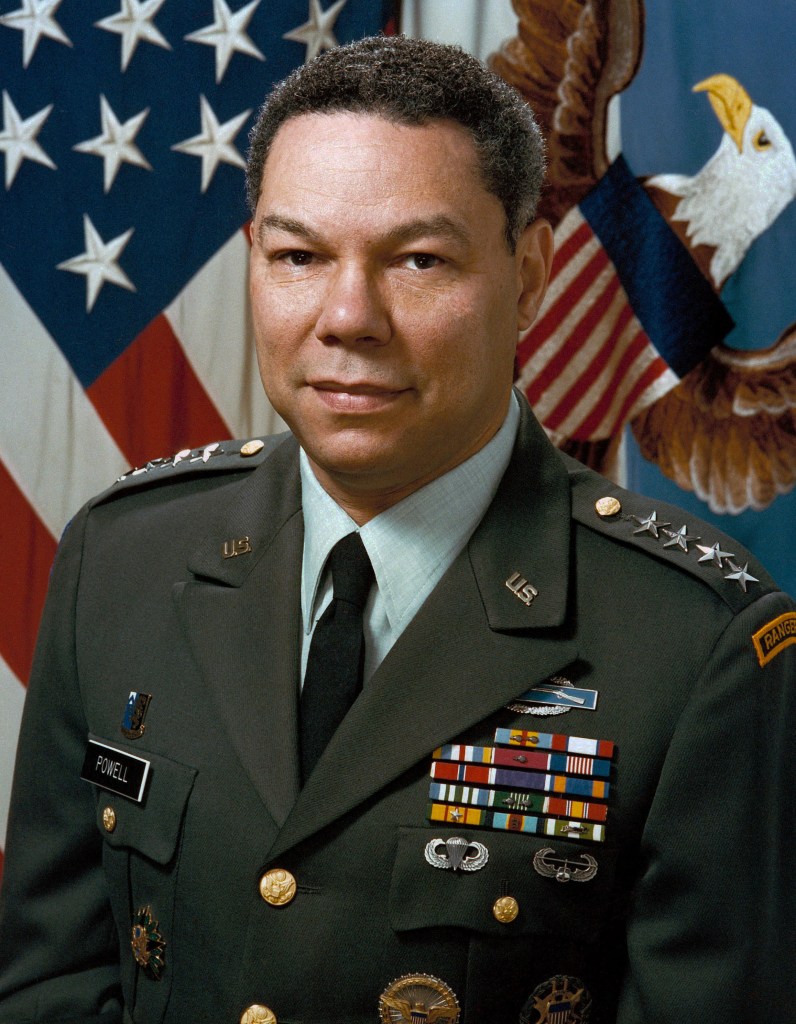
Chairman of the Joint Chiefs of Staff Colin Powell

Powell ending his military career as a Lieutenant General and Chairman of the Joint Chiefs of Staff (1989-93). During those years he was intimately involved in a number issues, particularly the invasion of Panama, and Operation Desert Storm. During this period he developed what we now call the Powell Doctrine. There would be no military action unless 1) it was truly necessary for US security 2) the US would use massive force and 3) there was significant public agreement.

After his retirement in 1993, he was invited to give numerous speeches, and attend a variety of seminars and conferences, but most importantly, he chair America’s Promise–Alliance of Youth, a non-profit organization to involving people in all walks of to build character and competence for young men and women. (He has remained involved in the organization throughout his life.)
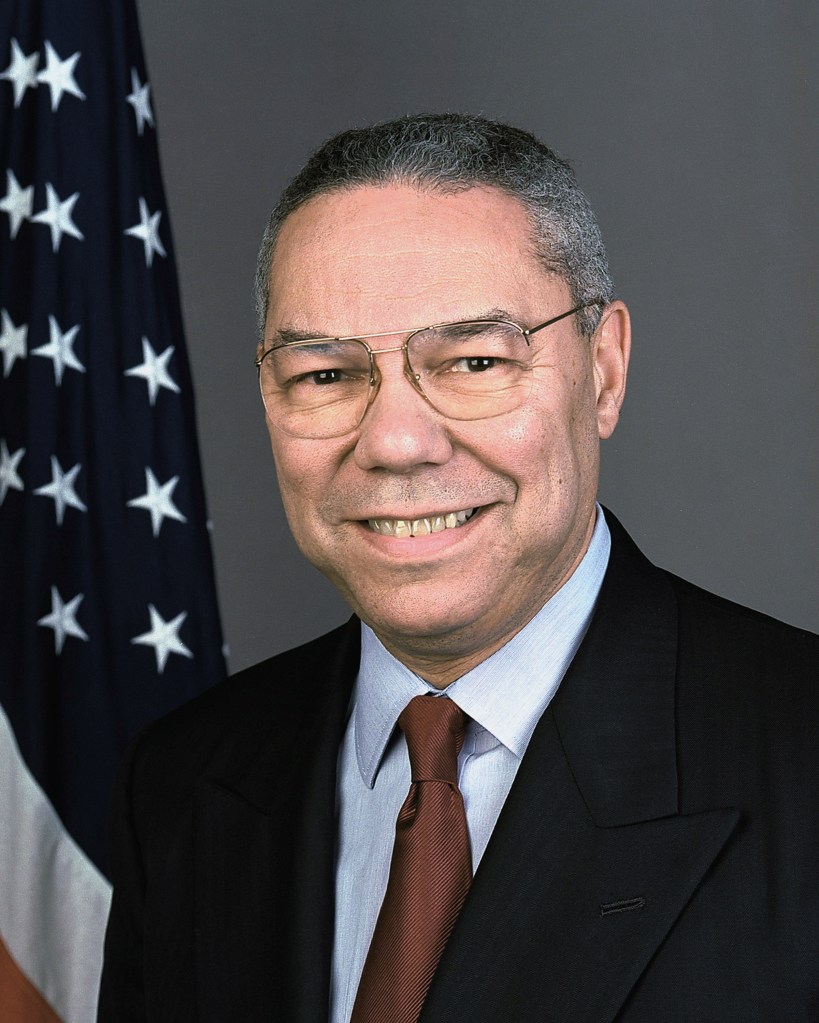
Secretary of State Colin Powell

Retirement didn’t last that long. He had been so important to so many US Presidents that in 2001 he became the first African American Secretary of State. The Senate confirmed his unanimously. Unfortunately, he started his work just months before 9/11 when everything changed for the US. Powell did a stellar job of dealing with the US’s relations with foreign nations, trying to put together a sound coalition for the War on Terror. However, he was in a very difficult position when dealing with the 2003 invasion of Iraq, and he resigned in November 2004.

Since he stepped down from the Chairman of the Joint Chiefs, he wrote two excellent books, but I think we should end this post with part of his second book It Worked For Me. His thirteen lessons can work for all of us.

–It ain’t as bad as you think. It will look better in the morning.

–Get mad, then get over it.

–Avoid having your ego so close to your position that when your position falls, your ego goes with it.

–It can be done!

–Be careful who you choose.

–Don’t let adverse facts stand in the way of a good decision.

–You can’t make someone else’s choices

–Check small things.

–Share the credit.

–Remain calm. Be kind.

–Have a vision.

–Don’t take counsel of your fears or naysayers.

–Perpetual optimism is a force multiplier.

If you’re interested in Powell’s autobiographies or some well-done biographies, take a look at these.

http://Colin Powell. My American Journey

http://Colin Powell, It Worked for Me: In Life and Leadership
http://Jeffrey Matthew, Colin Powell: Imperfect Patriot

http://Karen DeYoung, Soldier: The Life of Colin Powell

Should He Stay or Should He Go?

Next week, the head of the Joint Chiefs of Staff(JCS), General Mark Milley, is going to be on the hot seat in Congress regarding his involvement in the US debacle in Afghanistan. Add to that the comments in the new Woodward and Costa book regarding the General’s conversations with his opposite numbers in China. Some say they were standard discussions. Others believe that he was trying to overthrow the duly elected president and at the very lease should resign immediately. Should he stay? Or should he go? The Congressional hearings will be key to his future.

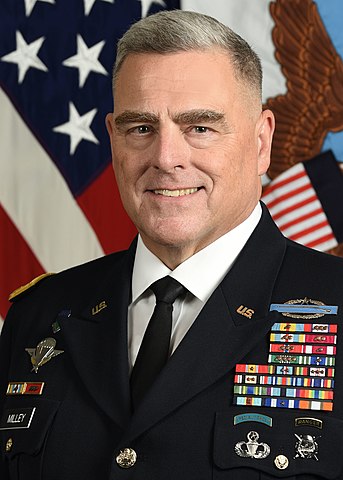
U.S. Army Gen. Mark A. Milley, 20th Chairman, Joint Chiefs of Staff, poses for a command portrait in the Army portrait studio at the Pentagon in Arlington, Va., Sept. 26, 2019. (U.S. Army photo by Monica King)

Yet a number of my students—friends, too, don’t really know how the JCS came about. For that we really should go back to the War of 1812. The war’s ground campaigns were key, yet the naval battles on Lake Champlain under Capt. Thomas MacDonough were a major component of the ultimate success of the War. President Madison and the Secretaries of War and the Navy understood that joint operations were vital. Nor can we forget the importance of the joint operations of General Ulysses S. Grant and Admiral David D. Porter during the Battle of Vicksburg. By 1900, war had become so complicated that it was clear that joint operations could not be done on an “as needed” basis. In 1903, the US established a Joint Army and Navy Board that could set up joint ops. However, it wasn’t a fully integrated Board. Rather it was simply a planning board which could discuss issues. By the Great War, is still was not truly involved in the actual conduct of joint operations. After the War, the Secretaries of War and of the Navy redefined the Joint Board. It now included the two services’ Chiefs, Deputy Chiefs, the Chief of War Plans Division of the Army and the Director of Plans Division of the Navy. The Joint Board could now make recommendations for joint operations.

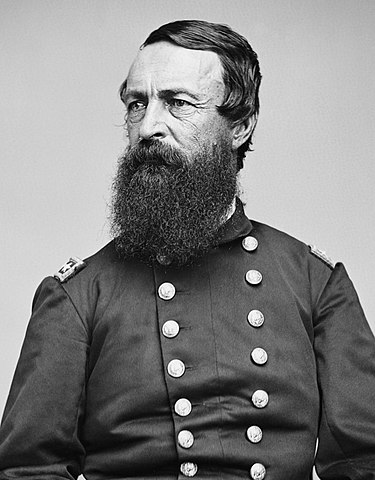
Admiral David D. Porter

This was headed in the right direction, until the attack on Pearl Harbor on December 7, 1941. In the Arcadia Conference (December 22, 1941-January 14, 1942) President Franklin Roosevelt and Prime Minister Winston Churchill set up the Combined Chiefs of Staff. For some time, the British Chiefs of Staff had established administrative, strategic and tactical coordination. It was clear to the Americans that to work closely with the Combined Chiefs, they would finally have to expand and coordinate the US Army and Navy planning and intelligence structures in an effort to provide advice to the Secretaries of War and the Navy, and to the President himself. To do so, the US set up a combined high command in 1942 that was called the US Joint Chiefs of Staff. Roosevelt wanted someone to be in charge, and looked to Admiral William Leahy.

Leahy was born in Iowa in May, 1875, and was graduated from the US Naval Academy in 1897. He served in the Spanish-American War, the Philippines, China, Nicaragua, Haiti and Mexico. During World War I, Leahy captained a dispatch boat that the Assistant Secretary of the Navy, Franklin Roosevelt used, and they developed a lifelong friendship. During the inter-war years Leahy held numerous posts and by 1937 he became the Chief of Naval Operation which he held until his retirement in 1939. Roosevelt then named him governor of Puerto Rico which he held until January 1941 when the President found that Leahy would be the best man to serve as ambassador to France–that is Vichy France. As ambassador he worked tirelessly to try to lessen the grip the Nazis held Vichy, but to no avail. After Pearl Harbor, Roosevelt ordered Leahy home, to serve as his senior military officer who would liaise with the chiefs of the Army and Navy. The US needed someone to work both with the President, and the chiefs, as well as the Combined Chiefs. All agreed that Admiral Leahy was the man for the job. He became the Chief of Staff to the Command-in-Chief of the United States on July 6, 1942.

Admiral William Leahy

With years of experience as a naval officer, and an innate understanding of diplomacy, he was able to wrangle all three US chiefs of staff–General George Marshall (USA), General Henry (Hap) Arnold (USAAF) and Admiral Ernest King (USN), and worked extremely well the the Combined Chiefs from the UK. When President Roosevelt died in April, 1945, President Truman requested that Leahy continue as Chief of Staff which he held until he retired again in March, 1949. He died at the Bethesda Naval Hospital in July 1959.

After the war, Leahy published his memoir, I Was There, which is one of the most honest memoirs I’ve read. He was not trying to add “spin” to any answers, wasn’t trying to “cover his six” by shifting responsibility to others. He was not a “political Admiral” like so many are these days. What would Leahy have thought about General Milley?

You may be interested in Leahy’s book, or a full biography of the Admiral as listed below

http://William Leahy, I Was There. (1950)

http://William Adams, Witness to Power, 1985