With the Olympics taking place shortly, a lot of my friends have been pulling out their DVDs, or getting on Netflix, to watch one of our favorite movies (even though it’s about the summer Olympics) Chariots of Fire. Filmed in 1981, it’s based on the real story of two of the 1924 British Olympians, Eric Liddell, played by Ian Charleson, and Harold Abrahams, played by Ben Cross. It’s just too good for me to tell you anything about it. You have to watch it!🤓🤓

However, what I will do is tell you something about the real men of Chariots of Fire. Eric Liddell was born in Tianjin, China, on January 16, 1902, to Scottish missionary parents. When he was six, his parents returned to the UK on furlough with him and his eight-year-old brother. At the end of the family’s holiday in Edinburgh, Scotland, both boys went to boarding school at Eltham College that was attended by many children of missionaries. He did well academically, and his rugby and sprinting made his a star athlete.
Liddell attended the University of Edinburgh where he studied Pure Science. He also played rugby for the University Club, and continued to work on his 100m and 220m sprints. (He was often called the “Flying Scotsman.”) Liddell was part of the British Olympic team that went to Paris in 1924. Everyone expected him to win the 100m. But the times for all of the races were announced early in the spring, and the 100m was going to be held on a Sunday. As a devout Christian, he would not run on the Sabbath, regardless of all the pleas from the most senior members of the British Olympic committee. Instead he trained for the 400m. The finals were on July 11, and the Americans were likely to win. Liddell ended up running the last 200m like a sprint. He won the gold, breaking both the world and Olympic records at 47.6 seconds.
Liddell graduated from the University in 1925, and returned to China as a teaching missionary. He was there throughout the Chinese Civil War, only returning to Scotland on a furlough in 1932 when he became an ordained minister of the Congressional Union of Scotland. He returned home again just before World War II, but was back in China when the war started and was interned in a civilian camp in 1943. He was the bedrock of the camp, but died in February 1945.

Harold Abrahams is the other main protagonist in the film. Born on December 15, 1899, he had served as a Lieutenant in the British Army in the Great War, and then attended Gonville and Caius College, Cambridge. He had been a runner since he was a child, and while at Cambridge was a member of the Athletic Club as well as a member of the Cambridge and Oxford the Achille’s Club for track and field. He competed in the 1920 Olympics, but lost in the quarter finals.
Abrahams graduated from Cambridge in 1923, but wanted to compete in the Olympics the following year. He hired Sam Mussabini as his personal coach who got him ready for the 100m and 200m sprints. He did win the 100m run, beating the American Charley Paddock who had been expected to win. Abrahams expected to continue running, but broke his leg in 1925 which ended his career. Instead, he returned to his legal career, but also worked as a sports commentator for more than 40 years, including attending the 1936 Olympics in Berlin. In addition, Abrahams was the President of the Jewish Athletic Association, and Chairman of the Amateur Athletic Association. He died on January 12, 1978.
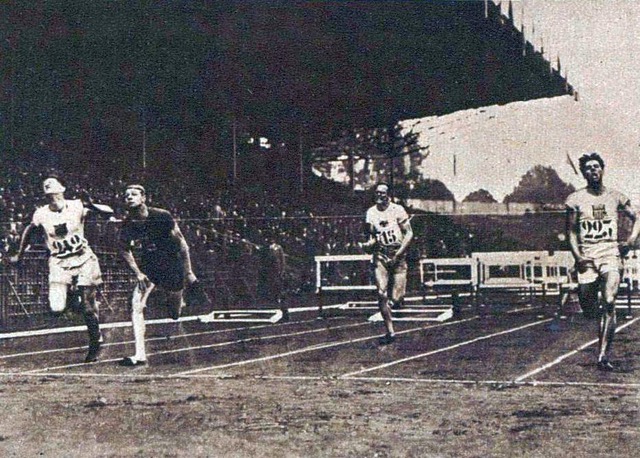
I can’t let you go without mentioning one other person at the 1924 British Olympic team–David Cecil, Lord Burghley–who was know as the “King of the Hurdlers.” Cecil won the 440 hurtles that year. He’s not one of the main characters in Chariot of Fire, but it’s fascinating to watch him fly over the hurdles.
As I said–watch the film!! It’s wonderful!! And if you’re interested in more about either man, take a look at http://Duncan Hamilton, For the Glory and http://Mark Ryan, Running with Fire


 Historical Lense