I love to see my family any time. Except in the afternoon of the second Saturday in December. The Army-Navy Game. I watch one, and only one sports event every year, and that’s the one. My father was a member of the class of 1944 (which graduated in June 1943) of the Naval Academy. I’ve watched the game since I was four, and have been able to attend it several times. Until I went to school, I thought the last words of our national anthem were “Beat Army!” As a military historian I’ve spent a lot of time with members of both services. (One of my closest friends graduated from West Point–I don’t hold that against him.) The game is so much more that a football game. It’s a brotherhood of very young people who have kept this country safe through some of the best and the darkest of times.
The Army-Navy game started in 1890 when Army Cadet Dennis Mahan Michie accepted a challenge from members of the Naval Academy. They played the first game on The Plain at West Point on November 29th that year. (The stadium at West Point is known as Michie Stadium). They alternated the game at Annapolis and West Point until 1893. That year, the Navy doctor told Midshipman Reeve that if he took another hit to his head it would cause brain damage, and quite possibly death. Reeve wasn’t about to stop playing, so he found a local shoemaker and had him put together a leather helmet–the first American football helmet. (Reeves survived and eventually became Admiral Joseph M. Reeves.)
A few days after the 1893 game, an Admiral and General met at the Army-Navy Club in Washington, D.C. Their discussion of the game turned into an argument, the argument turned to punches, and the punches only stopped when friends pried the two men apart after hearing the two of them loudly demanding a duel. A few days later this was brought up in a cabinet meeting and President Grover Cleveland told the Secretary of the Navy Hilary A. Herbert and Secretary of War Daniel S. Lamont to stop the games. That lasted until 1897 when Assistant Secretary of the Navy Teddy Roosevelt wrote to both President William McKinley and Secretary of War Russell Alger suggesting that within proper parameters it would be good for the young man to resume the game. McKinley and Alger agreed.

The game returned in 1899, but now was played in Philadelphia, which is roughly equidistant from both Annapolis and West Point. In 1901, now President Theodore Roosevelt attended the game, being sure to cross the field at half-time. Over the years many other presidents have attended the game, and all have crossed at half-time, but only one actually played in it. In 1912, then Cadet Dwight D. Eisenhower, played in the Army-Navy Game. (Ike graduated in 1915.) The game was not played in 1917 or 1918 because of World War I, but started up again in 1919. In 1926 they played at Soldier’s Field in Chicago which was dedicated to the men who had fought in World War I. More than 100,000 people attended and it ended in a 21-21 tie.
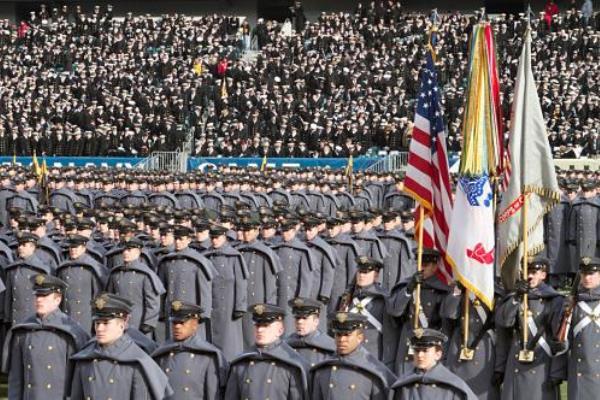
Since 1930 the game has been broadcast on the radio. Rather than stopping the game during World War II, it was played at Navy’s old Thompson Field in 1942 and at Army’s Michie Stadium in 1943. Only the players, coaches, trainers and staff members attended. However, when the Army team walked onto the field in November 1942, they found that their side had been fill with Midshipman. They had learned all of the Cadets’ cheers and fight songs, and some of the men who were there have told me that the roars for the Cadets were noticeably louder than for their own classmates. The same thing happened in reverse the following year when the Midshipmen went to West Point. They might have been Cadets or Midshipmen, but more than that they were, and are, brothers-in-arms.
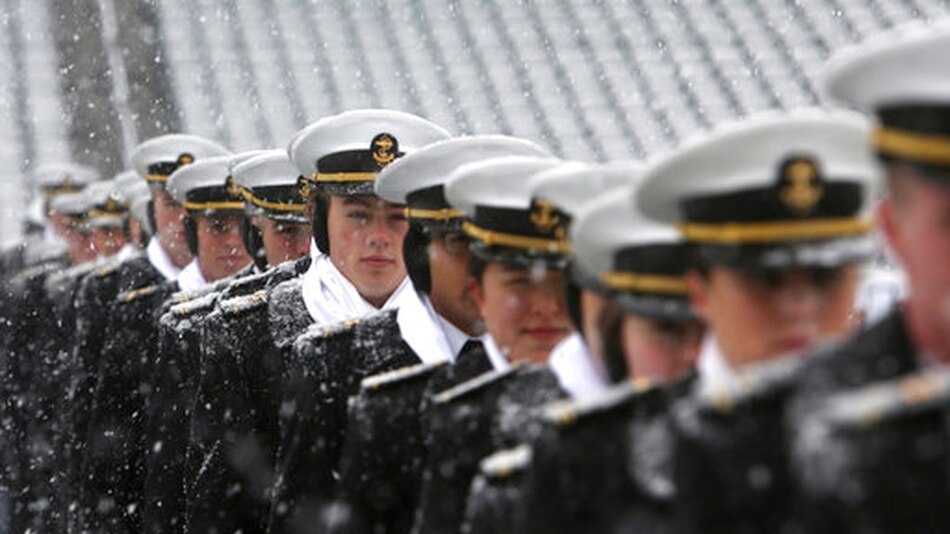
At the end of the war, not only were they back playing the Army-Navy Game in Philly, but 1945 was the first time the game was seen on TV. And 1963 was the first time there was an instant replay. Unfortunately it was also just weeks after the assassination of President John F. Kennedy. There were serious discussions that it should be suspended, but Mrs. Kennedy specifically asked that the game go one. Her husband had attended in 1961 and 1962, and had intended to be there. It was played in his memory.
So here we are in the middle of a pandemic. Back in late August some friends asked me if I thought they would play. Well, they’ve played in terrible weather, during a World War, at the tail end of the Spanish Flu epidemic . . . I thought they’d figure out a way to do it, and they have. Fingers crossed everyone will be well on Saturday, and even if it’s only the players and coaches, the 120th game will be played. It’s more than a game.
To my friends from West Point, I wish you good luck. For myself I can only say, BEAT ARMY!
 Historical Lense