No, it’s not time for me to retire. Colleagues keep asking me to participate in a number of discussions and students ask for help, so I’m pretty sure there’s still some worked left for me to do. However, there are instances when it’s time for someone to retire, and that can be people doing simple jobs to someone who is President of the United States. A case in point was Woodrow Wilson.
Wilson was the 28th President (1913-1921.) He had tried to pass a number of progressive pieces of legislation from the Federal Reserve Act to the Keating-Owens Child Labor Act, but he was forces to divert much of his agenda because of World War I (1917-1918). At the end of the war, he went to the Paris Peace Conference, and signed the Versailles Treaty in June, 1919, which included the League of Nations. The League was Wilson’s pride and joy, and he returned to the US expecting that the Senate would happily pass it. He was sadly mistaken. Many Senators believed that the League would require the United States military to become involved in other military actions, and having just ended what they expected would be the “war to end all wars” they did not want to become any part of it. Wilson went to work to get it passed.
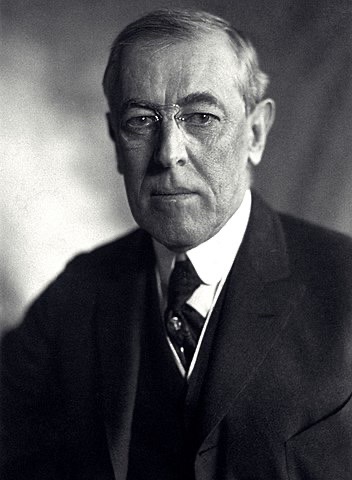
To that end, in September 3, Wilson and his wife, Edith Bolling Galt Wilson began a train tour throughout the western states during which he would hold rallies and speeches in 29 cities. At his speech in Pueblo, Colorado, on September 25, he began to slur his speech and wobble. His doctor, RAdm Cary Grayson, USN, convinced him to end his tour and they returned to the White House ASAP. On October 2, his wife found him on the floor in the bathroom. Wilson had had a stroke due to a blocked artery, paralyzing his left side, causing serious vision problems, speech issues and slowed his judgment. The following day, newspapers across the country announced that he had become ill, and needed a period of serious rest.
By October 6, Secretary of State Robert Lansing held a Cabinet meeting–almost never down without presidential permission. They had not seen or heard from Wilson for over a week and were getting very concerned. They finally got ahold of Dr. Grayson who, in the most careful terms, said that Wilson was fine, but ill and needed rest. Lansing knew that Grayson was lying through his teeth, but with both both Wilson’s family and doctor all in sync, there was nothing he felt he could do. After that Grayson made sure to speak to the press frequently, telling they that Wilson was definitely getting better. Of course, there was a constant rumor mill suggesting everything from Wilson being at death’s door to Wilson having become completely insane.
His wife, Edith, made sure that no one saw Wilson. Anyone bringing him papers would have to leave them with her. She would then read them, and if she decided it was important she would read them to her husband. She would then have the papers delivered, often with scratchy comments in the margins that looked nothing like Wilson’s handwriting, and his signature which looked very feeble.

Naturally, Edith, Grayson, and Wilson’s private secretary (now we call it the chief of staff) Patrick Tumulty knew that he needed to be seen, at least occasionally. An opportunity arrived on October 30, when King Albert I of Belgium and his wive, Queen Elizabeth, arrived in Washington, D.C., on a tours in the US. Normally a president would greet such a dignitary at the steps of the White House. This time, the King and Queen were escorted into Wilson’s bedroom where he was propped up on pillows, with his left arm, the one which had been paralyzed, gracefully covered by a blanked. The conversation lasted about 15 minutes. The Belgians left wishing him a speedy recovery and later told the press that the President seemed to be on the mend.
Congress was not convinces of that, and became more concerned as every week went by. Things came to a head in December, when the Senate Foreign Relations Committee pointedly asked Lansing when he had last spoken with Wilson. Lansing had to tell them that it hasn’t been since September. Members of the Senate started discussing setting up a formal enquiry, so to try to prevent that, the White House set up a meeting between Wilson and Senators Albert B. Fall (R.,NM) and Gilbert M. Hitchcock (D.,NB) on December 5. Both Senators visited Wilson in his bedroom. When Fall told him that they were praying for him, Wilson quipped “Which way?” The President said little more during the 40-minute meeting. He was lucky–Fall was a great talker and asked very few questions. Fall and Hitchcock’s visit were all over the newspapers, and kept the Senate at bay, but Lansing was still steaming. He knew full well that Wilson was truly unable to do his job, he but didn’t have any way of moving Wilson aside and have Vice President Thomas Marshall take the wheel.

Wilson did gradually improve, though he always needed to walk with two canes. He did attend some cabinet meeting in April 1920. The most important change was Wilson’s mental acuity. He had been an excellent political strategist, often finding good compromises, and changing course when change was warranted. After the stroke, however, he became adamant. He refused to even consider other options. Things needed to be done the way he wanted it. And because he was so insistent, and refused to compromise, the Senate refused to pass the League of Nations. We might have had a very different world if he had not bee so obstinate. But we’ll never know. He left the White House on March 4, 1921, and died in Washington, D.C. February 3, 1924.
–Epilogue
Given the current disaster in Afghanistan, and what we have seen and heard since April, 2021, one might seriously wonder if perhaps President Biden, who had two life-threatening brain aneurysms, which can definitely cause issues, may, like President Wilson, not be up for the work which is needed right now. Just a thought.
 Historical Lense