Hello, King Tut

It’s been a a difficult 24 hours for many people, but no matter what the outcome, what everyone really needs to do is to stop and take a deep breath. Some people meditate. Others take a few minutes to look at something completely different. I’ve been looking for a five minute “no election” post. Let’s try this. Ninety-eight years ago today, Howard Carter found King Tut’s tomb—one of the world’s best kept secrets for 3250 years.

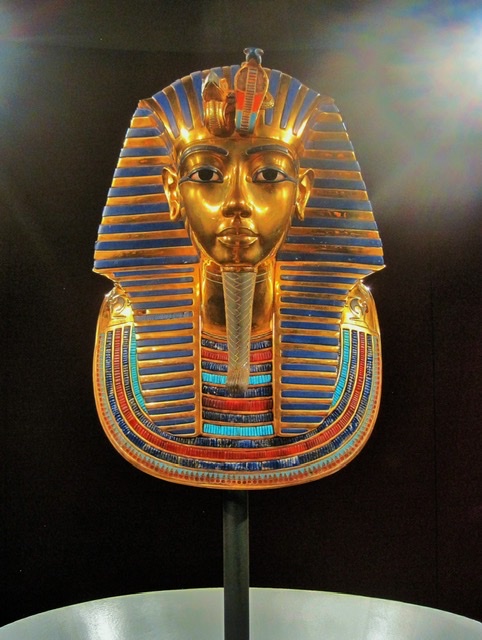
Tutankhamun (1342-1325 BC) was the last king of the 18th Dynasty, becoming king at age 8 or 9 after the death of his extremely controversial father, King Akhetetem. He had demanded that a new God, Aten, be the only God throughout Egypt. That caused confusion throughout the country, and massive upheaval among the priests and nobles. His son immediately returned everyone to polytheism, reconstructed statues, restored monuments and allowed all former festivals. The former King’s massive upheaval had also caused seriously economic issues, leaving the child Tutankhamun and his counselors to deal with issues both diplomatically and militarily, with campaigns in Nubia.
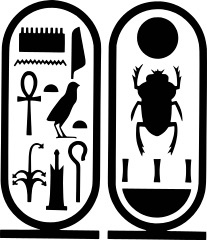
Cartouche in hieroglyphics spelling out “Tutankhamun, ruler of ON of Upper Egypt”

While Tut’s tomb contains body armor and campaign stools, it is unlikely that he rode into battle himself. CT scans done in 2005 and additional tests done at the same time have shown that Tut was about 5’6″ tall with a cleft hard palate and mild scoliosis. He was also missing at least one, possibly several, bone from his right foot and had a clubbed left foot, explaining why there were canes for him in his tomb. He also had numerous bouts of a severe strain of malaria. It appears that his death was due to his frail health, another bout of malaria, and a fall which caused a compound fracture of his left leg. Current thinking suggests that it was not due to foul play. While a few kings were placed in pyramids, many more were placed in tombs in the Valley of the Kings. And that’s where King Tut spent the following 3250 years.

Art from the Armarna period

Fast forward 3200 years. Howard Carter was born in Britain on March 9, 1874. His father was a talented artist and Howard also developed serious creativity. In 1891, when he was just 17, he joined the Egypt Expedition Fund to help catalogue and assist with the excavation of Egyptian tombs found around Beni Hasan. In 1894 he moved to Deir el-Baharia to record reliefs in the temple of Hatshepsut. By 1899 Carter became the Inspector of Monuments of Upper Egypt for the Egyptian Antiquities Service, based in Luxor, and four years later he moved to Lower Egypt where he developed the grid-block system to logically look for additional tombs. He returned to Deir el-Baharia in 1907 working for George Edward Herbert, Lord Carnarvon, who was financially backing the excavations of noble tombs around Thebes. Carter started working in the Valley of the Kings in 1914, but everything stopped that September with the outbreak of World War I.
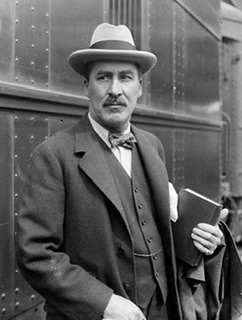
Howard Carter

During the War, Carter worked as a diplomatic courier and translator, but got back to his work at the end of 1917. However, by 1922, things had not been going well, and Carnarvon decided that he would only fund one more year of work in the Valleys of the Kings. In early November 1922, Carter’s crew was moving some debris . On the 4th, one of the water-boys slipped and when Carter went to see what had happened, he realized that he was standing at the top of a flight of stairs. He carefully dug out most of the steps till he found himself looking at mud-plastered door, with a cartouche stamped on it. He carefully refilled the staircase and sent a telegraph to Carnarvon telling him that they might have found something intriguing. Carnarvon arrived on the 23th, and on November 26, he and Carter went down the steps. With a small chisel and a candle they were able to see a jumble of gold and ebony implements. Most of the time, thieves had found, and robbed ,many of the tombs. To see something in such pristine condition was stunning.

There was a massive amount of work required, so Carter asked members of the Metropolitan Museum of Art in New York, who were then working in a different area of the Valley of the Kings, to help. They leapt at the change, and were particularly helpful in photographing all the items. It took over four months to catalogue all the artifacts in the first room. Finally, on February 16, 1923, Carter opened the second door. It was a sealed room with two statues standing guard—King Tut’s actual tomb! The pieces in the first space looked like trinkets compared to the artifacts in the main room, particularly the astonishing sarcophagus. It took over ten years to catalogue all the items, finally finishing the last details in February 1932. It had been Carter’s life’s work. With that, he retired, spending summers in London and winters in Egypt, dying in London on March 2, 1939.

Over the years, the Egyptian Ministry of Antiquities has worked tirelessly to preserve the stunning materials. Over the past ten years, in conjunction of the Getty Conservation Institute, the Egyptians have done tremendous work in preventing further wear, tear, decay and degradation, preserving Tutankhamum for posterity.
The World’s a Whirling Dervish

I know the world turns on its axis once every 24 hours, but sometimes it seems to go faster. Between the pandemic, lock-downs, protests, riots, wild fires, hurricanes, and the election, no sooner do we learn what’s going on, than the next problem is front and center. It was nice to find out that something good actually happened! It was on the radio, TV and online on August 13, but since then you really have to look for any additional information. What was it? The US brokered a deal between Israel and the United Arab Emirates (UAE). That is a BIG deal–the third time since 1948 that a Middle Eastern nation will be work with Israel rather than against it.

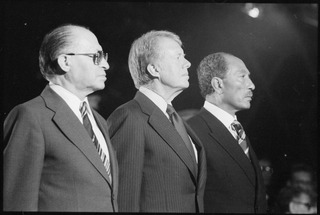
President Sadat, President Carter and Prime Minister Begin at Gettysburg (C7329-3a)

From 1948 until 1978, there was continuous tension in the Middle East, punctuated by the Suez Crisis (that makes me feel old)–the 6 Day War (1967) and the Yom Kippur War (1973). The Geneva Peace Conference of 1977 stalled after months of negotiations. What stunned everyone was when President Anwar Sadat of Egypt told his parliament that if invited, he would speak to the Israeli Knesset. He did get an invitation from Israel, via the US, and at the end of November, 1977, Sadat spoke to the Israeli parliament. Both nations had their own reasons for discussions–that’s for another time–but by the middle of 1978 President Jimmy Carter invited both men to come to Camp David to broker a peace.

Prime Minister Begin, President Carter and President Sadat

Some people consider President Carter to be a rather mild, sensitive man. Maybe. But his is an outstanding mediator! From September 5 to the 17th, Carter did a kind of shuttle diplomacy, walking from cabin to cabin, discussing, cajoling, bargaining–doing whatever he needed to to keep both men talking. By the 10th day they had arrived at an impasse. In a “Hail Mary” attempt, Carter took them to the Gettysburg National Military Park where they spend more than two hours learning about the actions. The carnage of Gettysburg wasn’t lost on the men. They signed “A Framework for the Conclusion of the Peace Treaty between Egypt and Israel,” on September 17th, and finalized the treaty at the White House in March 1979. It was not a perfect treaty, but it was an enormous breakthrough in Middle East peace.

King Hussein, President Clinton and Prime Minister Rabin

It was fifteen years before there was another peace agreement. Shortly after the first Oslo Accords (1993) King Hussein of Jordan discussed the possibility of some type of relationship with Israel with both Hosni Mubarak of Egypt (go for it) and Hafaz Assad of Syria (forget it). In the end, the King felt it was time to try to make a formal peace with Israel. Again the US provided the venue where King Hussein, Yitzak Rabin and President Bill Clinton signed a non-belligerent pact at the White House on July 25, 1994. Three months later they signed the final Jordan-Israel Peace Treaty at the border near Wadi Araba on October 26th. Egypt was pleased with the treaty. Syria simply ignored the whole thing. However, 20 minutes before the signing, Hezbollah, the Iran-backed terrorist group based in Lebanon, launched rockets and mortars into several Israeli settlements in Galilee. That had become a standard problem, so as the Israelis moved into more secure areas, they took their radios with them so they could listen to that historic event.

That brings us to 2020. For over a year before Covid-19 raised it’s ugly head, the US had been working behind the scenes with both Israel and the UAE to put together a working arrangement for both countries. On August 13, President Trump spoke with both Prime Minister Benjamin Netanyahu and Crown Prince Mohammed bin Zayad al Nahyan of the UAE to “sealed the deal.” Known as the “Abraham Accord,” it opens full diplomatic relations between both parties. Why? Several reasons. It turns out that there has been a lot of commerce in the recent past between both countries, which had to be done through third parties. (What a huge waste!) Much more concerning is the fact that the UAE, along with Saudi Arabia and a number of other Arab states, are Sunni Muslims, as opposed to Iran, which is Shia. This has caused seriously strained relations in much of the Middle East. The UAE believes it is in their best interests to work in the open with Israel.

Both parties have not wasted any time. On August 16, they opened telephone service between the UAE and Israel. They are working to establish commercial flights, and are in talks with Saudi Arabia to arrange for overflight. Israel and the UAE have signed agreements between more than 40 tech companies in both nations to work together to help defeat Covid-19. They are also working to set up a “chamber of commerce” or another professional organization to expand bilateral enterprises, and talks regarding trade, tourism, health, aviation and energy are all moving along quickly. At the same time, a number of other countries such as Bahrain and Oman are looking into the possibility of working with Israel on some level. Having a continuing improvement in relations throughout the Middle East would be welcome on almost every level. It will also put pressure on both Iran and the Palestinian Authority to finally start negotiations in earnest. Hopefully we’ll start seeing updates on page one soon.

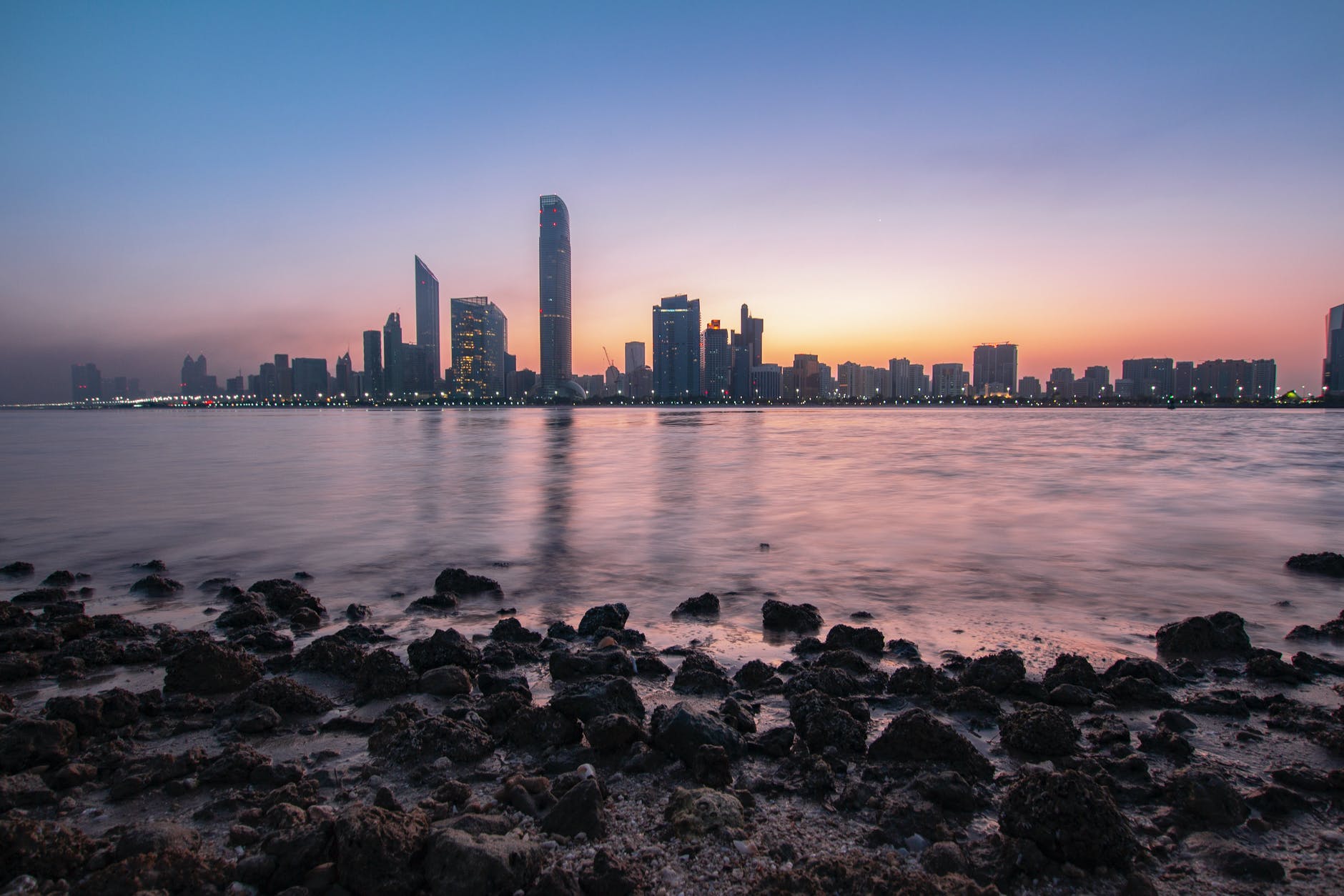
Abu Dhabi, U.A.E. Photo by Kevin Ponce Villaruz on Pexels.com