NATO Here We Come 🇫🇮 ðŸ‡¸ðŸ‡ª

Finland and Sweden (those are their flags) have just requested entrance into NATO. If they do ultimately join, they will be the 31st and 32d members. Most of us know something about NATO, but how did it come about? Well, you really need to go all the way to the meeting at Yalta in February 1945.

Churchill, Roosevelt and Stalin at Yalta, February 1945

At the meeting of the Big Three (Churchill, Roosevelt, and Stalin) the Soviet leader demanded, and the other men finally gave in, that at the end of the war, Poland would be under Soviet control. The Polish Government-in-Exile had worked side by side with the Allies, and had treaties with both Britain and France, but at that point, with Soviet tanks barreling through Poland on their way to Germany, there was little that the US or UK could do. However, neither Churchill not Roosevelt, and later Truman, were happy with the Soviet takeover. They were even more concerned with the way a Soviet-backed coup turned Czechoslovakia into a communist underling, and how the USSR set up the Berlin Blockade. Western European states feared that the Soviets would try to take over more nations that were still on their knees after the war. So in 1947, the United Kingdom and France signed a defensive pact known as the Treaty of Dunkirk.

President Harry S. Truman signing the NATO treaty

The Benelux countries–Belgium, The Netherlands, and Luxembourg–are small nations and, concerned with possible Soviet inroads, wanted additional military support from other major nations. On March 17, 1948, they joined with Britain and France and signed the Treaty of Brussels, which was a mutual defense pact which would last for fifty years. That was an excellent first step, but as most of Eastern Europe remained under the control of the Soviet Bloc, many in the West felt that they ultimately needed to work together with the US to stand up to Stalin.
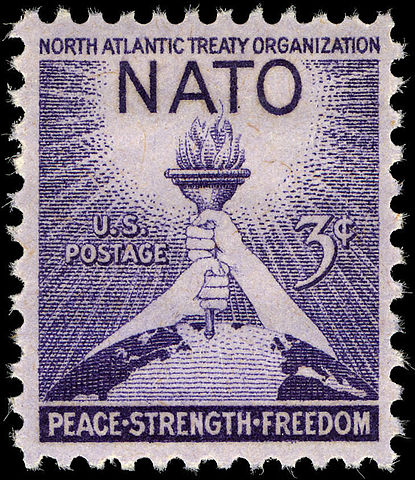
After another year of consultations, the US signed the North Atlantic Treaty Organization–NATO. In addition to the UK, France and the Benelux countries, Canada, Italy, Portugal, Denmark and Iceland joined the Organization. Greece and Turkey joined in 1952, and West Germany did so in 1955. So, during the peak of the Cold War, NATO faced the Warsaw Pact. Spain became a member of NATO in 1982. But it wasn’t until the breakup of the Soviet Union in 1991 that former members of the Warsaw Pact joined NATO. The Czech Republic, Hungary and Poland joined in 1999. Bulgaria, Estonia, Latvia, Lithuania, Romania, Slovakia and Slovenia entered in 2004. NATO accepted Albania and Croatia in 2009 while Montenegro joined in 2017 and North Macedonia in 2020.

Shortly after the fall of the USSR, it seemed to be possible that the West and Russia would be able to work well. But with Mr. Putin’s attacks in Georgia, Chechnya, and early forays into Ukraine, it’s no wonder that Sweden and Finland, both of whom had fought Russia to a stalemates in the past, would want to join an organization that could stand up against possible aggressions to come from Russia.
Brrrrrr

I’m good at remembering all kinds of anniversaries. For instance, today is the 80th anniversary of the beginning of Operation Barbarossa, the German invasion of the Soviet Union. But it’s so hot right now that I want to think about something cold–and the coldest thing I can think of that has anything to do with World War II is the Winter War, also known as the Russo-Finnish War.

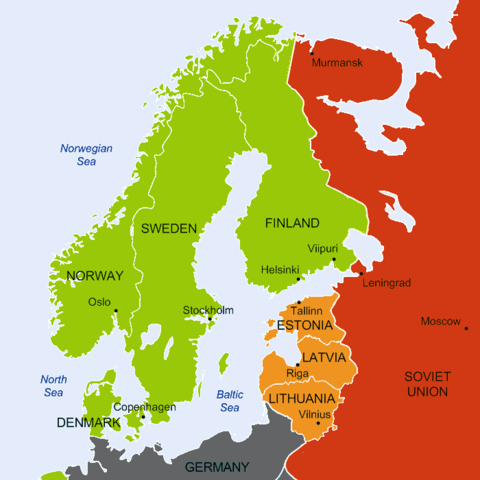
Finland had a checkered past with Russia/Soviet Union. Finland had actually been the Duchy of Finland, part of the Russian Empire until the Bolshevik November Revolution in 1917, at which point the Finns broke away from the Soviets and fought its own civil war between the Whites and the Reds. Eventually the Whites won, but throughout the 1920s remained very wary of the Bolsheviks. Finland developed a defensive treaty with Estonia, Latvia and Poland, but never got around to ratifying it. The Finns and Soviets did sign a nonaggression pact in 1932, but still remained extremely cautious. As soon as Germany invaded Poland in September 1939, Finland declared its neutrality, and a few weeks later, when Germany and the Soviet Union partitioned Poland, the Finns went on high alert.

Despite the fact that the Soviets were allied with the Germany, the USSR was concerned enough to want a buffer between the Karelian Isthmus and the USSR, especially Leningrad, just in case the Germans did turn on their “ally.” They opened talks with the Finns, requesting several islands in the Gulf of Finland, a 30-year lease to build a base at the Hanko Peninsula, and an additional 16-mile stretch of land on the Karelian Isthmus. In return, the Soviets offered Finland a significant amount of land to the north, though the Finns really weren’t interested. The Finns knew that that wasn’t a request, but entered negations simply to buy time to mobilize. That came to a crashing halt on November 30th, 1939.

THE SOVIET-FINNISH WAR (WINTER WAR), NOVEMBER 1939-MARCH 1940 (HU 55566) A Finnish ski patrol, lying in the snow on the outskirts of a wood in Northern Finland, on the alert for Russian troops, 12 January 1940. Copyright: © IWM. Original Source: http://www.iwm.org.uk/collections/item/object/205187864

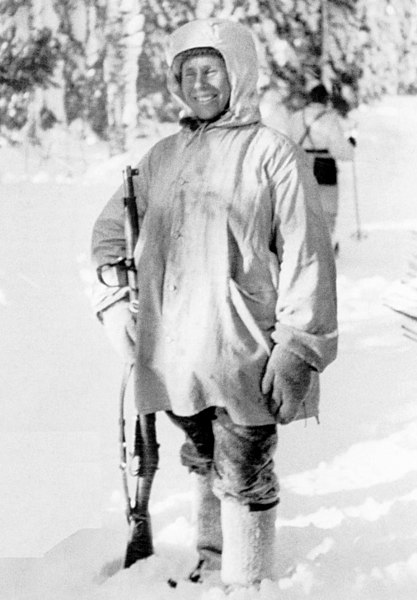
Just as the Germans had done in Poland, the Russians faked a border incident, and thousands of Soviets rushed into Finland, expecting an easy win. In fact, because they expected a rout, the Russians did not send their “A Team.” They were poorly led, poorly trained, poorly equipped, did not understand the terrain, and, thinking that they would be done in a few weeks, forgot about the brutal winters. Most of all, they didn’t understand the Finns. The Finns were fighting for their homes. They had thousands of ski troops. They often embraced unconventional warfare. They had some amazing snipers (notably Simo Hayha), and they were led by Marshall Carl Gustaf Mannerhiem.

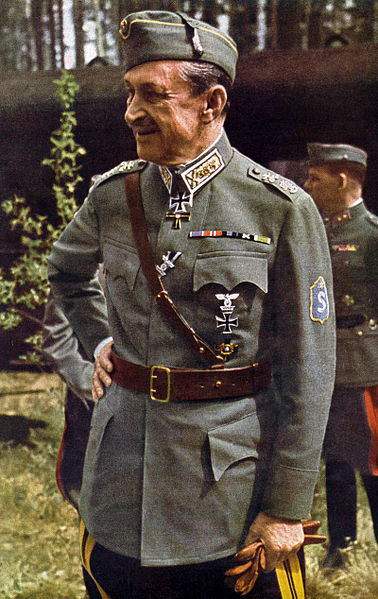
Marshall Carl Gustaf Mannerheim (1867-1951)

Marshall Mannerheim was born on June 4, 1867, in what known as the Duchy of Finland. It was actually part of the Russian Empire. He served in the Russian Army, becoming a Lieutenant General shortly before the November Revolution. As a member of the aristocracy, he fled back to Finland which had declared itself an independent nation. But almost as soon as he arrived, he was caught up in the civil war (January-May 1918)–Red Revolt (Bolsheviks) against White Guards (non-communists). Ultimately the Whites succeeded. He had held a variety of positions in the coming decades, but as war clouds gathered, he was again asked to lead the country’s defense.

Second Lieutenant Simo Hayha–Finnish sniper known to have achieved 500 shots

The Finns knew they were grossly outnumbered and out gunned. They immediately requested support from both Great Britain and France, but got very little help. However, they held out valiantly. Using white camouflage and their intimate understanding of the terrain, they held the Soviets at bay for three months. Eventually the Russians changed their command and tactics, and brought in masses of modern equipment, particularly artillery. They broke through the Karelian Isthmus and moved north to Viipuri. At that point, there was little more the Finns could. Anything else would have been a useless slaughter of their men, women and children. They signed the Treaty of Moscow on March 12, 1940, in which the USSR received western Karelia, and the naval base on the Hanko Peninsula.

Two excellent books on this subject are http://William Trotter, A Frozen Hell and http://Jonathan Clements, Mannerheim