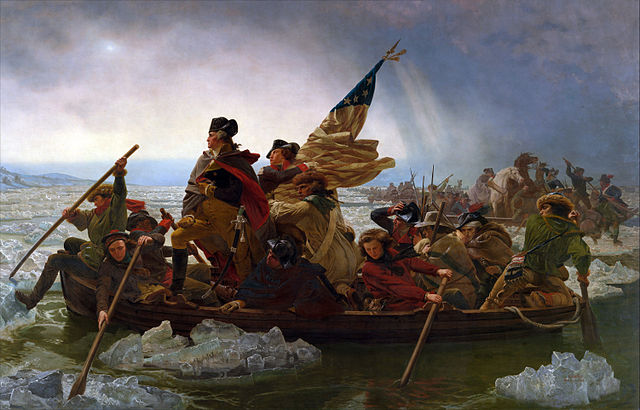
Painting of Washington Crossing the Delaware by Emanuel Leutze
During the holidays, some people have a tradition of settling down to watch a classic movie like “It’s a Wonderful Life,” “Holiday Affair,” or even “Home Alone.” Let me suggest another one–one that’s a true Christmas miracle. Take a look at The Crossing (2000). With Jeff Daniels as George Washington, Sebastian Roche as John Glover, Steven McCarthy as Alexander Hamilton and John Henry Canavan as General Henry Knox, it’s an extremely accurate portrayal of Washington’s crossing of the Delaware on Christmas 1776. (Along with some very funny moments)Two thousand ragtag Americans attacked the German Hessian mercenaries in what was truly the American’s last stand. All of their enlistments would end in January. Many had already left for home. Those who remained were freezing and famished, marching in rags, many without shoes. They had managed to cross into Pennsylvania barely ahead of the Hessians.
In a last attempt to keep the Americans fighting for their new country, Washington decided to cross back into New Jersey and attack the Hessians who were quartering in Trenton. Colonel John Glover, a mariner from Marblehead, MA, was in charge of rowing all of the American troops, including General Knox’s men, back to New Jersey, where they would attack the Hessians. It was a miserable night with snow, sleet and freezing rain. Everyone moved as quietly as possible, lest the Hessians hear them coming. The battle itself stunned the Germans who almost never fought in the winter, much less on Christmas Day.
I do hope that you’ll take a little time and watch the film. You’ll come away with a very different understanding of what happened that Christmas.
General John Glover
The men in Washington’s inner circle were an interesting group, particularly General John Glover (really, watch the movie!) I just finished a great book, The Indispensables (2021) by Patrick O’Donnell, in which Glover plays a major role. Glover came from Marblehead where, almost 10 years before the start of the Revolution, breaking with Great Britain became a quiet reality. By early 1775, Glover led the Marblehead Regiment, which really became “indispensable.” They fought at Lexington, at Bunker Hill, guarded Washington, brought the Americans across the East River from Brooklyn to Manhattan in what became the first “American Dunkirk,” and on Christmas night, 1776, rowed Washington and his men back across the Delaware, allowing them to take Trenton, and ultimately change the American Revolution.
Besides the book’s quick pace and outstanding details, O’Donnell discusses the truly diverse group of Marbleheaders. Men of all faiths, creeds and colors–whites, Native Americans, black and hispanic, all fought side by side. It was a forgotten page in American history which didn’t fully appear again until 1948. So if you’re not into movies, or if you want to learn more about Washington crossing the Delaware, and the Marbleheaders, this is a great choice.
January 20th is Inauguration Day. That has happened every four years since 1789. And ever since the first Inauguration, the new president has made an Inaugural Address. Some have been far too long. Some short and to the point. Others have been inspiring, while still others have been a boring list of “to does.” I spent the weekend reading, or listening to, a number of them. Both of Lincoln’s addresses are extremely important–and videos of JFK and, yes, Nixon, trust me–are well worth hearing because some of the sections are timeless, and given our current issues, necessary. But if you read only one Inaugural Address, read the first one that’s below.
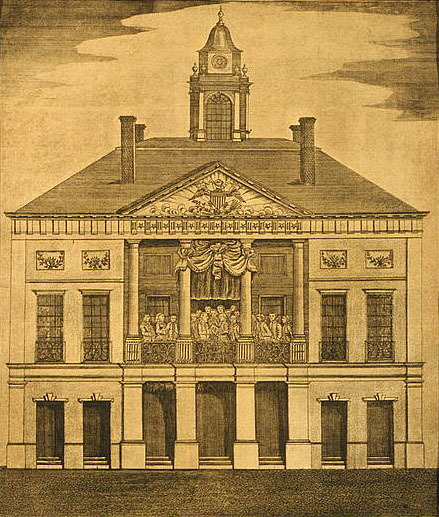
Federal Hall, New York City
Washington’s inauguration was quite different from those in the 21st century. It took a while for everyone to get to New York City, then the capital of the US. Washington arrived at the end of April, 1789, and moved in to his official residence at 3 Cherry Street. People began arriving at the crack of dawn on April 30. The crowd followed him to Federal Hall, where Washington went up to the second story balcony so the throngs could see him. Rather than wearing a military uniform, he wore a simple brown suit with silk stocking, silver buckles, and a red overcoat. Standing alongside members of Congress and the Senate, he held the Bible and took the oath of office from Robert Livingston, the Chancellor of the state of New York. That was followed by massive cheering and a 13-gun salute.
The group then returned to the Senate chamber where the new President delivered his address to Senators and Representatives. From there, they walked up Broadway to St. Paul’s Church where the Rt. Rev. Samuel Provoost, the Chaplin of the Senate and the first Episcopal bishop of New York officiated the service. There were no Inaugural balls at that time, though they did hold a celebration for him on May 7th. The Inauguration continued to be held on March 4 until the 20th Amendment, ratified in January 1933, change the date to January 20, starting in 1937.
So, as I said above, the following is Washington’s first Inaugural Address. Sometimes we can all use a refresher on what the Framers believed was necessary for a democratic republic. Yes, it sounds a little old-fashioned, but I’m sure you’ll understand what he was saying and why we might want to go back to practicing what they were preaching.
Fellow-Citizens of the Senate and of the House of Representatives:
Among the vicissitudes incident to life no event could have filled me with greater anxieties than that of which the notification was transmitted by your order, and received on the 14th day of the present month. On the one hand, I was summoned by my Country, whose voice I can never hear but with veneration and love, from a retreat which I had chosen with the fondest predilection, and, in my flattering hopes, with an immutable decision, as the asylum of my declining years–a retreat which was rendered every day more necessary as well as more dear to me by the addition of habit to inclination, and of frequent interruptions in my health to the gradual waste committed on it by time. On the other hand, the magnitude and difficulty of the trust to which the voice of my country called me, being sufficient to awaken in the wisest and most experienced of her citizens a distrustful scrutiny into his qualifications, could not but overwhelm with despondence one who (inheriting inferior endowments from nature and unpracticed in the duties of civil administration) ought to be peculiarly conscious of his own deficiencies. In this conflict of emotions all I dare aver is that it has been my faithful study to collect my duty from a just appreciation of every circumstance by which it might be affected. All I dare hope is that if, in executing this task, I have been too much swayed by a grateful remembrance of former instances, or by an affectionate sensibility to this transcendent proof of the confidence of my fellow-citizens, and have thence too little consulted my incapacity as well as disinclination for the weighty and untried cares before me, my error will be palliated by the motives which mislead me, and its consequences be judged by my country with some share of the partiality in which they originated.
Such being the impressions under which I have, in obedience to the public summons, repaired to the present station, it would be peculiarly improper to omit in this first official act my fervent supplications to that Almighty Being who rules over the universe, who presides in the councils of nations, and whose providential aids can supply every human defect, that His benediction may consecrate to the liberties and happiness of the people of the United States a Government instituted by themselves for these essential purposes, and may enable every instrument employed in its administration to execute with success the functions allotted to his charge. In tendering this homage to the Great Author of every public and private good, I assure myself that it expresses your sentiments not less than my own, nor those of my fellow-citizens at large less than either. No people can be bound to acknowledge and adore the Invisible Hand which conducts the affairs of men more than the People of the United States. Every step by which they have advanced to the character of anindependent nation seems to have been distinguished by some token of providential agency; and in the important revolution just accomplished in the system of their united government the tranquil deliberations and voluntary consent of so many distinct communities from which the event has resulted can not be compared with the means by which most governments have been established without some return of pious gratitude, along with an humble anticipation of the future blessings which the past seem to presage. These reflections, arising out of the present crisis, have forced themselves too strongly on my mind to be suppressed. You will join with me, I trust, in thinking that there are none under the influence of which the proceedings of a new and free government can more auspiciously commence.
By the article establishing the executive department it is made the duty of the President “to recommend to your consideration such measures as he shall judge necessary and expedient.” The circumstances under which I now meet you will acquit me from entering into that subject further than to refer to the great constitutional charter under which you are assembled, and which, in defining your powers, designates the objects to which your attention is to be given. It will be more consistent with those circumstances, and far more congenial with the feelings which actuate me, to substitute, in place of a recommendation of particular measures, the tribute that is due to the talents, the rectitude, and the patriotism which adorn the characters selected to devise and adopt them. In these honorable qualifications I behold the surest pledges that as on one side no local prejudices or attachments, no separate views nor party animosities, will misdirect the comprehensive and equal eye which ought to watch over this great assemblage of communities and interests, so, on another, that the foundation of our national policy will be laid in the pure and immutable principles of private morality, and the preeminence of free government be exemplified by all the attributes which can win the affections of its citizens and command the respect of the world. I dwell on this prospect with every satisfaction which an ardent love for my country can inspire, since there is no truth more thoroughly established than that there exists in the economy and course of nature an indissoluble union between virtue and happiness; between duty and advantage; between the genuine maxims of an honest and magnanimous policy and the solid rewards of public prosperity and felicity; since we ought to be no less persuaded that the propitious smiles of Heaven can never be expected on a nation that disregards the eternal rules of order and right which Heaven itself has ordained; and since the preservation of the sacred fire of liberty and the destiny of the republican model of government are justly considered, perhaps, as deeply, as finally, staked on the experiment entrusted to the hands of the American people.
Besides the ordinary objects submitted to your care, it will remain with your judgment to decide how far an exercise of the occasional power delegated by the fifth article of the Constitution is rendered expedient at the present juncture by the nature of objections which have been urged against the system, or by the degree of inquietude which has given birth to them. Instead of undertaking particular recommendations on this subject, in which I could be guided by no lights derived from official opportunities, I shall again give way to my entire confidence in your discernment and pursuit of the public good; for I assure myself that whilst you carefully avoid every alteration which might endanger the benefits of an united and effective government, or which ought to await the future lessons of experience, a reverence for the characteristic rights of freemen and a regard for the public harmony will sufficiently influence your deliberations on the question how far the former can be impregnably fortified or the latter be safely and advantageously promoted.
To the foregoing observations I have one to add, which will be most properly addressed to the House of Representatives. It concerns myself, and will therefore be as brief as possible. When I was first honored with a call into the service of my country, then on the eve of an arduous struggle for its liberties, the light in which I contemplated my duty required that I should renounce every pecuniary compensation. From this resolution I have in no instance departed; and being still under the impressions which produced it, I must decline as inapplicable to myself any share in the personal emoluments which may be indispensably included in a permanent provision for the executive department, and must accordingly pray that the pecuniary estimates for the station in which I am placed may during my continuance in it be limited to such actual expenditures as the public good may be thought to require.
Having thus imparted to you my sentiments as they have been awakened by the occasion which brings us together, I shall take my present leave; but not without resorting once more to the benign Parent of the Human Race in humble supplication that, since He has been pleased to favor the American people with opportunities for deliberating in perfect tranquillity, and dispositions for deciding with unparalleled unanimity on a form of government for the security of their union and the advancement of their happiness, so His divine blessing may be equally conspicuous in the enlarged views, the temperate consultations, and the wise measures on which the success of this Government must depend.
In 2015 the movie, “Wolf Warrior,” about an elite unit of the PLA, was a box-office smash in China, followed in 2017 by Wolf Warrior II. These days, the term “Wolf Warrior” describes an extremely aggressive approach that China is using around the world. While most nations are focused close to home, Beijing is expanding its tentacles in numerous parts of the world. There are no interesting pictures today, just serious words which we should not forget, even as we deal with problems in our own backyards. (I promise pictures next time!)
South China Sea. In March and April, China carried out training exercises in the South China Sea around one of their artificial island. They have increased the size of one, and created several new ones. They built installations on Woody Island, and currently dispute both the Spratly and Paracel Islands. They unilaterally banned summer fishing in disputed waters in Vietnam, and are causing serious issues with the Philippines. Vietnam, Japan and the Philippines are pushing back, and are working with the US to maintain the international freedom of the seas.
East China Sea. China is disputing not one or two, but eight islands there. Japan recently discovered a Chinese submarine sailing around both the Mayakovsky and Senkaku Islands, both owned by Japan. Tension has grown, and both countries have ramped up their radar and others military activities in the area.
Hong Kong. Sadly, things in Hong Kong have gone from bad to worse. Once the new laws and so-called security measures were passed by Beijing, it only took a few weeks for them to move security forces into Hong Kong. Well over 500 people have already been rounded up. More is coming. Police have told restaurant owners to get rid of pro-democracy posters. City officials have offered 1 Million Hong Kong dollars to anyone who helps in the arrest of a “subversive.” Despite significant US and UK sanctions, Beijing is taking Hong Kong apart. The UK has offered 3 million visa to Hong Kongers, though Beijing will not make it easy for the best and the brightest to leave. There’s an uneasy quiet in Hong Kong—most of the protests have gone underground. Many China-watchers expect that they’ve moved on to insurrection.
Tibet. Mao Zedong seized Tibet in 1949. In 1976, at the end of the Cultural Revolution, PLA troops built several roads up the high plateau to Tibet. Hundreds of men died along the way—didn’t matter. As soon as the PLA arrived in Tibet, they squelching any unrest at all, and started to close monasteries. Resentment built until there were riots against the Chinese in 2008. Beijing upped it’s game. Since 2011 virtually everyone has been barred from entering Tibet. Tibetans may only speak Mandarin Chinese anywhere outside the home. Beijing has been moving a great number of Han people into Tibet as teachers and virtually everything but the most menial laborers. Anyone wanting to become a monk has to pass stringent requirements to become a “patriotic, pious, expert.” Buddhist are badly mistreated on a daily basis.
Uighurs. The Uighurs are Muslims living in the area called East Turkmenistan, Uighuristan, or Xinjiang province which Mao grabbed in 1949. In the past twenty years, Beijing has destroyed Uighur mosques, and been more repressive than even in Tibet. Currently 1.3 million people are held in more than 85 massive detention camps—basically concentration camps with slave labor, torture and death. Those Uighirs who are not in the “reeducation camps” work under the harshest conditions with drones and massive cypher-security keeping track of everyone all the time. Currently, Beijing has started, preemptive pregnancy checks, forced sterilization, abortions, and forced birth control. Ultimately, it’s genocide
Sino-Indian Skirmishes. The short India-China War lasted from October 20, 1962, to November 20, 1962, leaving the Line of Actual Control in the area around Ladakh and Sikkiman near the Galwan Valley. Recently India has begun some large infrastructure projects, and in a preemptive move the Chinese sent troops to the area. On June 15, 20 Indian soldiers were killed, and 10 were held by the Chinese until June 18. It’s unknown how many, if any, Chinese were killed or wounded because Beijing refuses to divulge the information. The entire Indian nation is infuriated on every level because it’s become clear that Beijing wants to encroach on Indian sovereignty. India is pushing back. Interestingly, they have stopped using about 50 apps, including the seemingly fun TikTok, because those apps provide a back door for a huge amount of data that goes straight to Beijing. At the same time a number of nations are sending weapons and materiel requested by India, making it clear to China that it’s in for a fight if it goes any further.
As if all that wasn’t enough, China is doing its best to get involved in Venezuela, parts of Africa, Iran and areas in the Middle East. And don’t forget Taiwan!!
So, why would I start discussing China on a national holiday? Because this is 4th of July weekend, and I’ve been rereading something GeorgeWashington wrote in 1799. “…make them believe that offensive operations, often times, is the surest, if not the only means of defense.” Beijing understands that. Even before the pandemic, China’s had serious economic problems, problems with the “belt and road,” problems in Hong Kong and Taiwan, etc. Now, most of the world is angry with China because even if it didn’t invent Covid-19, it didn’t alert anyone until it was much too late. What to do? Personally, I’d apologize profusely and do everything I could to be helpful. (But I’m a dog lover.) Xi Jinping is smarter than I am. And he’s a Wolf Warrior. When in doubt, attack—economically, culturally or militarily—especially when people are otherwise occupied. At the very least you can buy time. Best case, you get more of what you wanted in the first place. … Something to ponder.
Several members of my family recently sent me some pictures from a trip they took to Savanah, Georgia, and asked me what I knew about Casimir Pulaski. Well, Monday, March 2, is Pulaski Day in Chicago, so I though I’d give everyone a very short course on the Father of the American Cavalry.
Plaque in Savannah, Georgia
Kazimiarz Michael Wladyslaw Wiktor Pulaski was born on March 4, 1745, in Warsaw, Poland, the son of Count Joseph Pulaski. The Count was a member of the Bar Confederation (1768-1772) that was trying to defend Poland against Russia. (Sadly it ended with the 1st Partition of Poland.) The young Casimir fought valiantly as a cavalry officer, but ultimately he had to flee Poland. He spent the years 1771 to 1775 traveling Europe and the Ottoman Empire trying to put together enough money and troops to return to Poland. Instead, he ended up in debtors prison in France.
Luckily, some of his friends bailed him out and introduced him to Benjamin Franklin, then in France as an agent of the Second Continental Congress. Franklin was always looking for outstanding European officers to train Americans in the Continental Army, most of whom grew up as farmers or merchants, not soldiers. Franklin liked the man, and send a letter introducing Pulaski to George Washington. Pulaski sailed from Nantes and arrived in Boston on June 23, 1777. He immediately headed to Philadelphia where, in August, he requested a commission from Congress—but like virtually everything else, Congress took its time.
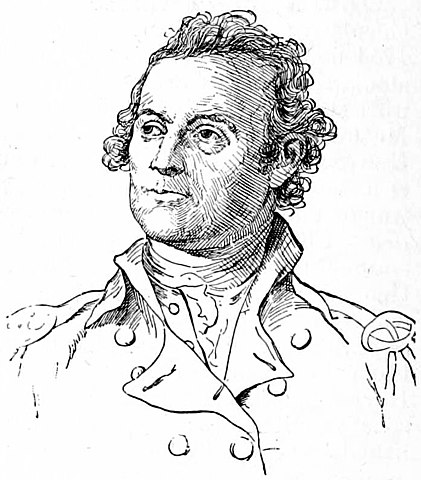
Portrait of General Casimir Pulaski from the Great Generals series
Pulaski was not a man to wait patiently so on August 20th, while Congress inched along, he rode out to Neshaminy Falls and met Washington. Early in September, the British began moving on Washington’s men. On September 11, the Redcoats started a flanking maneuver in an effort to cut off some of the Continental troops. Pulaski didn’t care about a commission. He asked permission from Washington to take some of the General’s personal guards and deal with the British. Washington agreed, so Pulaski led 50 men in a countercharge that bought enough time for the Americans to retreat in an almost-orderly fashion. Regardless of the best efforts of the American cavalry, the British won the Battle of Brandywine. Just four days later, Pulaski received his commission as a Brigadier General. He immediately began reforming and training an American cavalry unit.
Pulaski joined Washington and his men that frozen winter at Valley Forges. The Pole kept training his cavalry despite the desperate lack of food, clothing and heat. By the middle of February, Pulaski decided it was time to see what his men could do—and foraging for food was a good way to start. He and 50 of his cavalrymen headed toward Burlington, New Jersey, where they hooked up with General Anthony Wayne. On February 28, 1778, several British sentries saw what they thought was a large number of American cavalry, so they headed back toward the Delaware River. Pulaski and Wayne’s men attacked the Redcoats the next morning. It was actually a small skirmish, though Pulaski’s horse was shot out from under him. He and his men returned to Valley Force with some intelligent—and so desperately needed food.
Washington at Valley Forge
Working with the Americans chafed on Pulaski. His English was rudimentary at best, and he strenuously disagreed with much of the tactics and strategy developed by the men in Washington’s inner circle. By March 1778, he was so frustrated that he resigned his commission. But he shortly decided that he needed to take another shot with the American Cavalry. Ultimately Congress reinstated his commission. He formed a unit of 68 lancers and 200 infantrymen, many of whom were foreigners who he recruited in Baltimore.
While the new unit trained, American privateers seized British ships along the New Jersey coast and sailed them to ports along the Little Egg Harbor River. The courts sent all the materiel to Valley Forge, and sold the ships. After loosing close to 20 ships in just three months, the British, based in New York City, sent 15 ships with hundreds of soldiers to stop the privateers. They reached Little Egg Harbor in early October, and on the 7th torched a number of houses, confiscated the contents of the vessels, and destroyed 10 ships. They would have done more, but they heard that the Polish general and 250 men were on their way. In the early morning of October 15, 400 Redcoats attacked a 50-man detachment of Pulaski’s men, bayoneting almost of them (known to this day as the Little Egg Harbor Massacre), then hastily returned to New York harbor. The American cavalry continued to train in the Minisink region of the upper Delaware River over the winter.
In February 1779, Pulaski requested that Washington transfer him and his men to the Southern front. As much as Washington appreciated Pulaski’s skill, he was a very difficult man to deal with, so Washington was happy to oblige!! They arrived in Charleston, South Carolina, in May 1779. There he met Colonel John Laurens, and together they convinced the City Fathers to try to defend Charleston, rather than surrender it to the British. They did, in fact, hold Charleston, though the Americans, including Pulaski’s Cavalry Legion, paid a heavy price. However, what all the Americans were really aiming for was to retake Savannah, Georgia.
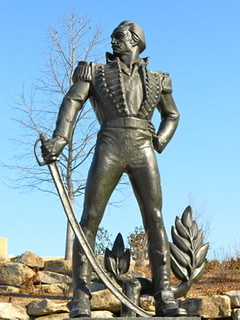
Monument to General Casimir Pulaski in Savannah, Georgia
Pulaski, like so many who lived in the South in those days, battled with malaria in the summer, but it didn’t stop him. By September he and his men reached Augusta, Georgia, where they joined General Lachlan McIntosh’s troops. As part of a joint French-American attempt to take Savannah, McIntosh and Pulaski would be the forward units for General Benjamin Lincoln’s men. On October 9, 1779, during a valiant but hopeless cavalry charge, Pulaski was hit by grapeshot. His men carried him from the field and put him aboard the brig Wasp, where he died two days later. Originally laid to rest on the Greenwich Plantation, he was reinterred at the Casimir Pulaski Monument in Savannah.
Statue of General Casimir Pulaski, Fairmount Park, Philadelphia
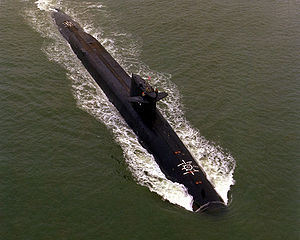
Though Pulaski’s life was cut short, he was not forgotten. Just two weeks after his death, Congress ordered a monument to be dedicated to him, though it wasn’t finished until 1854. The Marquis de Lafayette layer a cornerstone for Pulaski’s monument in Savannah in 1825. A bust of Pulaski has been in the U.S. Capital since 1867. There are a number of statues of Pulaski across the U.S. Numerous cities and counties are named for Pulaski, as are bridges and a skyway. Of course, as mentioned at the beginning of this discussion, Pulaski Day is celebrated on the first Monday in March in Chicago, as well as other cities. And one of the most interesting ways he is remember is the name of a U.S.Navy submarine—the U.S.S. Casimir Pulaski.
The U.S.S. Casimir Pulaski
As I said, this was a very short course. If you’re interested in more information on Pulaski, below are some very good books.
Leszek Szymanski. Casimir Pulaski: A Hero of the American Revolution.
Douglas Shores. Kazimierz Pulaski: General of Two Nations.
Francis Kajancki. Casimir Pulaski: Cavalry Commander of the American Revolution.




 Historical Lense