During Black History Month we pay tribute to many important Black Americans—Martin Luther King, Rosa Parks, Frederick Douglass, Harriet Tubman, Sojourner Truth, Thurgood Marshall—yet there are so many more who made important contributions, but are rarely discussed. I first learned about Lewis H. Latimer when my parents took us to the Edison National Historical Site that had just opened in September 1962. Near a heavy incandescent light bulb hanging from the ceiling was a small sign that included Mr. Latimer’s name. Everyone knew about Thomas Edison, but who was Mr. Latimer?🧐

Born on September 4, 1848 in Chelsea, Massachusetts, Lewis Howard Latimer was the youngest of four. His parents, Rebecca and George Latimer, had been slaves in Virginia, but had fled to the North in 1842. However, shortly after they arrived in Boston, George was discovered and thrown into jail. Defended by Frederick Douglass and William Lloyd Garrison, Latimer’s case went all the way to the Massachusetts Supreme Court, but to no avail. Ultimately, a minister and several other Abolitionists “bought” him, and immediately set him free.
Things went well until 1857 and the passage of the Dred Scott decision. At that point, George Latimer became so convinced that he might be captured again the he fled. All four children did what they could to help support the family. Just days before Abraham Lincoln free the slaves (September 22, 1863) young Lewis Latimer joined the U.S. Navy. He served aboard the U.S.S. Massasoit until honorably discharged on July 3, 1865. He immediately found a job as an office boy for Crosby and Gould, patent attorneys in Boston, for $3.00 a week.
The draftsmen who worked for the attorneys fascinated Latimer who quickly taught himself mechanical drawing. It didn’t take long for the partners to see that the office boy had serious potential. They found a new office boy and promoted Latimer to draftsman for $20.00 a week. In short order he became the best draftsman in the office. At the same time, he started to develop other new inventions/patents. In 1874 he and co-inventor W.C. Brown patented a toilet system called the Water Closet for Railroad Cars. Two years later, a local teacher asked Latimer to help him put together the documents for an invention he was trying to patent. The teacher was Alexander Graham Bell, and the patent was the telephone, submitted on February 14, 1876.
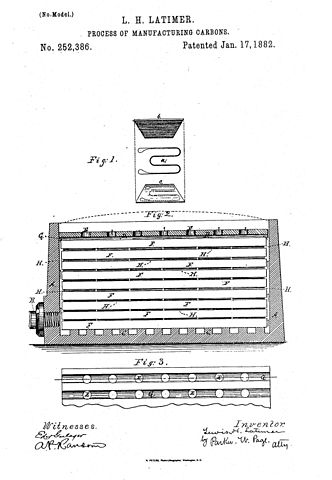
In 1880, the Latimer family (Lewis had married Mary Wilson in 1873 and they had two young girls) moved to Bridgeport, Connecticut, and became the Assistant Manager and head draftsman of the United States Electric Lighting Company, working with one of the founders, Hiram Maxim, best known for the famous Maxim Gun. In those days, Thomas Edison’s electric light bulb was in its infancy. He made the filaments of bulbs out of bamboo, paper, even heavy thread. It worked, but is flickered and died very fast. Several companies, including the Electric Lighting Company, were competing with Edison to make a better bulb. Latimer invented a carbon filament that lasted much longer and was much less expensive than earlier bulbs. He sold the patent to the US Electric Lighting Company in 1881.
Toward the end of 1881, Latimer led a team that put up electric lights in train stations, some government buildings, and cities like Philadelphia, New York City, Montreal and London. Maxim went with them to London, but decided to stay and continue working on his gun. When Latimer returned to Bridgeport late in 1882, he worked for several smaller firms until 1884, when Edison, who knew talent when he saw it, hired him to work in both the Engineering and Legal Departments. In addition to his work with Edison, Latimer published his book, Incandescent Electric Lighting: A Practical Description of the Edison System, in 1890. It was one of the standard texts for years.
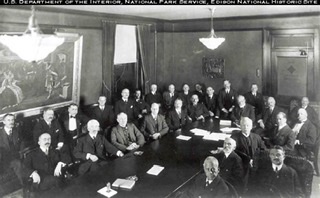
In 1896, Latimer joined the Joint Board of Patent Control between General Electric and Westinghouse, where he worked until 1911. At that point he went into private patent consulting until he retired in 1922. Latimer was recognized as one of the outstanding men in his field, and on January 24, 1918, he became one of the founding members of a professional/social group called Edison’s Pioneers—an elite organization of men who had worked with Edison in the early days.
Though he was laser-focused on his work, Latimer was happily married for 51 years and adored his children and grandchildren. Over the years, he had been deeply involved in the Grand Army of the Republic. He had also played the flute quite well, wrote poetry and plays, and taught mechanical drawing and English at the Henry Street Settlement until his death in December 1928. An ingenious, dignified gentleman, he was inducted in the National Inventors Hall of Fame in 2006.

 Historical Lense