China: STOP🚫

Several readers have asked me my personal thoughts—here you go.
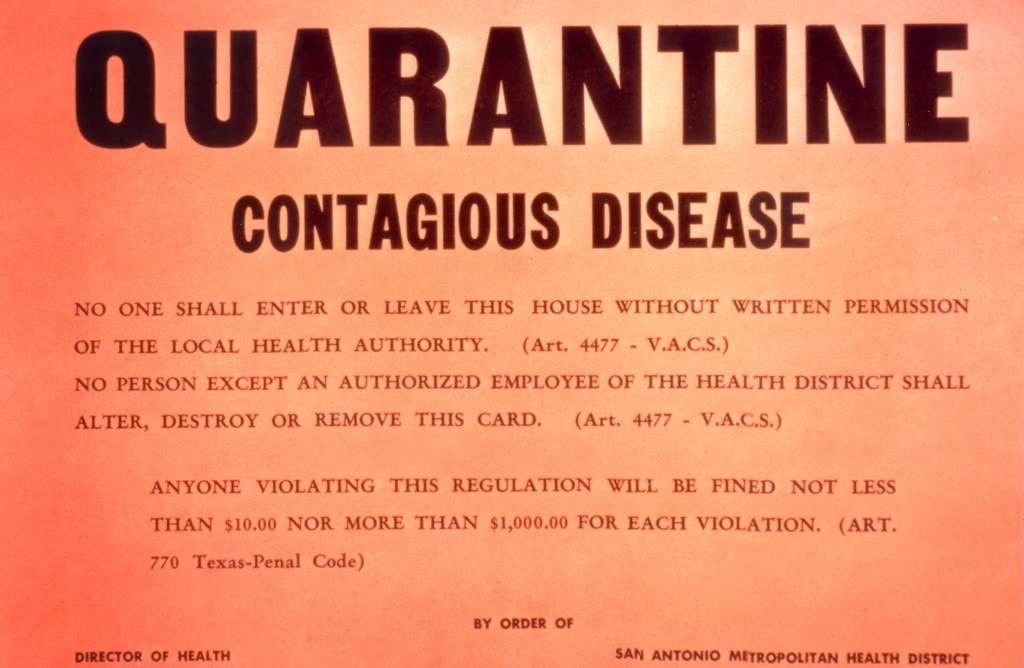
Now that we’ve examined both supply chains and Intellectual Property (IP) theft—what do we do? In the short term, follow the guidelines of our Governors, and the wonderful Drs. Fauci and Birx. We’re all bored and stressed, and it’s doubly hard for parents with children. But we need to stay home and not add more pressure on nurses and doctors—as well as the truckers, pharmacies and supermarkets. Above all, wash your hands and don’t touch your face!! Take a deep breath. Take lots of deep breathes. And remember the gospel song based on Charles Tindley’s 1900 hymn, “We Shall Overcome.”

Now, for the long term. There are as many opinions as there are people. From small companies to massive conglomerates, from members of Congress to members of the clergy, from pundits to plumbers. Personally, I believe globalization is here to stay, and in many ways that’s a good thing. Since WWII, almost a billion people have moved out of grinding poverty. Amazing medical advances have allowed us to live longer with a better quality of life. (Think of it this way—I got the small box vaccine when I was a child. Today it’s eradicated. Penicillin was just becoming commercially available in the late 40s. We’re now on the fifth generation of antibiotics. Almost everything has changed in medicine.) And technology has made incredible strides in communication and trade. Think Internet and everything that’s come with it.

About 25 years ago I had a conversation with one of my former grad students who asked me what I thought our major global challenge would be in the future. There were so many to choose from.😠 Ultimately, I told him that I thought the real problem would be China. That surprised him. We periodically catch up, and a while ago he, sadly, agreed with me. Today, no more kicking the can down the road. We’ve already discussed moving strategic supply chains home, and refusing to hand over certain Intellectual Property, even if it costs more to build parts or drugs elsewhere. We must not be at the mercy of China!

Skeletal Formula of Ciprofloxacin (2d generation antibiotics)

For 20 or so years, it’s been easier and cheaper to manufacture things overseas. Who’s at fault? There’s plenty of blame to go around. Why hasn’t the federal government maintained stockpiles of the APIs (active pharmaceutical ingredients) and their chemical building blocks? Equally, possibly more important, why haven’t states kept their own stockpiles of equipment? Hospital groups and large pharmacy chains (we know the names) didn’t demand this from government or state agencies. Of course these private groups could, and should, have maintained at least some of the most vital drugs and medical equipment themselves. I can only be partially aggravated with US pharma. It literally costs billions of dollars and many year to develop new drugs, and only a few of them actually work. They take massive risks…they’re entitles to some rewards. But not by making the drugs overseas❗️And finally, until quite recently the FDA had two speeds—slow and stop. It’s only when facing a disaster that they are finally doing what they should have done all along.

Those are good questions. I wish I had good answers 😖 What I do know is that if we just sit around twittering and waiting for someone to do something, nothing will change. So do a little investigating—heaven knows we have the time—and start asking, no, DEMANDING, that our Representatives and Senator, major pharmacy chains, hospital groups and manufacturers, start changing the way we all do business. There will be all kinds of excuses, “We can’t do that because…” As an historian I know what this country can do when it sets its mind to it. As I mentioned earlier, there have been some initial improvements—some shifts in supply chains and crackdowns of Intellectual Property theft. However, we must hold the appropriate feet to the fire and get this done ASAP. God willing this will never happen again, at least in in our lifetimes—but something else will, and we must be in a significantly better position to deal with it when that day comes.

China: What Do We Do Now? Part 2

I’m back with part two of my discussion/rant—this time looking into the problem of Intellectual Property (IP) Theft. First, what is Intellectual Property? According to the World Intellectual Property Organization, IP is a creation of the mind that can include inventions, literature and artistic works. They are protected by patents, copyrights, trademarks and trade secrets. And just to be sure that we’re all on the same page, theft is knowingly taking or transferring property belonging to another with the intent of depriving the owner from said property indefinitely.

United States Patent and Trademark Office

The first patents and copyrights were granted in the United States in 1790, though the name “Intellectual Property” was first used in 1867. There have been patent and copyright infringements and similar issues over the years, but problems have grown exponentially since the late 20th century with the combination of constantly growing supply chains and the explosion of digital technology and internet file sharing.

Intellectual Property theft can happen anywhere—within a nation’s borders or beyond. It hurts companies, their employees, even sovereign nations. Currently, the major culprit of IP theft is China. Billions of dollars are lost to IP theft every year. According to a CNBC poll in March, 2019, 20% of American companies have had IP stolen by either the Chinese government or Chinese state-run companies. (1) As of March 2019, China has stolen between $225 billion and $600 billion dollars, and up to 750,000 jobs have been lost. (2)

The United States Copyright Office

There are several ways to carry out IP theft. Think modern-day Jams Bonds. Corporate espionage is one. Cyber-attacks on computers, networks and other personal devices can quietly get massive amounts of information and data. In addition, the Chinese government can be quite straightforward about it. In some cases, Beijing simply insists that a foreign company that’s invested, or working, in China, provides all IP information and licenses. In other cases, rather than the state simply demanding the information, a state-run company requires that the overseas firm it’s working with transfer their technology to the Chinese firm.

IP can include everything from watches (am I the only person who still wears a watch?) and lamps to lasers and airplane parts. If a company is OK allowing Beijing to have it’s IP to build lamps in China, well, have fun. But to share American IP on things like our pharmaceuticals and turbine parts—I just keep hearing my father’s words, “HOW STUPID CAN YOU BE?” There are times when it’s simply common sense (while apparently isn’t that common) to refuse to provide IP to someone who, in truth, wants to do you harm. While China is full of good, decent people, the government is a despicable, dangerous, totalitarian state that doesn’t care about it’s own people. Why should we think that Xi Jinping et al. would work with us?!?!? Until there is a sea-change in Beijing, we need to move both our strategic IPs and supply chains home—or at the very least to countries where we can work well together.

National Intellectual Property Rights Coordination Center

Recently, the US has started enforcing the appropriate patent, copyright and trademark laws. In addition, there have been some small successes, notably in December, 2018, when the G-20 insisted, and the Chinese agreed, to a memorandum which outlined 38 punishable offenses for IP theft. But it remains to be seen if they carry it out, or simply talk a good game. In addition, the US maintains the National Intellectual Property Rights Coordination Center to deal with IP Theft. Both the FBI and Homeland Security are increasingly focusing on IP theft of elements of health, safety, and national security.

  1. Fortune “One in 5 U.S. Companies Say China Has Stolen Their Intellectual Property.: 3/1/2019
  2. Fortune “Briefing,” 3/1/2-19

China: What Do We Do? Part 1

Sometimes I put history on hold and discuss something more current. Today rather than talking about the Black Death (1346-1352), Smallpox (1870-1874), or the Spanish Influenza (1918), I want to discuss—possibly rant a bit—on current supply chain difficulties and what must be done from here on in.

First, what is a supply chain? According to Investopedia, supply chains are “networks between a company and suppliers to produce and distribute a specific product to the final buyers.” Basically, rather than having a company build a complete product in-house, a firm hires several companies to build different components, puts them together at one of those factories and sends the finished product to the buyer. They are generally done overseas. There are a lot of different ways of doing this, but that’s the general idea. Supply chains are done because they are generally faster and cheaper.

General theory of a supply chain

American companies have used supply chains for years, but they really ramped up after World War II. In the ‘60s and ‘70s, with the development of multi-national corporations, we began to see more parts built overseas, increasingly in China, because of lower wages. By the early ‘90’s supply chains from China had grown significantly. There certainly were some hiccups. Raw material shortages, recalls, and tougher regulations all caused issues, but sooner or later they were worked out.

However, some parts of a supply chain are extremely serious. Ninety-two percent (92%) of pharmaceuticals and biologics, many of which are Active Pharmaceutical Ingredients (APIs), and forty percent (40%) of over-the-counter drugs and supplements—even something as simple as Vitamin C—are only made in China. In addition, sixty-six percent (66%) of the rare earth elements (REE), many of which are required in high tech parts, and by the Defense Department—things like guidance systems, lasers, satellite communication equipment and jet engines—come from China

Now for my rant. China is a communist country. Xi Jinping may wear an elegant suit and tie but he’s simply an updated version of Mao Tsedung. As the President of the People’s Republic of China he made himself president for life, as well as Chairman of the Central Military Commission. Censorship blankets China. Mass surveillance is standard operating procedure, including complete internet censorship. One million Uighurs have been put into concentration camps, and Tibet is being destroyed. And that’s just the tip of the iceberg. Mao’s Cultural Revolution—Xi’s decision to hide the coronavirus for months. To me, that’s a distinction without a difference. Why on earth should we place our most important products in the hands of China???

In the past 3-5 years, some companies in the US have been in discussions to move their supply chains from China to Taiwan, Cambodia, Vietnam, Indonesia, Malaysia, Mexico, even the United States. Some have actually pulled the trigger and moved. That is a good, but a small first step. Global supply chains are perfectly fine if we’re interested in furniture or eye glass frames. But in my opinion, it’s extremely dangerous to allow a nation which is so obviously opposed to the United States to control our vital resources. We have the authority under the International Emergency Economic Powers Act of 1977 (IEEPA) to require US companies to move the most important pharma, biologic, REEs and what every else is vital to our nation.

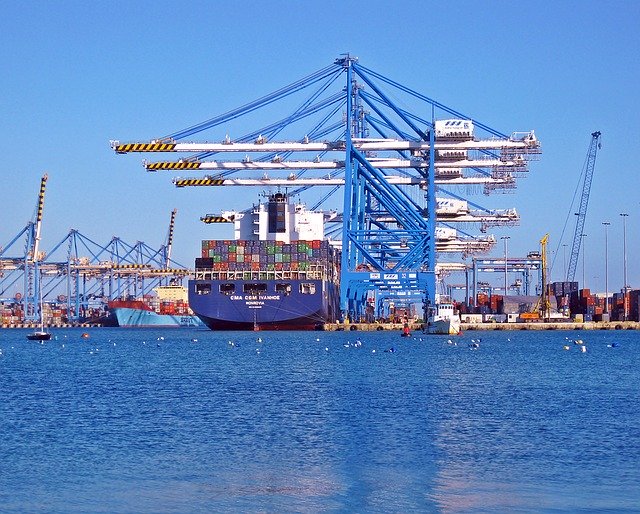
One of hundreds of ship containers move thousands of supply chain products each year

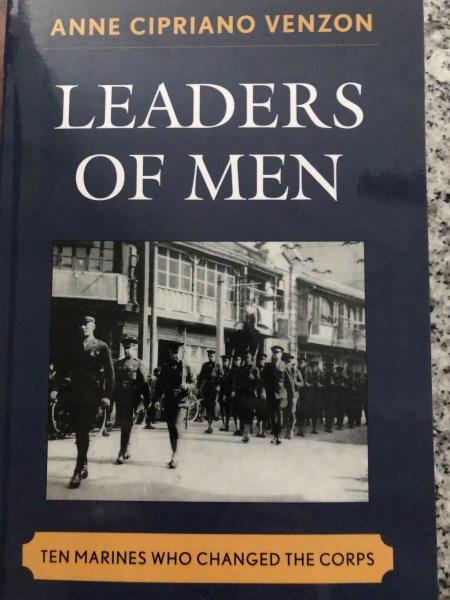
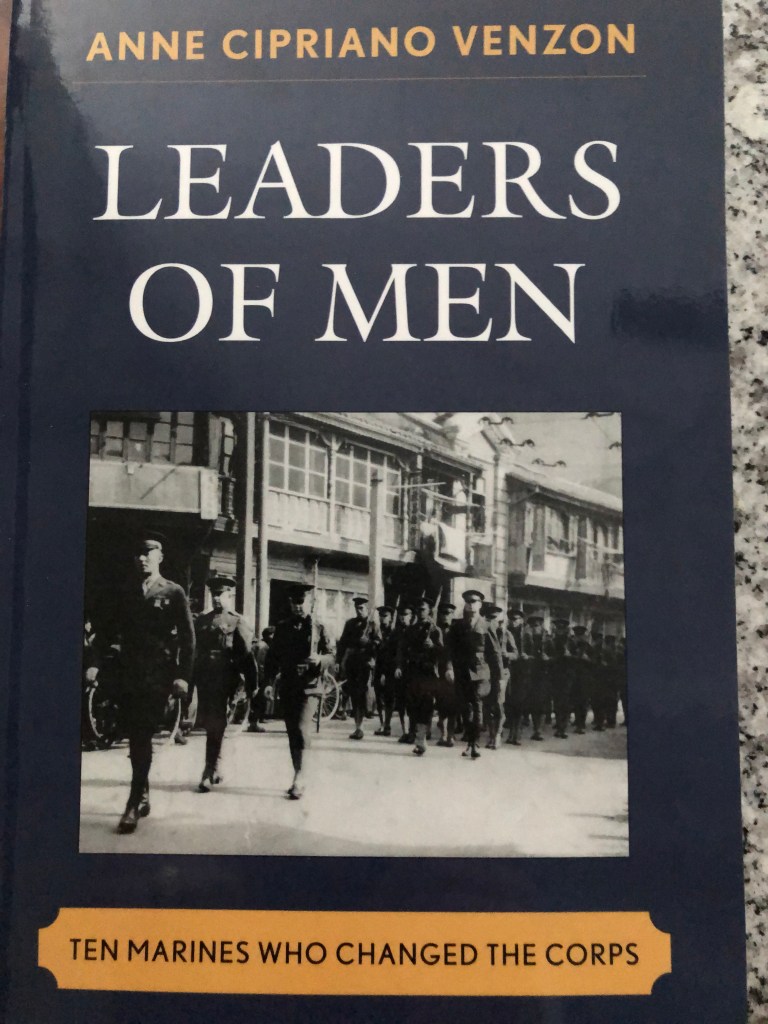
Review of LEADERS OF MEN: Ten Marines Who Changed the Corps

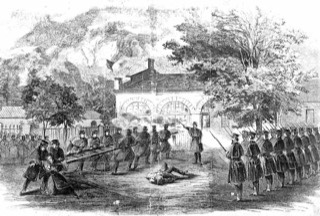
Marines at Harpers Ferry 1859

As an historian, I spend a lot of time reading military history, particularly Marine Corps history. It’s fairly easy to find a lot of great books on the American Revolution, the Civil War, World Wars I and II, and an amazing number of books on our current military. What’s hard to find is information on what happened between the end of the Civil War, when the Marines were basically a small constabulary, and World War I, when the Marines were an elite fighting force of 72,000 men.

Well, actually several things changed after the Civil War. The U.S. went from sail to steam meaning larger, faster ships which needed additional sailors—and Marines (often called “soldiers of the sea.”) Marines also received several new and improved weapons like the Maxim gun, precursor of the machine gun. After 1865, the country began growing at a massive rate, as did our foreign trade. And with that foreign trade went both the Navy and Marines. Even so, the Marines were different by the beginning of the Great War—and I recently read a book which, at least in part, explained why.

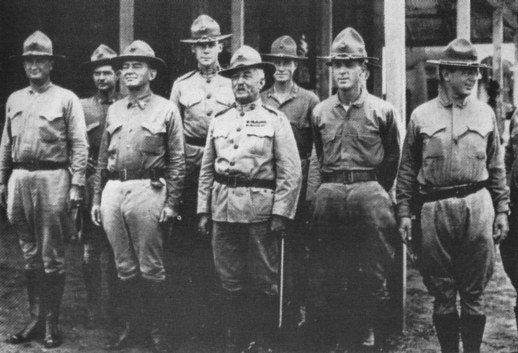
From left to right, Wendell Neville, John Lejeune, Littleton Waller and Smedley Butler circa 1914

Leaders of Men by Dr. A.C. Venzon discusses 10 Marine officers who overlapped the years 1861 to 1923 and explains how their natural leadership abilities gradually changed the attitudes, training, and morale of the Marine Corps. From Col. Robert Huntington, who joined the minuscule 3,000-man Marine Corps in June 1861 and started his career at First Manassas, to Col. Fritz Wise, who fought with his men at Belleau Woods in 1918, each of these men learned from their elders and, in turn, trained those who followed them.

A portrait of Marines at Belleau Woods, 1918

It’s a fascinating, eclectic group. In addition to Huntington and Wise, there’s the indomitable Smedley D. Butler. But Venzon includes other men who’s names have been shoved into dusty corners of libraries. These men, like Littleton W.T. Waller, Joseph (Uncle Joe) Pendleton, Wendell (Buck) Neville, “Hiking” Hiram Bears, John (Handsome Jack) Myers, and George Thorpe, fought in Egypt, Alaska, Panama, China, Ethiopia, Djibouti, Honduras, Nicaragua, Cuba, the Philippines, Mexico and Haiti. One was an absolute martinet. One or two drank too much. Some were wounded. Some dealt with malaria or dengue fever. One had a breakdown. All had their foibles. But well after they retired, the men they had trained and fought with would tell anyone who would listen that they had become better Marines, real Marines, because of these men.

The author has used extensive, little-known documents and rare photographs to reintroduce these men who had such an important part of the USMC in the 20th century and beyond. A relatively short book has given the reader a much better understanding of what actually made the Marine Corps what it is today.

Anne Cipriano Venzon. Leaders of Men: Ten Men Who Changed the Corps. Latham, MD: Roman & Littlefield, 2008.

Black History Month—Meet Lewis H. Latimer

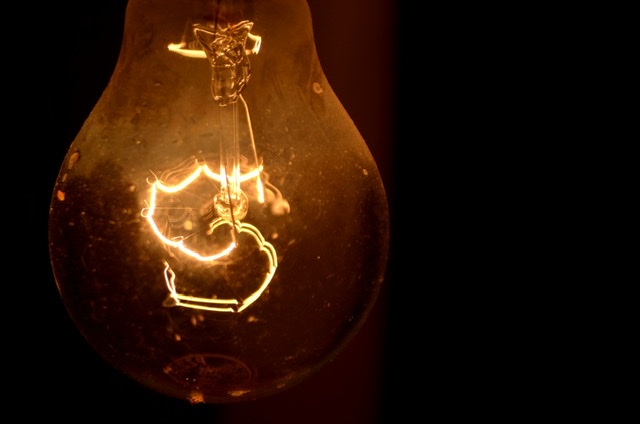
During Black History Month we pay tribute to many important Black Americans—Martin Luther King, Rosa Parks, Frederick Douglass, Harriet Tubman, Sojourner Truth, Thurgood Marshall—yet there are so many more who made important contributions, but are rarely discussed. I first learned about Lewis H. Latimer when my parents took us to the Edison National Historical Site that had just opened in September 1962. Near a heavy incandescent light bulb hanging from the ceiling was a small sign that included Mr. Latimer’s name. Everyone knew about Thomas Edison, but who was Mr. Latimer?🧐

Lewis Howard Latimer

Born on September 4, 1848 in Chelsea, Massachusetts, Lewis Howard Latimer was the youngest of four. His parents, Rebecca and George Latimer, had been slaves in Virginia, but had fled to the North in 1842. However, shortly after they arrived in Boston, George was discovered and thrown into jail. Defended by Frederick Douglass and William Lloyd Garrison, Latimer’s case went all the way to the Massachusetts Supreme Court, but to no avail. Ultimately, a minister and several other Abolitionists “bought” him, and immediately set him free.

Things went well until 1857 and the passage of the Dred Scott decision. At that point, George Latimer became so convinced that he might be captured again the he fled. All four children did what they could to help support the family. Just days before Abraham Lincoln free the slaves (September 22, 1863) young Lewis Latimer joined the U.S. Navy. He served aboard the U.S.S. Massasoit until honorably discharged on July 3, 1865. He immediately found a job as an office boy for Crosby and Gould, patent attorneys in Boston, for $3.00 a week.

The draftsmen who worked for the attorneys fascinated Latimer who quickly taught himself mechanical drawing. It didn’t take long for the partners to see that the office boy had serious potential. They found a new office boy and promoted Latimer to draftsman for $20.00 a week. In short order he became the best draftsman in the office. At the same time, he started to develop other new inventions/patents. In 1874 he and co-inventor W.C. Brown patented a toilet system called the Water Closet for Railroad Cars. Two years later, a local teacher asked Latimer to help him put together the documents for an invention he was trying to patent. The teacher was Alexander Graham Bell, and the patent was the telephone, submitted on February 14, 1876.

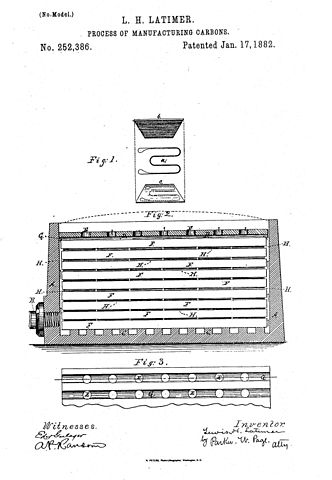
One of Lewis H. Latimer’s most important patent—the carbon filament.

In 1880, the Latimer family (Lewis had married Mary Wilson in 1873 and they had two young girls) moved to Bridgeport, Connecticut, and became the Assistant Manager and head draftsman of the United States Electric Lighting Company, working with one of the founders, Hiram Maxim, best known for the famous Maxim Gun. In those days, Thomas Edison’s electric light bulb was in its infancy. He made the filaments of bulbs out of bamboo, paper, even heavy thread. It worked, but is flickered and died very fast. Several companies, including the Electric Lighting Company, were competing with Edison to make a better bulb. Latimer invented a carbon filament that lasted much longer and was much less expensive than earlier bulbs. He sold the patent to the US Electric Lighting Company in 1881.

Toward the end of 1881, Latimer led a team that put up electric lights in train stations, some government buildings, and cities like Philadelphia, New York City, Montreal and London. Maxim went with them to London, but decided to stay and continue working on his gun. When Latimer returned to Bridgeport late in 1882, he worked for several smaller firms until 1884, when Edison, who knew talent when he saw it, hired him to work in both the Engineering and Legal Departments. In addition to his work with Edison, Latimer published his book, Incandescent Electric Lighting: A Practical Description of the Edison System, in 1890. It was one of the standard texts for years.

In 1896, Latimer joined the Joint Board of Patent Control between General Electric and Westinghouse, where he worked until 1911. At that point he went into private patent consulting until he retired in 1922. Latimer was recognized as one of the outstanding men in his field, and on January 24, 1918, he became one of the founding members of a professional/social group called Edison’s Pioneers—an elite organization of men who had worked with Edison in the early days.

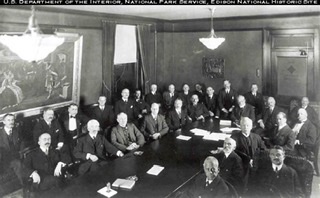
Edison’s Pioneers—Latimer is seen in the lower right

Though he was laser-focused on his work, Latimer was happily married for 51 years and adored his children and grandchildren. Over the years, he had been deeply involved in the Grand Army of the Republic. He had also played the flute quite well, wrote poetry and plays, and taught mechanical drawing and English at the Henry Street Settlement until his death in December 1928. An ingenious, dignified gentleman, he was inducted in the National Inventors Hall of Fame in 2006.

Will You Be My Valentine?❤️

It’s cold in the Mid-Atlantic right now. It still gets dark early. And there’s plenty of snow. Face it—February is a pretty dreary month. The only bright spot is Valentine’s Day…aka St. Valentine’s Day. When I was young, we would make little paper Valentines to give to everyone in our class. As adults we come up with lovely cards, candies, flowers—whatever we decide to give to those we love. But of course the historian in me is curious how the holiday came about.

Going back to Roman times, they had a festival called Lupercalia in mid-February. The Romans dedicated it to Faunus, the god of agriculture, in the hope that spring and the planting season would come early. By 200 C.E., there seems to have been several Christians named Valentine. One legend says that before being martyred, a priest who had healed the blindness of one of his jailer’s daughters wrote her a letter, and signed it “from your Valentine.” Another story suggests that it was St. Valentine of Terni. A third theory says that St. Valentine married a number of couples in defiance of Emperor Claudius II Gothicus who demanded that all single men join his army. Which of these men was the real St. Valentine is lost in the mists of time, but it does appear that he was, in fact, martyred around the year 270.

By the end of the 5th century, Pope Gelasius I ended the Lupercalia festival. However, the Church decided that it would be appropriate to celebrate the feast of the martyred St. Valentine on February 14. Over the centuries, Valentine’s feast day morfed from a day in the liturgical calendar into one of love and romance. The first time we know of romance equating with St. Valentine is in the 1380s and Geoffrey Chaucer’s poem “Parliament of Foules,” in which he says “For this was on seynt Valentynys day, Whan euety Byrd cimyth there to she’s his make.”

An 1909 Valentine’s Day card

The oldest known St. Valentine’s Day card was made by Charles, Duke of Orleans, while imprisoned in the Tower of London in 1415 after he was captured at the Battle of Agincourt. By the 15th century people would often write small romantic notes to loved-ones, and by the 17th century there were a few printed cards, though that was quite rare until the mid-1800s. Today there is a plethora of cards—from the most romantic to hilarious, and from the most modest to extravagant. The Greeting Card Association keeps track of all cards each year, and in 2019 there were 145 million Valentine cards sold. Personally, I’ve keep all of the cards my kids have given my over the years, and those hand-made, hand-written cards are far and away the best.

The best Valentine’s Day card I ever received😇

Review of THE VOLUNTEER

Captain Witold Pilecki

I’ve been a military historian for 45 years, and in that time I’ve read only a handful of books as powerful as Jack Fairweather’s The Volunteer—the story of Captain Witold Pilecki, who fought in the Polish-Soviet War (1919-1920). During the inter-war years he rebuilt his family’s property that was destroyed in World War I, and became an important leader of the community. He also was a reserve officer in the Polish 19th Infantry Division that was called up on August 26, 1939. On September 1, 1939, the Germans started barreling east toward Warsaw, and 17 days later the Soviets lumbered west toward the Vistula. Poland surrendered on September 28, 1939, and the Government went into exile in Great Britain.

At that point, most men tried to return to their families. However Fairweather suggests Pilecki held a different perspective. As much as he loved his wife and children, he also loved his country and he felt that he had an inner duty to defend it. So rather than going home, Pilecki and a friend set up the Secret Polish Army in Warsaw. The following spring, Pilecki entered discussions with the more mainstream Underground Home Army. Early that summer, the Underground began hearing that an old Polish Army barrack in the town of Oswiecim—the Germans called it Auschwitz—was being used as a concentration camp for Polish political prisoners. The Underground wanted to find out what was going on there, and if possible to set up an Underground cell. Though several members suggested it to Pilecki, no one would order anyone to go on such a dangerous mission. Witold thought long and hard but ultimately concluded that he would do what was right. On September 18, 1940, he packed a few belonging and calmly waited for the German raid that the Underground knew was on its way. That started a 2 1/2 year odyssey into the hell that was Auschwitz.

Using memoirs, diaries, letters, books, interviews, newly-opened papers from the post-Polish communist archives and, most fascinatingly, Witold’s own information smuggled out of the camp to the Underground, Fairweather has described Pilecki’s astonishing journey. The starvation, torture, beatings, freezing winters, and rampant disease became routine. Slowly he built a small Underground. Their most important work was keeping meticulous records of when people entered the camp, and when and how they died. Very occasionally family members managed to pay for a Polish prisoner to be released. Whenever possible they took the information out of the camp with them and managed to get it to the Home Army. From there couriers would get it to the Polish Government-in-Exile in Britain. Initially the Government could not believe what was happening in the camp. It was far fetched. They needed corroboration. Pilecki and his Underground had to be exaggerating. And then came the Final Solution.

Pilecki and the other inmates were set to building new barracks, infirmaries, other odd buildings and crematoria. Then came the trains—first a trickle, then a stream and then a floodgate. The Underground also learned about Zyklon B—the gas used to exterminate millions of people. The Underground continued keeping records, periodically getting it to Warsaw and on to London. By now it had become clear that Palecki’s information was correct and the Government-in-Exile was trying to convince the Allies to bomb Auschwitz.

By spring of 1943, Pilecki concluded that there was little more he could do in Auschwitz. He’d barely survived typhus, and knew that he simply wouldn’t last much longer. He had the same internal discussion that he’d had before volunteering for the camp, and ultimately decided that he could do more with the Home Army then in the camp. He and two friends made their escape an on August 25 Pilecki was back with the Home Army in Warsaw. One of his first tasks was to put together what is called Witold’s Report—an extremely accurate paper providing the number of people who arrived at Auschwitz, and those who were killed.

In November 1943, Pilecki became part of the secret anti-Soviet unit of the Home Army, the NIE, for it was clear that the Soviets had their eyes on Poland. Soviets, Bolsheviks—to Pilecki communists were communists. He’s fought them before and he would do it again. And if there had been any doubts about the Soviets, the fact that they patiently waited just across the Vistula in August and September 1944, allowing the Germans to destroy what was left of Warsaw made it crystal clear. Rather than being taken by the Soviets at the end of the Warsaw Uprising, Pilecki surrendered to the Germans, and was finally liberated by the US 12th Armored division in April 1945.

As soon as he was liberated, Pilecki joined the Intelligence Division of the the Polish II Corp then based in Italy under General Anders. During his down-time, he began a book on his time in Auschwitz. Sadly, toward the end of the war, Poland came under Soviet jurisdiction. However, for the time being the Polish Forces-in-Exile carried on. Anders ordered Pilecki to return to Warsaw to report on the Soviet situation. He arrived in Warsaw in December 1945 and started to put together an intelligence network. Apparently someone informed on him in the summer of 1946. Though Anders told him to leave, Pilecki refused and continued to provide intelligence to the Forces-in-Exile until he was arrested on May 8, 1947. He was interrogated and tortured for months, but refused to give up any serious information. On March 3, 1948, the first show trial began—he was presented with a whole host of charges, and sentenced to death on May 15. Witold Pilecki was shot ten days later.

The show trial was just a part of the campaign to replace the Home Army and the Government-in-Exile with the Lublin, or Polish People’s Republic. Immediately after the fall of the communist Poland in 1990, Pilecki and hundreds of others were rehabilitated. He was posthumously awarded the Order of Polonia Restituta and the order of the White Eagle, the highest Polish decoration. As Fairweather has shown us throughout the volume, Pilecki looked beyond himself, his family and friends, and tried to do what was needed for his country. It is a fascinating, horrifying, and ultimately an uplifting book that adds Witold Pilecki to the Polish Pantheon with Kazimierz Pulaski, Tadeusz Kosciusko and Ignacy Jan Paderewski.

This coming Monday, January 27, will be the 75th anniversary of the liberation of Auschwitz. Only those who were there can possibly understand what happened, but it is imperative that we remember.