Lai, Lee, Wong . . . Who’s Next?

Last week I posted about the serious need to help the small and medium-size gyms, not only to keep them afloat, but also because of the serious health benefits good gyms provide all of us. Covid-19 has, understandably, focused all of us close to home. We’re working hard to keep family, work and school on an even keel. That gives us little time or energy to look outward. Between the virus and the election, Hong Kong has been on our back burner–and China has taken full advantage of that. So let’s take a minute and see what’s been going on in Hong Kong for the past few months.

Since the summer, with Beijing’s new National Security Laws now in place, China is closing the noose around Hong Kong tighter every day. Many Hong Kongers are quietly making their plans–either stay and fight, or sell their property and leave. Taiwan, the UK, Canada, Australia and the US are ready to help, but it’s a difficult process to leave Hong Kong–especially since it’s not known if Beijing will continue to recognize Hong Kong passports. There are also questions because many, but not all Hong Kongers have dual passports.

Jimmy Lai and Martin Lee at a 2019 protest in Hong Kong

On August 23th, 12 Hong Kongers, between 16 and 33 years old, tried to use a speedboat to make a 400-mile dash from a quiet cove in northeastern Hong Kong to Taiwan. All of them had been very involved in the massive demonstrations in 2019. They only made it 36 miles before the Chinese equivalent of the Coast Guard stopped them. They ended up in jail in Shenzhen province, just across the border in China proper. They are charged with everything from riot to weapons charges. Another nine people were charged in October. They may receive up to 10 years in prison for allegedly helping the “Hong Kong 12.” It’s estimated that over the past few months 10,000 Hong Kongers have been detained.

Chinese leadership recently announced it is beginning to impost “comprehensive governance” for the next five years. “Comprehensive governance” means direct rule from Beijing–no democratic rule, no civil liberties in Hong Kong. Then the Council of Hong Kong expelled four members of the Civic Party, one of Hong Kong’s numerous pro-democracy parties. The remaining 15 members of the party resigned from the Council in protest, leaving what we’d call the “rump” of the Council to do Beijing’s bidding.
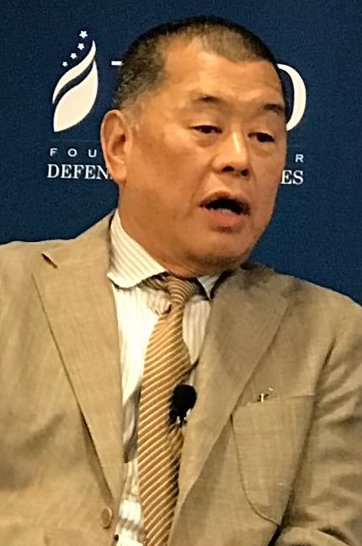
Jimmy Lai

Also in October, police raided the offices of media mogul and pro-democracy leader, Jimmy Lai, the owner of the Apple Daily newspaper and Next Digital magazine. He could certainly leave if he wanted to. He doesn’t. He had arrived in Hong Kong as a child who had stowaway on a fishing boat, and worked his way up from literally nothing. Later that month, more than 100 police took him into custody. He proudly walked out of his firm in handcuffs which he, and so many Hong Kongers considered a badge of honor. He’s currently out on bond but will go on trial for sedition and collusion with a foreign power. Then came the announcement that Martin Lee, the Father of the Hong Kong democracy movement who had been working for a free Hong Kong since he fled from China in 1949, had also been arrested. At the age of 82, Lee has said that he will not leave even if he dies in jail. “Dying without my convictions is what would really give me pain.” (WSJ Nov. 16, 2020)

Martin Lee

It’s not just the older people who are staying. Many students and young people are staying too. For instance, Joshua Wong recently pled guilty and is held in solitary confinement for organizing an illegal protest near Hong Kong’s main police station last year. He knows that he can spent the next three years in jail, but he also knows that the fight for freedom will continue. According to Michael Yon, the well-known war correspondent who spend six months with the protesters, this is a serious insurrection. The fact that the US has put severe restrictions on banks in Hong Kong has given renewed hope to the freedom fighters. However, they are very concerned that the new administration may not stand with Hong Kong the way the current administration has.

The reason that I posted this update is because as difficult as things are here, the Hong Kongers are in a much worse position. The day is coming–hopefully sooner than later🤞–when we may go back to something close to normal. Left to the mercies of Beijing, what will Hong Kong be like by them? What could we do about it? Like I said in the last post–write your congressman/woman and insist that the US continue to put pressure on China, what we can to stand with a free Hong Kong.
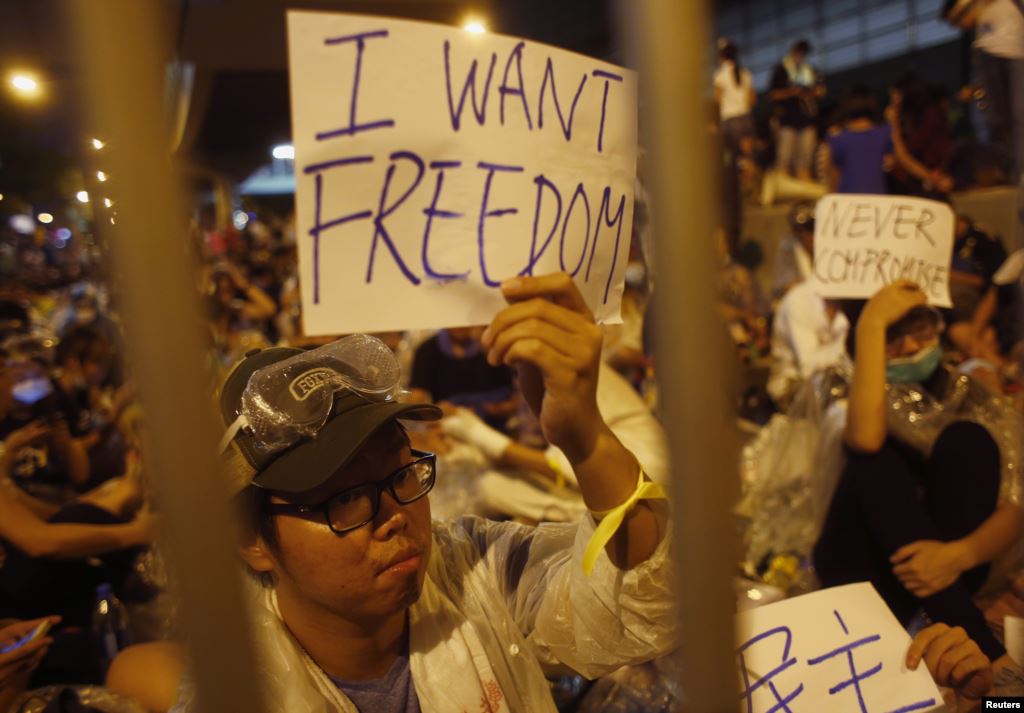
FREE HONG KONG
photo from VOA

So Write Your Congressman! 😠

Over the years, when someone had a problem, people would suggest that the person should write to his/her Congressman/woman. And sometimes it actually works! However, the issue is usually resolved when a lot of people write. That’s what I just did, and I hope a number of people will do the same. What did I write to him about? Not a foreign relation problem or political issue, or anything historical. Something much closer to home. Even more important the the problems of greater restrictions for restaurants are the problems facing small and medium-sized gyms.

Yes, me, the most un-athletic woman you’d ever meet is extremely concerned about gyms. Before the pandemic there were 40,000 small and medium-size gyms in the US. Since the middle of March, 6,000 have already closed, and by the end of the year, it’s expected that one in four existing gyms will go into bankruptcy. Though many businesses have received a lifeline from a variety of federal relief programs, gyms rarely qualify because of their unique requirements and extremely specific types of expenses. They need assistance now, not months from now!

As much as we might like to eat in a restaurant, or maybe meet friends for a drink, it’s actually important that we go to the gym. With the extreme measures they take constantly to keep things safe, I go regularly. My 93-year-old mother goes regularly. Why would we do that in the middle of a pandemic? Because research has shown that consistent physical work reduces the risk of infectious diseases, as well as chronic illnesses like diabetes and heart disease. Regular workouts are also part of weight loss.

And? Well, check the CDC. They keep telling us that diabetes, heart disease and obesity put people at a much higher risk for Covid-19. In addition, lockdowns for schoolchildren and adults working at home are adding pounds. We used to talk about the freshman 15. Now there’s the Covid 19. Even worse is the depression that is causing serious problems for the young, old, and inbetween-ers. With proper precautions–including masks, hand washing, social distancing, and proper ventilation, we should give serious thought to going back to the gym. And if it’s not right for some of us, at least help them now so that they will still be there when you can go back.

How do we help? Take a look at the Community Gym Coalition. There’s more information there, and with one click you can “write your Congressman/woman,” and tell them how extremely important it is for them to help the small/medium gyms. They are not only keeping people employed, they are keeping people healthy and better able to deal with Covid-19 or whatever else comes our way.

If you’d like to see more of the research, take a look at Exercise Immunology Review from the University of Bath. Below are the conclusions:

Concluding Remarks

Contemporary evidence from epidemiological studies shows that leading a physically active lifestyle reduces the incidence of communicable (e.g., bacterial and viral infections) and non-communicable diseases (e.g., cancer), implying that immune competency is enhanced by regular exercise bouts. However, to this day, research practice, academic teaching, and even physical activity promotion and prescription continues to consider a prevailing myth that exercise can temporarily suppress immune function. We have critically reviewed related evidence, and conclude that regular physical activity and frequent exercise are beneficial, or at the very least, are not detrimental to immunological health. We summarize that (i) limited reliable evidence exists to support the claim that exercise suppresses cellular or soluble immune competency, (ii) exercise per se does not heighten the risk of opportunistic infections, and (iii) exercise can enhance in vivoimmune responses to bacterial, viral, and other antigens. In addition, we present evidence showing that regular physical activity and frequent exercise might limit or delay immunological aging. We conclude that leading an active lifestyle is likely to be beneficial, rather than detrimental, to immune function, which may have implications for health and disease in older age.

🦃 HAPPY THANKSGIVING 🦃

So many of us are having a very different Thanksgiving on Thursday–not traveling, only spending time with our own little “bubble,” even our long-standing high school football rivalrys won’t happen.😳 Face it–as Alexander says, it’s been a “Terrible, Horrible, No Good, Very Bad” year. It’s nice to know that one thing will carry one, although with some significant changes, and that’s the Macy’s Thanksgiving Day Parade.

Macy’s–originally the R.H. Macy’s Store–was founded by Rowland Hussey Macy. Born in 1822, he went to sea on a waling ship at 15, and while there got a star-shaped tattoo, which remains the company’s logo to this day. Eventually he arrived in New York, set up shop on 6th Avenue, and R.H. Macy was an instant success, partly because it was often ahead of its time. For instance, it was the first store to sell towels in colors. Pretty standard today, but in 1855 it was a new idea.

Rowland Hussey Macy

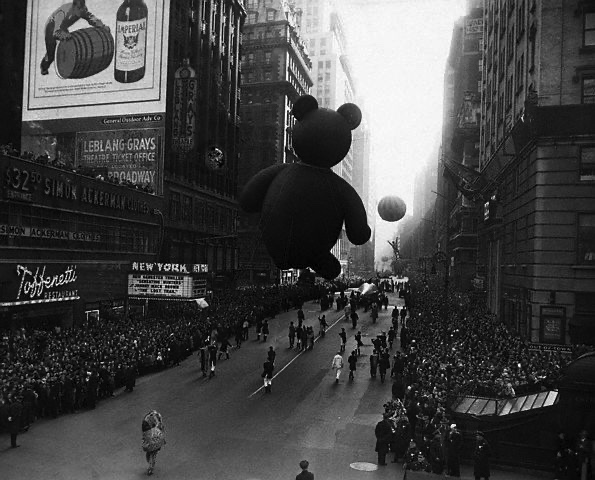
Mr. Macy died in 1877, and the family owned and operated the business until 1895 when Isidore and Nathan Straus purchased it, keeping the name and the star logo. In 1902 they moved the business to Herald Square at 34th Street and Broadway, where it remains the flagship store. In 1924, the staff put together a parade which included animals from the Central Park Zoo, circus performers, marching bands and member of the store in brilliant costumes. Santa arrived at the end of the parade and sat on a throne on the balcony of the store. The parade started at 145th street, and ended at 34th. 250,000 people attended that year. It was a great success, and in early 1925 they decided to move it to Thanksgiving Day, the start of the holiday shopping season.

1930–image by Bettman/CORBIS

In 1927 Macy’s added floats to the parade. They also decided that it would be better to use balloons rather than animals in the parade. Mickey Mouse was the first, and favorite large balloon, though Felix the Cat was a close second. During the 1930s, when they got to the end of the parade, those in charge would simply let go of the balloons and watch them fly away. After the war, they felt that it would be better to deflate the balloon and keep them for the next year. By 1932, people in the area who couldn’t attend the parade were able to listen to it on the radio. The last parade before the war was in November 1941. Between 1942 and 1944, rubber and helium were needed for the war effort.

The parade returned in 1945 and continues to this day. Several things turned the Macy’s Day parade into a national event. The first was the movie Miracle on 34th Street in 1947 with Natalie Woods, Maureen O’Hara and John Payne that included scenes from the 1946 parade. And 1948 was a banner year–the first time the parade was on TV. (Black and white until 1960 when it was in color) This Thanksgiving, the parade will start just a few block from Herald Square. It will still be all three hours–9am to 12 noon–but you’ll only be able to see it on TV or on-line. No one will be on the parade route. But there will still be the balloon, the floats, a number of stars, dancers, and of course, Santa. Everyone involved will be taking all possible precautions. When things get back to normal–and I personally do believe it will–you’ll be able to tell your grandchildren what the parade looked like in 2020.

Happy Thanksgiving to you all!!

Photo by August de Richelieu on Pexels.com

Everybody’s out of step but Jonny!

Here’s an apocryphal story that I’m sure you’ve heard many times. During a 4th of July parade a mother was terribly proud that her son, Jonny, was marching. As he came into view the mother started jumping up and down and waving. The people around her didn’t say anything, but they all saw that Jonny was completely out of step. She didn’t care. She kept waving and, pointed to the boy, loudly told everyone near her that “everyone’s out of step but my Jonny.” I have a feeling that that’s exactly when the US is currently doing. Despite the fact that most nations in Europe and Asia have new restrictions because of spikes from the virus, they have sent their children back to school. Of course they have made significant changes and upgrades to keep both the children and their teachers safe, but they are back in school.

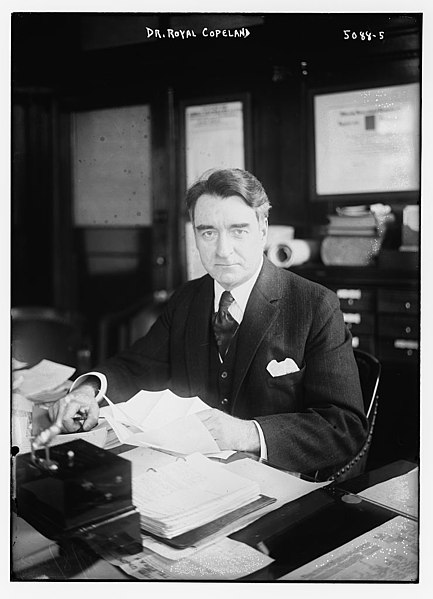
Dr. Royal S. Copeland

I was curious to see if New York shut the schools in 1918. Nope. When the second wave started in September 1918, Dr. Royal S. Copeland, New York City’s Health Commissioner and Dr. Josephine Baker, the Director of the Department of Health’s Bureau of Child Hygiene decided that children would be better off in school. At that point there were 1 million children in the New York City schools, and 750,000 of them were living in tenements, or other areas of the City that were crowded, not properly ventilated, and not particularly safe. Copeland and Baker believed that it would be much better to have the children in school which was safer, cleaner, had proper ventilation, and in some cases feed them, and where the teachers could routinely make sure they were well. If not, the school nurses would take them home, or if need be, to the hospital.

Copeland’s rational was that the teachers could keep explaining to the children how to behave during the pandemic. (Same thing as today–wear a mask, watch your hands frequently and keep your distance) In addition, there was no such thing as day-care in those days, and in many families, both of the parents had to go out work, or there would be no food, and no rent. (Equally true today) Staying in school would keep the children safe, at least for much of the day. It was also another way to help with medical surveillance .

Dr.John D. Robertson

New York wan’t the only city which kept the schools open. Dr. John D. Robertson, Chicago’s Health Commissioner, also decided to keep the schools open during the Spanish Flu. 500,000 children attended Chicago’s schools, and like Copeland, Robertson was convinced that it was better to keep the kids in school rather than have them at home by themselves or out on the streets. As the weather got colder, the custodians would raise the heat, and keep the windows open. Some parents decided to keep their children home, so the teachers simply spread the children further apart. Robertson was convinced that the parents kept the children home because of “Fluphomia.”

New Haven, Connecticu’s Health Commissioner, Dr. Frank Wright, did much the same as New York City and Chicago. Here too, a number of parents decided that they would prefer to keep their children home, and again the teachers spread out the desks for the rest of the children. The City Fathers felt it was important to keep the schools open, even though some of the teachers were also absent, either because they caught the flu, or simply decided not to go in.

Fast forward 102 years. Apparently parents, administrators and politicians in the rest of the world agree with Copeland, Robertson and Wright, and are confident enough to send their children to school. Researchers have found significant evidence that young children are not “spreaders.” They have also found out how truly destructive it is for children to be out of school, not just for their education, but also for their emotional and societal well-being and growth. Ask our own CDC or the American Academy of Pediatrics. For the past seven months everyone from mayors to governors have been telling us to follow the science–why don’t they?! Don’t believe me? Take a look at comments from the head of the CDC, and the head of CDC’s Mental Health section. It’s time to move beyond political fighting between mayors and governors and unions. What’s more important to them than our children? In Italy all children from ages 3 to 11 go to school every day. And in the UK all children, including little Prince George and Princess Charlotte go to school. If it’s safe for the third in line to the British throne to go to school, why can’t our children? I guess everyone’s out of step but the US.😱

Guadalcanal Diary (movie)

Guadalcanal Diary–a movie based on a memoir written by war correspondent Richard Tregaskis. Why am I posting about a movie made 77 years ago, when there are so many current issues that need our attention? Because I’m done hearing words like defund, defame, slander, woke, and on and on. And there is absolutely NO excuse for any elected official to tolerate violence from either the right or the left. Whether we’re happy or furious with the election, we are all Americans and as such, we must treat all Americans with respect. The Marines at Guadalcanal came from every walk of life, every state of the Union, every denomination (or no denomination), had dropped out of school or held advanced degrees, had voted for Republicans or Democrats, and none of it mattered to them. They were Americans. Would they be proud of any of us today????

So what about Guadalcanal Diary? The movie is one of the most intense and realistic films that ever came out of the war, and actually was opened on November 5, 1943, just months after the end of the campaign that lasted from August 7, 1942 to February 9, 1943. Guadalcanal is one of a chain of islands in the eastern Solomon Islands. After the Battles of the Coral Seas and Midway, the US began its “island hopping” campaign to eventually reach Tokyo.

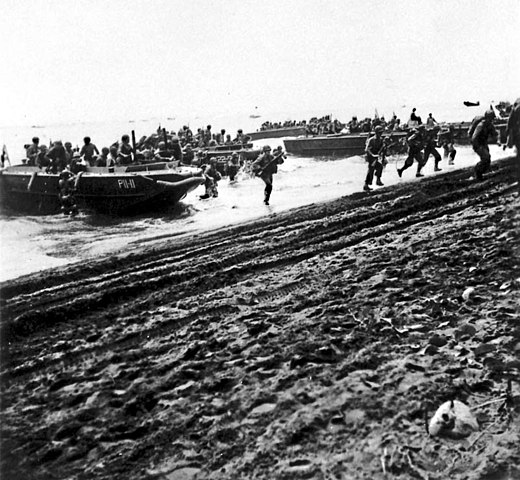
1st Division, USMC landing at Guadalcanal, August 7, 1942

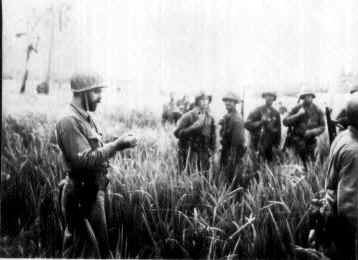
Seventy-five warships and transports arrive at Guadalcanal, with 11,000 Marines, led by MajGen. Alexander A. Vandegrift. They surprising the Japanese in what’s known as the “Midnight Raid of Guadalcanal.” They quickly secured the area around Lunga Point and found that the Japanese had been in the process of setting up an airstrip. The Marines immediately took charge of it, renaming it Henderson Field. By August 30th there were Wildcats, Dauntlesses, Aircobras and assorted other planes, all part of the Cactus Air Force (Cactus was the codename of Guadalcanal). They would attack ships in the “Tokyo Express” which were delivering men and materiel from Rabaul to the Guadalcanal, as well as provide support for the Marines.

On the 8th, it became clear that Japanese aircraft and naval vessels at Rabaul were close enough to do significant damage to the Americans. Seamen and Marines off-loaded as much of the supplies as possible, but the Navy sailed away early on August 9, taking with them roughly half of the supplies needed by the Marines. That left some bad feelings for years. In defense of the Navy, one Australian cruiser was sunk and three US cruisers and two destroyers were badly damaged that same night in what’s called the Battle of Savo Island. Over the following months tens of ships sank into what we still call Ironbottom Sound.

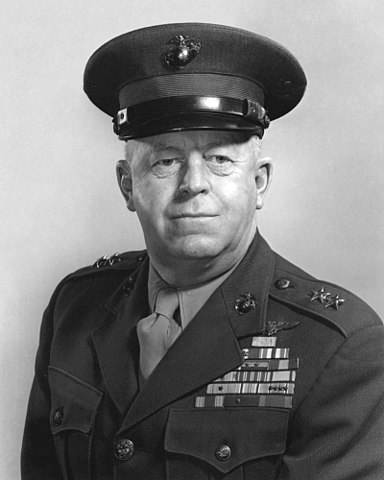
BGen. Merritt Edson

Over the next four month, the Japanese attempted to retake Guadalcanal, while the Americans kept expanding their perimeter. During the Battle of Tenaru on August 21, the Americans counterattacked several companies of Japanese infantry, killing two-thirds of then near the Lunga River. Early in September, coast watchers informed the Marines that the Japanese were planning another massive raid. Major “Red Mike” (Merritt) Edson and his men carried out several raids, bringing back information that 3000 Japanese were planning to move from Lunga River to Henderson Field. With that, he and more than 800 Marines took up their places on what became know as Edson Ridge. Over the next three days, the fighting on and around the Ridge was brutal—often hand-to-hand. By the 14th, when the Japanese began to pull back, they had lost 850 men—the Marines has lost 104.

Henderson Field

The Marines began strengthening and expanding their perimeter, with sporadic Navy convoys bringing much needed supplies and ammunition. At the same time, the Japanese were moving 20,000 troops from Rabaul to Guadalcanal. By October 17, they were ready to take Henderson Field. They were expecting about 10,000 US troops. Actually there were about 23,000 Americans. The fighting began on the 23d and for the following two nights there were constant attacks all around the Lunga River. A few Japanese troops even managed to break through to the airfield, but the Marines, some Army infantry, cooks, Navy medics–anyone who could use a rifle–won the Battle of Henderson Field.

Group of Carlson’s Raiders, Guadalcanal

From there, the Marines went on the offensive, and by early November the Japanese were trying to blend into the jungle. By the 12th the remaining Japanese were at Koli Point. Evan Carlson (of Carlson’s Raiders) made a 29-day trek along the expanding American perimeter, carrying out a number of small engagements and forcing the Japanese to constantly retreat. By the time the Japanese had returned to the Lunga River, only 700-800 of the 20,000 troops remained.

By the end of the month, the Japanese were truly desperate, with virtually no supplies or food. Intelligence told the US that Japanese destroyers were going to attempt to resupply them. Task Force 64, with four cruisers and six destroyers, attempted to torpedo the Japanese ships, but in just four minutes, the Japanese destroyers turn and torpedo the American ships, severely damaging three cruisers, and sinking one at Iron Bottom Sound during the short Battle of Tassafaronga. Nonetheless, the Japanese realized that they could not retake Guadalcanal. Though they limped along until February the Japanese began to abandon Guadalcanal to the Americans in December 1942.

So watch the movie and then really, honestly think about how we are acting. Are we really trying to work together, or prefer to tear the nation apart? And if you want some additional information, you can read Tregaskis’ book. It really gives us something to think about this Thanksgiving.

Happy Birthday Marines! 🥳

Tun Tavern, November 10, 1775, saw the birth of the United States Marine Corps. So many of us think of Marines at Belleau Wood, Iwo Jima, Inchon, Da Nang and Fallujah, but Marines have been in so many more areas of the world. Sometimes it’s been in battle, but frequently they went to show the flag. One long-forgotten diplomatic mission happened in 1903-1904 in Abyssinia (Ethiopia).

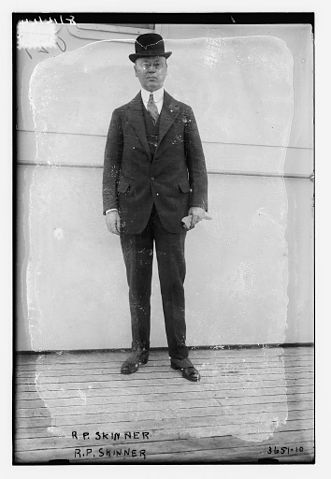
In the summer of 1903, the US decided to establish relations with the nation of Abyssinia. Few people knew much about it, though it was a well functioning nation which had actually defeated the Italians in 1894 when Rome thought it would be a cake-walk to seize the Abyssinia. The US much preferred to be a trading partner. The State Department told Consul Robert P. Skinner, then in France, to travel to Addis Ababa, capital of Abyssinia, and develop a treaty.

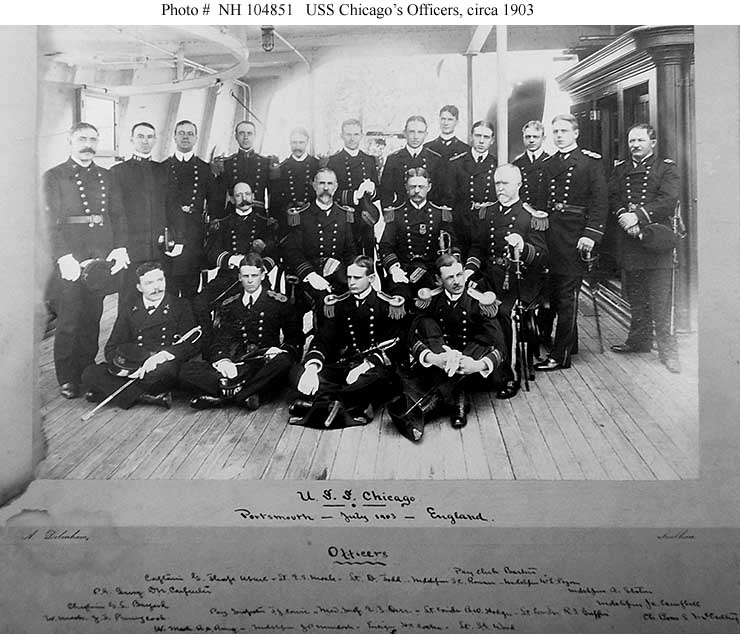
At that same time, the U.S.S. Brooklyn, U.S.S. San Francisco, and U.S.S. Macias were off the coast of Beirut, and they were ordered to put together a detachment of Marines, with a few seamen, to join Skinner on his trek to Addis Ababa. Lt. Charles L. Hussey, USN led the party. With him was Capt. George C. Thorpe, USMC, one sergeant, two corporals, 14 privates, six sailors, one hospital steward, a coxswain and an electrician. They sailed aboard Macias through the Suez Canal and down the Red Sea to Djibouti in what was then called French Somaliland. There they met up with Skinner and his secretary, Horatio Wales.

From Djibouti they took a rickety, narrow-gauge train about 200 miles to the end of the line at Dire Dawa, which was filled with mud huts, a telegraph office and a telephone exchange. There they set up Camp Scott. The following day they enlisted a translator, and bought 45 mules and 46 camel for their 300-mile trek to Addis Ababa. Shortly after they started their journey, they received a message from Ras Mekonnen asking the Americans to make a 32-mile detour to Harrar. As the most trusted counselor to the Emperor Menilek II, and the man who had defeated the Italians at the Battle of Adwa, that was a “command performance.” The Ras and 100 of his soldiers met the Americans just outside the city, and led Skinner and the entire detachment in to Harrar. The Consul and the translator spoke at length with Mekonnen and the following day returned to Dire Dawa. They finally headed out to Addis Ababa on November 29.

Most of the camel and mule handlers were members of the Danakil tribe, who were more warriors that muleteers. At one point, the man in charge of the animals told Thorpe to head in a different direction. When Thorpe insisted that they follow the American’s route, the man pulled a knife on the Captain. He and another Marine grabbed the knife. The man then snatched one of his own men’s spear. The Marines grabbed that as well, at which point the man gave up, flopped on the ground crying and carrying one—and then got up and started heading in the right direction.

Things went well until the evening of December 3d when the Danakil and what seemed to be a large group of men in the area began to threaten the Marines. Hussey, Thorpe and Skinner were discussing whether they might need to fight their way back to Dire Dawa when they started hearing very loud voices in a language even the translator didn’t understand. There seemed to be numerous people wandering around the area. Thorpe and his men formed a skirmish line and were seconds away from moving out when the clouds moved and they saw a huge number of monkeys who took one look at the Marines, and fled.

Marine Captain George Cyrus Thorpe is fourth from the left of the group standing

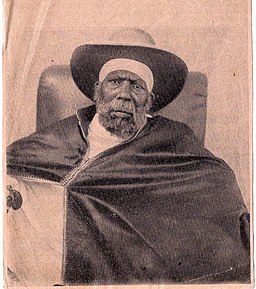
They trekked on across the grassland, until early in the morning of December 18, when they arrived about a mile away from Addis Ababa. Taking some time to change into their dress uniforms, they were met by Abyssinian troops and a group of Emperor Menilek II’s counselors, all dressed in brilliantly colored uniforms and the cavalry riding a variety of animals from Arabian steeds to zebras. After a “formal picnic” the Americans were escorted into Addis Ababa straight to the Geubi, the Emperor’s palace, where they met Menelik II. After a 21-gun salute and shaking hands will all the Americans, Skinner presented the Emperor with a large silver tray engraved with an invitation for Abyssinia to join the Louisiana Purchase Exposition in St. Louis in the spring of 1904. The Emperor immediately agreed. After some additional discussions with Skinner, the Emperor withdrew and the Americans marched to another palace to the tunes of Hail Columbia and the Marseilles.

Skinner and the Emperor continued their talks the following day. They agreed to establish diplomatic relations, and agreed to Most Favored Nations status between the two countries. Later that day, the Americans met diplomats from Italy, Great Britain and Russia, as well as the Abuna, Archbishop Mathias, the head of the Coptic Christian Church, and one of the most influential men in Abyssinia. On the 23st the Americans attend a mpressive banquet. The following day Emperor visited Camp Roosevelt, where he watched the Marines parade and Thorpe put his men through the Manuel of Arms and Bayonet exercises. Cpl. Joseph Rossell (later Colonel, USMC) showed the Emperor the Krag-Jorgenson rile, disassembling it, answering Menilek’s technical questions, then reassembling it at breakneck speed, loading it with blanks, and handing it to the Emperor who enjoyed shooting over the heads of some of his own men.

Emperor Menelik II

After additional discussions, Menilek and Skinner signed the treaty on December 27. The Emperor then presented each Marines and Seamen with the Menilek medal, and presented Hussey and Thorpe with the Star of Ethiopia medals, and two spears. As they were about to leave, the Americans were also presented with two massive elephant tusks, and two lion cubs to be presented to his friend, Theodore Roosevelt. The camels which were to carried the cubs in large baskets were terrified. Camels and lions don’t mix, but eventually they relented and carried the cubs, swaying along, back to Dire Dawa. (One of the cubs became terribly seasick because of the constant swaying, and eventually died. The Emperor replaced it, and both lions spent the rest of their days at the National Zoo in Washington, D.C.) By January 15, the Americans were back in Djibouti, boarding the Macias, and heading back to Beirut. Mission accomplished.

SEVEN DAYS IN MAY . . . Book, Movie, or Both?

I’m sure you’ve figured out by know that I read–a lot! But I’ll also confess that I’ve only stayed up all night reading twice–one of the two books was the novel Seven Days in May by Fletcher Knebel, and I’ve read it a number of times since then. It was also made into a movie, and while I’m not a film connoisseur I’ve seen it several times. Last night, through the wonders of the internet, I went on-line and watched Seven Days in May again, probably for the fifth time since it came out in 1964. This morning I got the book out and will start rereading it after dinner. I’m not certain which is better–the book or the movie.

Either way, as we come toward the end of a grueling election campaign, the novel/movie, in many ways, may give us pause and serious thought about what’s gone on over the past three years–and how it might end. For those who haven’t read the novel or seen the movie, here’s a quick synopsis. After a very close call between the US and USSR, in something similar to the Cuban Missile Crisis, the American President (played by Frederic March) concluded that the two nations must begin nuclear disarmament. The Soviets agree and both sides sign a significant treaty. However, a few men in the Pentagon (led by Burt Lancaster) and other parts of the government violently disagree, and set about staging a coup d’etat against the President. One man, a Colonel working in the Pentagon (Kirk Douglas), finds out about the coming coup, and alerts the President. It’s a stark, compelling book/film of true political intrigue. (Spoiler alert–the good guys win in the end 😇)

It is such a good read that even I, who very rarely reads novels, was totally engrossed. It’s not a standerd action movie, but you can still end up on the edge of your seat. Ultimately, either the book or the movie is wonderful in its own right, and both give us a lot to think about.

Where were you during the ……….. Cuban Missile Crisis?

First of all, why am I asking? Because the Cuban Missile Crisis started on October 16, 1962–58 years ago this Friday. I remember where I was (but then I old🧓.) I was in the sixth grade as Wyoming School. Though it started on the 16th, the nation didn’t hear about it until Monday the 22nd, when President Kennedy delivered an address to the nation.

Aerial Photo of start of Soviet launch site

By early 1962, US intelligence found that Soviet advisers, missiles and aircraft was arriving in Cuba, and by May it was clear that Fidel Castro was allowing up to 60 medium and intermediate nuclear missiles, along with tons of equipment, to set up in Cuba. The missiles were carried on the decks of transport ships–all nicely covered to prevent detection. Of course, the 42,000 troops had to stay below-deck, where it was sweltering in the summer Caribbean heat, lest the American see them.

Premier Nikita Khrushchev

Soviet Premier Nikita Khrushchev was hoping that he could have the missile batteries up and running before the Americans found out. At the height of the Cold War it would have been a signifiant coup for the USSR to have a toe-hold so close to the US. Khrushchev also hoped that it would help pivot the West away from Berlin, where less than a year ago East Germany and the Soviet Union had build the Berlin Wall. And we shouldn’t forget that Castro was still furious over the aborted Bay of Pigs invasion, and would be happy to assist the Soviets.

However, a Russian defector, Colonel Oleg Penkovsky, had provided significant intelligence to the CIA. In addition, aerial reconnaissance, and information from people on the ground indicating that MIG-21 fighters and Il-28 bombers were already in Cuba. The first group of missiles arrived on September 8. CIA Director John McCone sent a memo to President Kennedy describing that they had found. It would have been useful to send a U-2 to get additional data, but the US had decided to pause the spy planes because the Soviets had caught sight of them. The five-week “Photo Gap” from September 8 to early October came at a bad time, since it became clear that the Russian troops were setting up batteries of SS-4 and SS-5 medium-range nuclear missile.

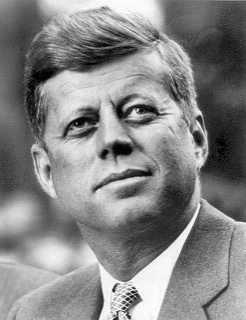
President John F. Kennedy

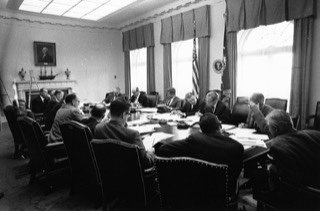
Early in October, JFK and his Executive Committee (ExComm) concluded that a total of 40 missiles was standing up in southern Cuba. Some members of ExComm tended to be Hawks, suggesting that the US should make a first strike against the missiles immediately, followed by an invasion of Cuba, making sure the missiles were disarmed, and possibly end Castro’s reign at the same time (remember this was little more than a year after the Bay of Pigs). On the other hand, the Doves of the ExComm wanted to be extremely measured. Kennedy decided to follow what he called Flexible Response. US Navy ships quietly moved toward Cuba. As US ships took up their positions, they were ordered to use a warning shot if Soviet ships approached. If the warning shot didn’t stop them, the Americans would foul the rudder of any oncoming ships. Later US intelligence found that Soviet vessels were told to return fire if the Americans got too close.

Executive Committee (EvComm)

On the evening of Monday, October 22, the President spoke to the nation explaining that the Soviets had brought nuclear missiles to Cuba, just 90 miles from Florida. They must leave. He imposed a quarantine (really a blockade, but the word “blockade” technically can mean war). The US went on DEFCON 2, (defense readiness condition) the second highest alert status, and 550 B-52 bombers from Strategic Air Command (SAC) were on high alert. You can imagine school the next day! We were the “big kids” and understood at least the main issue. Several parents kept their children home. Looking back, it might have been nice to be one of the little kids–they were blissfully running around playing tag, and thought that the air aid drills were fun.

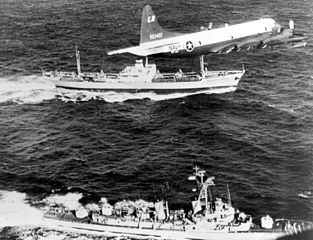
US Navy P-3 over Soviet ship Metallur Anosov and USS Barry

Both Kennedy and Khrushchev were micro-managing the situation, trying to avoid a nuclear war. It didn’t take long for the Soviets to see that the US wasn’t going to budge. Ninety miles from Florida was too close for the US to ignore. Late in the evening of the 24th, Khrushchev sent a message saying that Soviet vessels would move out of the quarantine area. The following day, he sent a personal message to JFK saying that the USSR would remove the missiles from Cuba if the US promised not to attack Cuba. Later that day, Khrushchev followed up by saying again that they would remove the missiles from Cuba, as long as the US wouldn’t attach Cuba, AND remove the Jupiter missiles which the US had in Turkey. Which was it? Was the USSR going to remove the missiles and sail away? Or would they need that quid pro quo (see… like I’ve said before, quid pro quos are used all the time!!) that they would only remove their missiles in Cuba if the US removed the Jupiters from Turkey.

Black Saturday, October 27th, was the height of the Crisis. One of the Soviet missile shot down a U-2 plane.

Jupiter missiles

At that point, Kennedy simply ignored the Soviet’s second letter and agreed that the US would not attack Cuba as long as the missiles were removed. However, in truth the Jupiters were obsolete and were going to be removed fairly soon anyway, so the US used back-channel discussions to agree to remove them.

Kennedy’s popularity went through the roof. In the Soviet Union, Khrushchev seemed to have also achieved a victory, but behind the Kremlin walls it was clear that his days were numbered, and he “retired” in 1964. Both sides had scared themselves in starting talks for nuclear disarmament. Tensions in Berlin slowed, though they didn’t truly end until the fall of the Berlin Wall. And on August 30, 1963 the US and USSR announced a direct phone line called the “Hotline,” making it possible for Cold War leaders to be in touch quickly, and hopefully avoid another Crisis like that of October ’62.

The Magnificent Yankee (film)

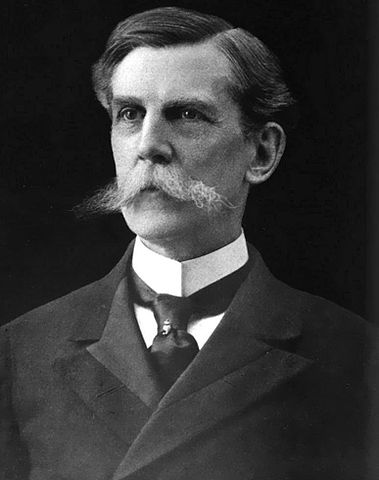
With Associate Justice Ruth Bader Ginsburg’s passing, all eyes are on the Supreme Court. Only 114 people have sat on the Court since 1789. We know little about some of them, but others like John Marshall, Thurgood Marshall, and Sandra Day O’Conner, have been outstanding both as jurists and as individuals. One titan of the Court who we tend to overlook in the 21st century was Oliver Wendell Holmes. We briefly studied him in high school, and I remember that there actually was a movie about him, so I checked it out. Made in 1950, The Magnificent Yankee actually is a film about the man and only tangentially about the body of his work.

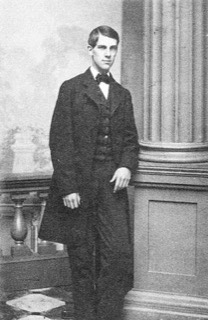
Oliver Wendell Holmes c.1861

Since the film begins with Holmes arriving in Washington D.C. to take his seat on the bench, we should have a bit of the back-story. He grew up in Boston in an Abolitionist family, and in the spring of 1861, just a few months before his graduation from Harvard University, he received a commission as a Lieutenant in the 20th Regiment of the Massachusetts Volunteer Cavalry. He served in the Peninsula Campaign, Battle of Fredericksburg, the Wilderness Campaign, Antietam, Balls Bluff and Chancellorsville. He was wounded twice and nearly died from dysentery. He returned to Boston as a Brevet Colonel when the the Regiment disbanded in 1864.

Fanny Bowditch Dixwell Holmes

After passing the bar in 1866, he went into private practice, and married Fanny Bowditch Dixwell in 1872. During those years, he was the editor of the American Law Review, and wrote The Common Law, first printed in 1881, and still in use. In August 1899 Holmes became the Chief Justice of the Massachusetts Supreme Judicial Court. Barely three years later, Teddy Roosevelt nominated him to the US Supreme Court, and the Senate confirmed him on December 4, 1902.

On the Court, he worked on the Insular Cases, Northern Security Co. v. US, Otis v. Park, Schenk v. US, and numerous other high profile cases. In the years he served on the bench, he wrote many of the 853 majority opinions, but was known as the “Great Dissenter” with his 72 dissenting opinions–most of which he wrote. His fellow jurists believed that Holmes was a fantastic writer in both dissent and majority opinions. He retired at the age of 90, having spent 29 years on the Supreme Court. Being too elderly to attend the inauguration in 1933, Franklin Roosevelt and his wife, Eleanor, visited him immediately after the ceremony. Holmes died of pneumonia on March 6, 1935, just two days short of his 94th birthday.

Associate Justice Oliver Wendell Holmes

The film focuses on the man more than the Supreme Court, though the viewers get a good idea of Holmes’ approach to the law and to many of his friends and colleagues. His butting heads with Teddy Roosevelt, his polite but frustrating conversations with Charles Francis Adams, Jr., his clerks who were “his sons,” and his, and Fanny’s, long-time close friendship with Louis Brandeis provide us with a good understanding of Holmes the man, and an insight to one segment of Washington D.C. at the turn of the 20th century. One of the most important scenes comes at the end of the movie, when Franklin Roosevelt went to see him. Holmes tells his secretary that while he’s a Republican and Roosevelt is a Democrat, he is also the President, so he will show the President the deference he deserves. Rather different from the way people tend to behave in the 21st century. Maybe we should thing about that.

If you’re interested in a solid book about Oliver Wendell Homes, take a look at: Catherine Drinker Bowen, Yankee from Olympus.

The World’s a Whirling Dervish

I know the world turns on its axis once every 24 hours, but sometimes it seems to go faster. Between the pandemic, lock-downs, protests, riots, wild fires, hurricanes, and the election, no sooner do we learn what’s going on, than the next problem is front and center. It was nice to find out that something good actually happened! It was on the radio, TV and online on August 13, but since then you really have to look for any additional information. What was it? The US brokered a deal between Israel and the United Arab Emirates (UAE). That is a BIG deal–the third time since 1948 that a Middle Eastern nation will be work with Israel rather than against it.

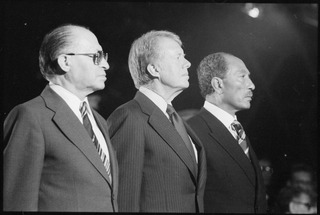
President Sadat, President Carter and Prime Minister Begin at Gettysburg (C7329-3a)

From 1948 until 1978, there was continuous tension in the Middle East, punctuated by the Suez Crisis (that makes me feel old)–the 6 Day War (1967) and the Yom Kippur War (1973). The Geneva Peace Conference of 1977 stalled after months of negotiations. What stunned everyone was when President Anwar Sadat of Egypt told his parliament that if invited, he would speak to the Israeli Knesset. He did get an invitation from Israel, via the US, and at the end of November, 1977, Sadat spoke to the Israeli parliament. Both nations had their own reasons for discussions–that’s for another time–but by the middle of 1978 President Jimmy Carter invited both men to come to Camp David to broker a peace.

Prime Minister Begin, President Carter and President Sadat

Some people consider President Carter to be a rather mild, sensitive man. Maybe. But his is an outstanding mediator! From September 5 to the 17th, Carter did a kind of shuttle diplomacy, walking from cabin to cabin, discussing, cajoling, bargaining–doing whatever he needed to to keep both men talking. By the 10th day they had arrived at an impasse. In a “Hail Mary” attempt, Carter took them to the Gettysburg National Military Park where they spend more than two hours learning about the actions. The carnage of Gettysburg wasn’t lost on the men. They signed “A Framework for the Conclusion of the Peace Treaty between Egypt and Israel,” on September 17th, and finalized the treaty at the White House in March 1979. It was not a perfect treaty, but it was an enormous breakthrough in Middle East peace.

King Hussein, President Clinton and Prime Minister Rabin

It was fifteen years before there was another peace agreement. Shortly after the first Oslo Accords (1993) King Hussein of Jordan discussed the possibility of some type of relationship with Israel with both Hosni Mubarak of Egypt (go for it) and Hafaz Assad of Syria (forget it). In the end, the King felt it was time to try to make a formal peace with Israel. Again the US provided the venue where King Hussein, Yitzak Rabin and President Bill Clinton signed a non-belligerent pact at the White House on July 25, 1994. Three months later they signed the final Jordan-Israel Peace Treaty at the border near Wadi Araba on October 26th. Egypt was pleased with the treaty. Syria simply ignored the whole thing. However, 20 minutes before the signing, Hezbollah, the Iran-backed terrorist group based in Lebanon, launched rockets and mortars into several Israeli settlements in Galilee. That had become a standard problem, so as the Israelis moved into more secure areas, they took their radios with them so they could listen to that historic event.

That brings us to 2020. For over a year before Covid-19 raised it’s ugly head, the US had been working behind the scenes with both Israel and the UAE to put together a working arrangement for both countries. On August 13, President Trump spoke with both Prime Minister Benjamin Netanyahu and Crown Prince Mohammed bin Zayad al Nahyan of the UAE to “sealed the deal.” Known as the “Abraham Accord,” it opens full diplomatic relations between both parties. Why? Several reasons. It turns out that there has been a lot of commerce in the recent past between both countries, which had to be done through third parties. (What a huge waste!) Much more concerning is the fact that the UAE, along with Saudi Arabia and a number of other Arab states, are Sunni Muslims, as opposed to Iran, which is Shia. This has caused seriously strained relations in much of the Middle East. The UAE believes it is in their best interests to work in the open with Israel.

Both parties have not wasted any time. On August 16, they opened telephone service between the UAE and Israel. They are working to establish commercial flights, and are in talks with Saudi Arabia to arrange for overflight. Israel and the UAE have signed agreements between more than 40 tech companies in both nations to work together to help defeat Covid-19. They are also working to set up a “chamber of commerce” or another professional organization to expand bilateral enterprises, and talks regarding trade, tourism, health, aviation and energy are all moving along quickly. At the same time, a number of other countries such as Bahrain and Oman are looking into the possibility of working with Israel on some level. Having a continuing improvement in relations throughout the Middle East would be welcome on almost every level. It will also put pressure on both Iran and the Palestinian Authority to finally start negotiations in earnest. Hopefully we’ll start seeing updates on page one soon.

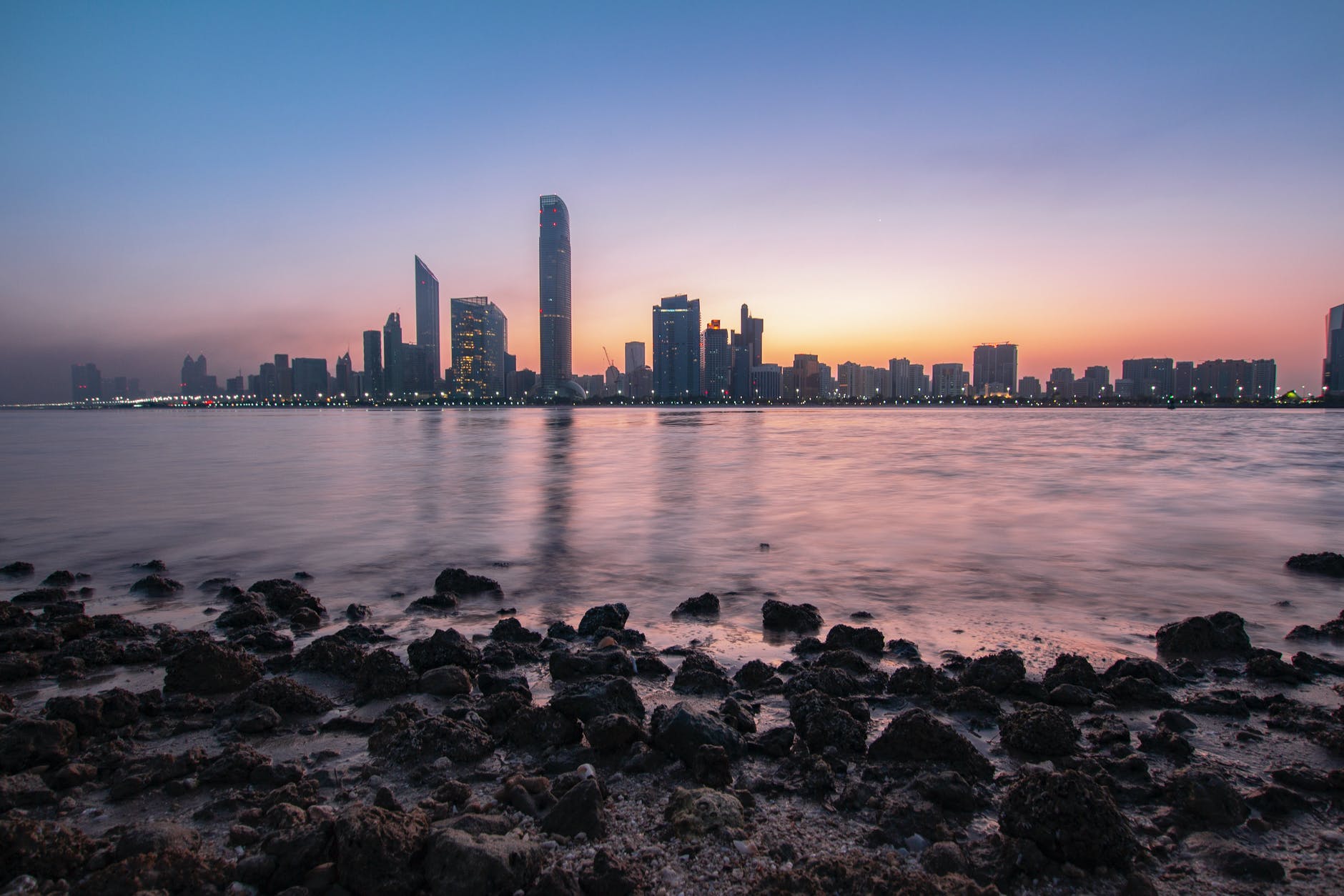
Abu Dhabi, U.A.E. Photo by Kevin Ponce Villaruz on Pexels.com