I was completely surprised when I turned on the radio at lunchtime yesterday and hear that General Colin Powell had died from complications of Covid-19 while battling Multiple Myeloma. He has been a fixture in the American military and political life for fifty years. His hair got a little grayer, but his thoughtful, incisive approach to everything he does, his true decency for people in every walk of life, has made an impressive mark in our country. People in the current corridors of power could take a few lessons from him.
General Powell was born in New York City in April, 1937, to parents who had immigrated from Jamaica. He grew up and went to public school in the South Bronx. He didn’t really know what he wanted to do, so he went to City College of New York (CCNY), and while he was there, joined the ROTC. He graduated in 1958 and was commissioned as a Second Lieutenant in the US Army. He fought in Vietnam, and went on to a variety of infantry and staff positions, including as US Security Adviser (1987-89).
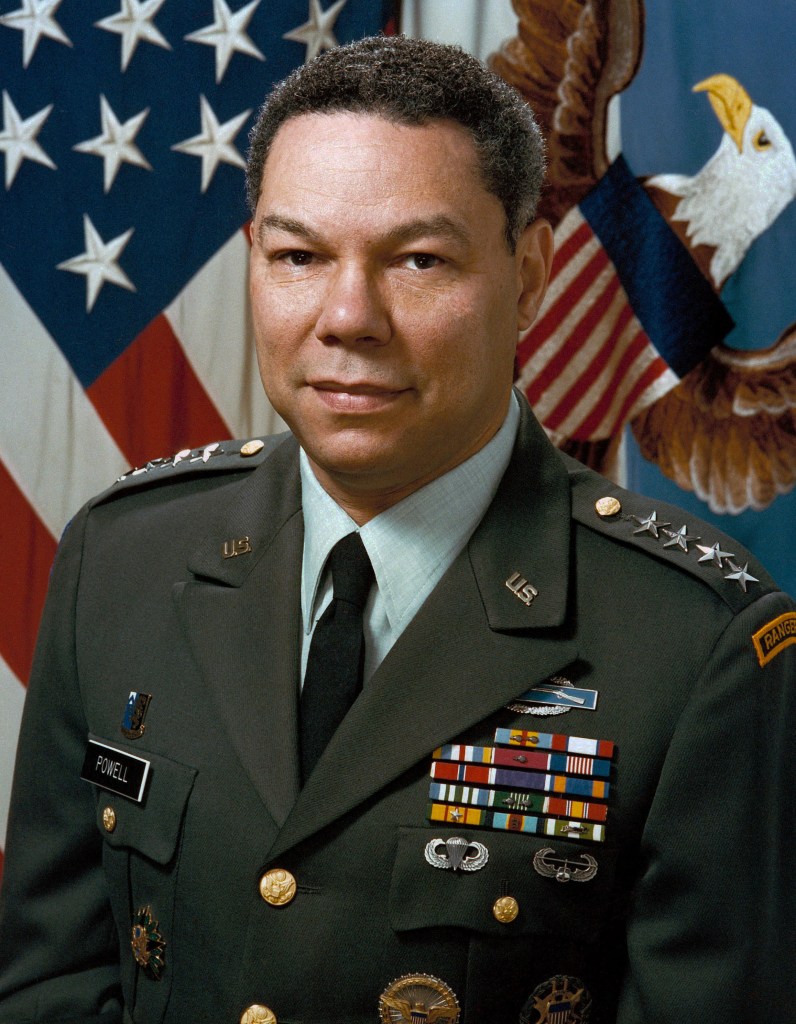
Chairman of the Joint Chiefs of Staff Colin Powell
Powell ending his military career as a Lieutenant General and Chairman of the Joint Chiefs of Staff (1989-93). During those years he was intimately involved in a number issues, particularly the invasion of Panama, and Operation Desert Storm. During this period he developed what we now call the Powell Doctrine. There would be no military action unless 1) it was truly necessary for US security 2) the US would use massive force and 3) there was significant public agreement.
After his retirement in 1993, he was invited to give numerous speeches, and attend a variety of seminars and conferences, but most importantly, he chair America’s Promise–Alliance of Youth, a non-profit organization to involving people in all walks of to build character and competence for young men and women. (He has remained involved in the organization throughout his life.)
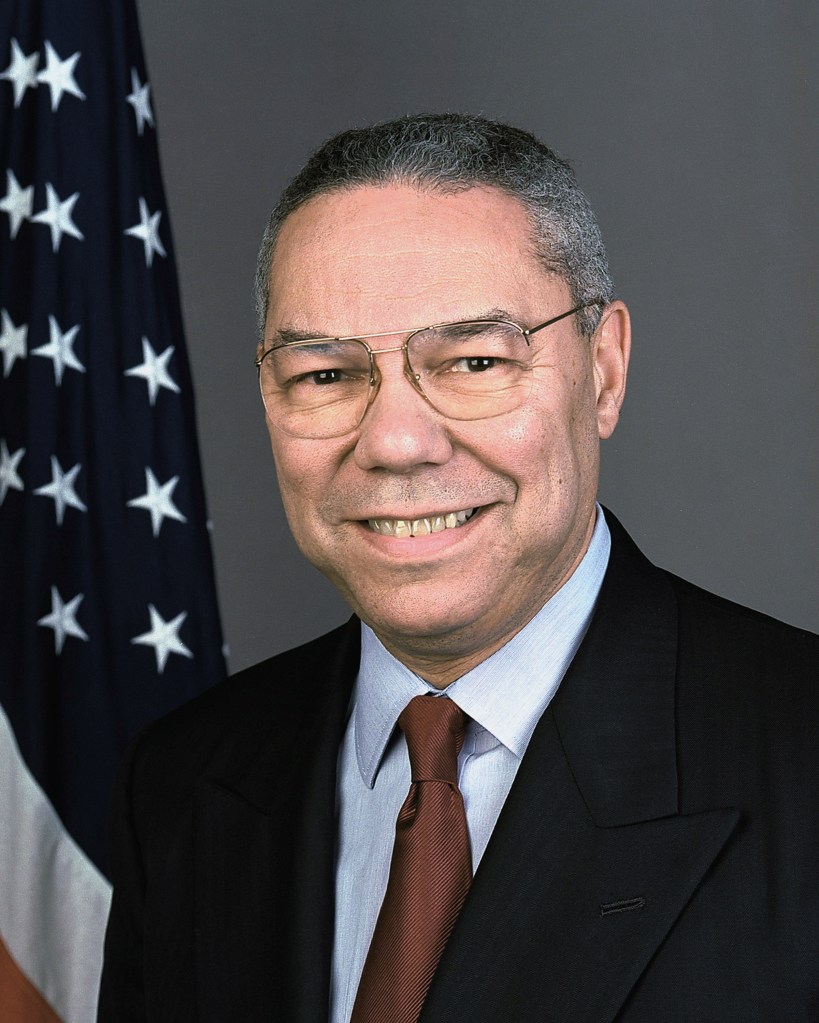
Secretary of State Colin Powell
Retirement didn’t last that long. He had been so important to so many US Presidents that in 2001 he became the first African American Secretary of State. The Senate confirmed his unanimously. Unfortunately, he started his work just months before 9/11 when everything changed for the US. Powell did a stellar job of dealing with the US’s relations with foreign nations, trying to put together a sound coalition for the War on Terror. However, he was in a very difficult position when dealing with the 2003 invasion of Iraq, and he resigned in November 2004.
Since he stepped down from the Chairman of the Joint Chiefs, he wrote two excellent books, but I think we should end this post with part of his second book It Worked For Me. His thirteen lessons can work for all of us.
–It ain’t as bad as you think. It will look better in the morning.
–Get mad, then get over it.
–Avoid having your ego so close to your position that when your position falls, your ego goes with it.
–It can be done!
–Be careful who you choose.
–Don’t let adverse facts stand in the way of a good decision.
–You can’t make someone else’s choices
–Check small things.
–Share the credit.
–Remain calm. Be kind.
–Have a vision.
–Don’t take counsel of your fears or naysayers.
–Perpetual optimism is a force multiplier.
If you’re interested in Powell’s autobiographies or some well-done biographies, take a look at these.
Never hear of him? How about George Orwell? Orwell was the nom de plume of Eric Arthur Blain, and Blain/Orwell wrote numerous works. He’s most remembered by Animal House and 1984.👀
Eric Arthur Blain, nom de plume of George Orwell
Born in India in June 1903 where his father was a member of the India Civil Service, he was brought up in the UK, attending St. Cyprian’s School from 1911 to 1916, and Eton College from 1917-1921. Rather than attend university, he became an officer in the Imperial Police (later known as the Indian Police Service), working in a number of posts in Burma. He resigned while on leave in England after a bout of Dengue Fever, and began his writing career. Orwell wrote a number of books, as well as essays, poetry, and worked as a journalist in both Britain and France. During the Spanish Civil War he served with the International Brigade, where he was badly wounded by a bullet in throat in May 1937. During World War II he wasn’t “fit for service” because of his medical issues, but worked for the BBC’s Eastern Service, broadcasting to India. It was after the war that Blain/Orwell wrote tow pf his most famous books–Animal Farm published in 1945 and 1984 published in 1949. He died in January 1950 from tuberculosis which he’d originally received in the hospital in Spain.
Ever read 1984? I read it in high school. Great book. Then we had to read it again in college. And it was an even better book then, because four years can make a big difference. We had much more general knowledge, and when we read carefully, we could look beyond the story plot. We had a better understanding of what Orwell’s dystopian novel was getting at–things like free expression and mass surveillance. 👀
Then can the movie, 1984–premiered in the UK in 1984. John Hurt, Richard Burton, Suzanne Hamilton and Cyril Cusack starred in the film which received a BAFTA nomination. It followed the novel closely, leaving those of us who watched it thinking seriously about the ways that truth and free speech can be manipulated in a variety of ways.👀 I was teaching my then, and had a great group of grad students who stopped after class one day to discuss the movie, and the parallels between the film’s “Thought Police” 👀 and the “re-education camps” of Pol Pot and China’s Cultural Revolution.👀 It was an excellent discussion, and since then, I’ve often included either the book or movie 1984 in specific syllabi.
For the past five or so years, I’ve required either the movie or the book each year. Why? Because I‘ve been seeing a noticeable shift away from free speech. I’ve been hearing too many people, not only in seminars but even with people I’ve known for years, trying to shout people down.👀 In some areas, books have been banned from libraries.👀 Recently, the university where I earned my Ph.D. tried (but ultimately failed) to fire a professor simply because they didn’t like some of his comments and seminar questions. That’s sounding a lot like the Thought Police👀 from 1984, isn’t it?
Unless I’ve missed something, we still follow all of the Constitution, including the First Amendment that provides free speech for all, not just those who agree with us. Prior generations in my extended family came here to get away from surveillance,👀 intolerance,👀 and suppression.👀 What I heard from the time I was a child, and what I tried to teach my children, was that, “while I disagree with what you say, I will defend to the death your right to say it”—and some of them did just that! I would hope that more of us will remember how important truly free speech is. And if you need a refreshed, take a look at 1984–👀book or movie, it doesn’t matter which.
January 20th is Inauguration Day. That has happened every four years since 1789. And ever since the first Inauguration, the new president has made an Inaugural Address. Some have been far too long. Some short and to the point. Others have been inspiring, while still others have been a boring list of “to does.” I spent the weekend reading, or listening to, a number of them. Both of Lincoln’s addresses are extremely important–and videos of JFK and, yes, Nixon, trust me–are well worth hearing because some of the sections are timeless, and given our current issues, necessary. But if you read only one Inaugural Address, read the first one that’s below.
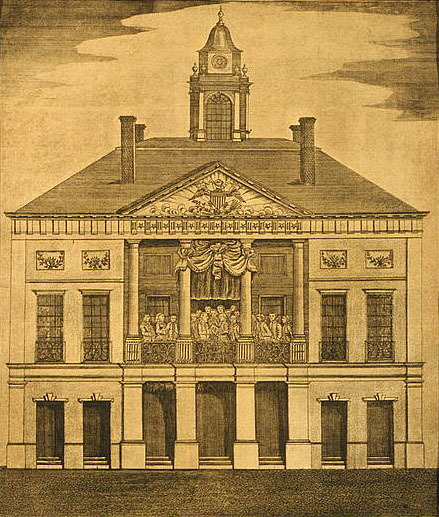
Federal Hall, New York City
Washington’s inauguration was quite different from those in the 21st century. It took a while for everyone to get to New York City, then the capital of the US. Washington arrived at the end of April, 1789, and moved in to his official residence at 3 Cherry Street. People began arriving at the crack of dawn on April 30. The crowd followed him to Federal Hall, where Washington went up to the second story balcony so the throngs could see him. Rather than wearing a military uniform, he wore a simple brown suit with silk stocking, silver buckles, and a red overcoat. Standing alongside members of Congress and the Senate, he held the Bible and took the oath of office from Robert Livingston, the Chancellor of the state of New York. That was followed by massive cheering and a 13-gun salute.
The group then returned to the Senate chamber where the new President delivered his address to Senators and Representatives. From there, they walked up Broadway to St. Paul’s Church where the Rt. Rev. Samuel Provoost, the Chaplin of the Senate and the first Episcopal bishop of New York officiated the service. There were no Inaugural balls at that time, though they did hold a celebration for him on May 7th. The Inauguration continued to be held on March 4 until the 20th Amendment, ratified in January 1933, change the date to January 20, starting in 1937.
So, as I said above, the following is Washington’s first Inaugural Address. Sometimes we can all use a refresher on what the Framers believed was necessary for a democratic republic. Yes, it sounds a little old-fashioned, but I’m sure you’ll understand what he was saying and why we might want to go back to practicing what they were preaching.
Fellow-Citizens of the Senate and of the House of Representatives:
Among the vicissitudes incident to life no event could have filled me with greater anxieties than that of which the notification was transmitted by your order, and received on the 14th day of the present month. On the one hand, I was summoned by my Country, whose voice I can never hear but with veneration and love, from a retreat which I had chosen with the fondest predilection, and, in my flattering hopes, with an immutable decision, as the asylum of my declining years–a retreat which was rendered every day more necessary as well as more dear to me by the addition of habit to inclination, and of frequent interruptions in my health to the gradual waste committed on it by time. On the other hand, the magnitude and difficulty of the trust to which the voice of my country called me, being sufficient to awaken in the wisest and most experienced of her citizens a distrustful scrutiny into his qualifications, could not but overwhelm with despondence one who (inheriting inferior endowments from nature and unpracticed in the duties of civil administration) ought to be peculiarly conscious of his own deficiencies. In this conflict of emotions all I dare aver is that it has been my faithful study to collect my duty from a just appreciation of every circumstance by which it might be affected. All I dare hope is that if, in executing this task, I have been too much swayed by a grateful remembrance of former instances, or by an affectionate sensibility to this transcendent proof of the confidence of my fellow-citizens, and have thence too little consulted my incapacity as well as disinclination for the weighty and untried cares before me, my error will be palliated by the motives which mislead me, and its consequences be judged by my country with some share of the partiality in which they originated.
Such being the impressions under which I have, in obedience to the public summons, repaired to the present station, it would be peculiarly improper to omit in this first official act my fervent supplications to that Almighty Being who rules over the universe, who presides in the councils of nations, and whose providential aids can supply every human defect, that His benediction may consecrate to the liberties and happiness of the people of the United States a Government instituted by themselves for these essential purposes, and may enable every instrument employed in its administration to execute with success the functions allotted to his charge. In tendering this homage to the Great Author of every public and private good, I assure myself that it expresses your sentiments not less than my own, nor those of my fellow-citizens at large less than either. No people can be bound to acknowledge and adore the Invisible Hand which conducts the affairs of men more than the People of the United States. Every step by which they have advanced to the character of anindependent nation seems to have been distinguished by some token of providential agency; and in the important revolution just accomplished in the system of their united government the tranquil deliberations and voluntary consent of so many distinct communities from which the event has resulted can not be compared with the means by which most governments have been established without some return of pious gratitude, along with an humble anticipation of the future blessings which the past seem to presage. These reflections, arising out of the present crisis, have forced themselves too strongly on my mind to be suppressed. You will join with me, I trust, in thinking that there are none under the influence of which the proceedings of a new and free government can more auspiciously commence.
By the article establishing the executive department it is made the duty of the President “to recommend to your consideration such measures as he shall judge necessary and expedient.” The circumstances under which I now meet you will acquit me from entering into that subject further than to refer to the great constitutional charter under which you are assembled, and which, in defining your powers, designates the objects to which your attention is to be given. It will be more consistent with those circumstances, and far more congenial with the feelings which actuate me, to substitute, in place of a recommendation of particular measures, the tribute that is due to the talents, the rectitude, and the patriotism which adorn the characters selected to devise and adopt them. In these honorable qualifications I behold the surest pledges that as on one side no local prejudices or attachments, no separate views nor party animosities, will misdirect the comprehensive and equal eye which ought to watch over this great assemblage of communities and interests, so, on another, that the foundation of our national policy will be laid in the pure and immutable principles of private morality, and the preeminence of free government be exemplified by all the attributes which can win the affections of its citizens and command the respect of the world. I dwell on this prospect with every satisfaction which an ardent love for my country can inspire, since there is no truth more thoroughly established than that there exists in the economy and course of nature an indissoluble union between virtue and happiness; between duty and advantage; between the genuine maxims of an honest and magnanimous policy and the solid rewards of public prosperity and felicity; since we ought to be no less persuaded that the propitious smiles of Heaven can never be expected on a nation that disregards the eternal rules of order and right which Heaven itself has ordained; and since the preservation of the sacred fire of liberty and the destiny of the republican model of government are justly considered, perhaps, as deeply, as finally, staked on the experiment entrusted to the hands of the American people.
Besides the ordinary objects submitted to your care, it will remain with your judgment to decide how far an exercise of the occasional power delegated by the fifth article of the Constitution is rendered expedient at the present juncture by the nature of objections which have been urged against the system, or by the degree of inquietude which has given birth to them. Instead of undertaking particular recommendations on this subject, in which I could be guided by no lights derived from official opportunities, I shall again give way to my entire confidence in your discernment and pursuit of the public good; for I assure myself that whilst you carefully avoid every alteration which might endanger the benefits of an united and effective government, or which ought to await the future lessons of experience, a reverence for the characteristic rights of freemen and a regard for the public harmony will sufficiently influence your deliberations on the question how far the former can be impregnably fortified or the latter be safely and advantageously promoted.
To the foregoing observations I have one to add, which will be most properly addressed to the House of Representatives. It concerns myself, and will therefore be as brief as possible. When I was first honored with a call into the service of my country, then on the eve of an arduous struggle for its liberties, the light in which I contemplated my duty required that I should renounce every pecuniary compensation. From this resolution I have in no instance departed; and being still under the impressions which produced it, I must decline as inapplicable to myself any share in the personal emoluments which may be indispensably included in a permanent provision for the executive department, and must accordingly pray that the pecuniary estimates for the station in which I am placed may during my continuance in it be limited to such actual expenditures as the public good may be thought to require.
Having thus imparted to you my sentiments as they have been awakened by the occasion which brings us together, I shall take my present leave; but not without resorting once more to the benign Parent of the Human Race in humble supplication that, since He has been pleased to favor the American people with opportunities for deliberating in perfect tranquillity, and dispositions for deciding with unparalleled unanimity on a form of government for the security of their union and the advancement of their happiness, so His divine blessing may be equally conspicuous in the enlarged views, the temperate consultations, and the wise measures on which the success of this Government must depend.
This year we’re celebrating Rev. Martin Luther King, Jr’s 92d birthday. I’m sure that he would say that there’s still work to do, but that we have, thanks to him and so many other people, made significant changes for the better. Yet it’s been more than fifty years since his assassination. Since then too many people have forgotten some of what he stood for–specifically non-violence. At such a difficult time as this, maybe we should remind ourselves of some of his core beliefs.
King was born on January 15, 1929. Both his father and grandfather had been pastors at the Ebenezer Baptist Church in Atlanta, Georgia. King himself attended the Booker T. Washington High School in Atlanta, where people first realized that he was an outstanding public speaker. In 1944, at the end of his junior year, he became a freshman at Morehouse College, one of the Historically Black Colleges. He earned a degree in Sociology in 1949, and had decided that he, too, wanted to go into the ministry. He attended Crozier Theological Seminary in Pennsylvania, graduating in 1951, and moved to Boston College where he earned a doctorate in 1955.
The Montgomery Bus Boycott began in December of that same year and continued for 385 days. King’s home was bombed and he was jailed, but finally the US District Court ended racial segregation on buses. During the boycott, King had become an important orator and major figure in the work to end segregation. In 1957, he, along with Ralph Abernathy, Fred Shuttlesworth, Joseph Lowery and others established the Southern Christian Leadership Conference (SCLC). Largely made up of black churches, they set about using nonviolent protests to end segregation. At the same time, he wrote an important book–Strive Toward Freedom.
Sit-ins in lunch-counters in Atlanta starting in 1960, ultimately resulted in desecrated in the fall of 1961. Then in 1963 the SCLC started a campaign to end segretion in Birmingham, Alabama–using non-violent actions including marches and sit-ins. Even children were involved. The Chief of Police, Eugene (Bull) Connor condoned using high-pressure hoses and police K9s against protesters. Both black and white Americans could now see this on TV and were horrified. Finally Connor left the force, and many of the Jim Crow Laws were repealed. During the time that MLK was in jail in Birmingham, (the 13th of 29 times he was jailed) he wrote the famous “Letter from Birmingham Jail.”
Scene of the March on Washington August 1963
Though King’s reputation grew, he was not happy with the slow pace of desegregation and hoped the the upcoming March on Washington for Jobs and Freedom could make a significant difference. On August 28, 1963, 250,000 people of every race and creed arrived at the National Mall in Washington, D.C. King delivered a memorable17-minute speech, but the part that we all remember was given extemporaneously. (I was listening to it on the radio as my Mother and I were washing the windows–some thing you never forget!) The March and that speech made it impossible to ignore the issues on a national level. The Civil Rights Act was passed in 1964, and the Voting Rights Act was passed in 1965.
I Have a Dream speech at the March on Washington
King couldn’t be at the Edmund Pettus Bridge between Selma and Montgomery on March 7, 1965–known as Bloody Sunday. Learning what had happened, he got there as soon as he could and began working. On March 25 the marchers finally were able to walk all the way without more violence. He briefly moved to Chicago in 1966 to help with desegregation in parts of the city, and in March 1968, went to Memphis, Tennessee, to support black sanitation and public workers who were on strike. On April 3, he delivered the important “I’ve Been to the Mountain” speech. The following day, at 6 pm, James Earl Ray shot King on the second floor balcony at the Lorraine Motel. He died at St. Joseph Hospital an hour later.
Riots erupted almost immediately from Washington, D.C., Baltimore, Chicago, Louisville, Kansas City and many other cities, large and small. President Johnson declared April 7th a national day of mourning, and Vice President Hubert Humphrey attended the funeral. Dr. King rests at the Martin Luther King, Jr. National Historical Park.
Martin Luther King Jr. Memorial, Washington, D.C.
Below is the extemporaneous part of King’s “I Have a Dream” speech. Read it carefully. What do his words truly mean. I think you’ll find that he hoped that we can all come together, not split apart. He would not have wanted to see riots after his death, and I believe that he would not have wanted to see the riots–any riots–of this past year. If we learn anything from him, I believe that it’s that violence creates more violence. Peaceful protest brings people together. Which do you prefer?
I say to you today, my friends, so even though we face the difficulties of today and tomorrow, I still have a dream. It is a dream deeply rooted in the American dream.
I have a dream that one day this nation will rise up and live out the true meaning of its creed: ‘We hold these truths to be self-evident: that all men are created equal.’
I have a dream that one day on the red hills of Georgia the sons of former slaves and the sons of former slave owners will be able to sit down together at the table of brotherhood.
I have a dream that one day even the state of Mississippi, a state sweltering with the heat of injustice, sweltering with the heat of oppression, will be transformed into an oasis of freedom and justice.
I have a dream that my four little children will one day live in a nation where they will not be judged by the color of their skin but by the content of their character.
I have a dream today.
I have a dream that one day, down in Alabama, with its vicious racists, with its governor having his lips dripping with the words of interposition and nullification; one day right there in Alabama, little black boys and black girls will be able to join hands with little white boys and white girls as sisters and brothers.
It has been a terrible week. As an American, as an historian, I never thought I would see something in our Capital that was truly horrifying. Thankfully, the rule of law prevailed and I pray that it will continue to prevail forever. It is time for both sides to realize that we must work together.
Most of us can’t do anything in the halls of power. But what we can do is look introspectively and see if we are truly doing what’s right–not easy, not what feels good, but what’s right. Before I start this year’s historical diatribes, I should tell you about something interesting that helps me to be a bit more rounded, and in this crazy world that’s important–and I found it in a rather unlikely place.
About four months ago I started working with a Functional Nutritionist. As a “lady of a certain age,” I’m actually in pretty good shape–at least my trainer and doctors thinks so. (Who am I to disagree?) But there were a few things that just annoyed me, and if ever there was a time to try to get into tip-top condition it’s in the middle of a pandemic. So I did my research–you know me and my research–and got in touch with what I have found to be an excellent Functional Nutritionist. We do everything via virtual visiting, and things have been going very well.
Our most recent appointment was just before the holidays. Liz made a few tweaks. She also took a little time to discuss the fact that there really is more to Functional Nutrition than changes in diet, supplements, exercise, etc. Significant medical research has shown that acknowledging gratitude improves our immune systems, lowers depression, helps with sleep and has a number of other important long-term benefits. It doesn’t need to be momentous. It can be a simple as keeping a short list every day–like being grateful that the Christmas tree is finally out of the house, enjoying a really cosy sweatshirt, and being able to play with your friend’s puppy.
She suggested that I download her Gratitude Journal and give it a shot. Hmmm. Well, it’s only for 21 days . . . I had nothing to loose. At first I didn’t see any difference, but in week two (this past week) I did see that despite being so upset, I actually am a bit calmer and sleep better! Maybe the psychologists are right.🧐 She said that my friends are welcome to download the Gratitude Journal, so I’m sharing the link with you all. Some of you may find it helpful. https://www.impactfunctionalnutrition.com/gratitude-journal It takes all of a minute every day–two if you really have to think about it–but it’s well worth doing.
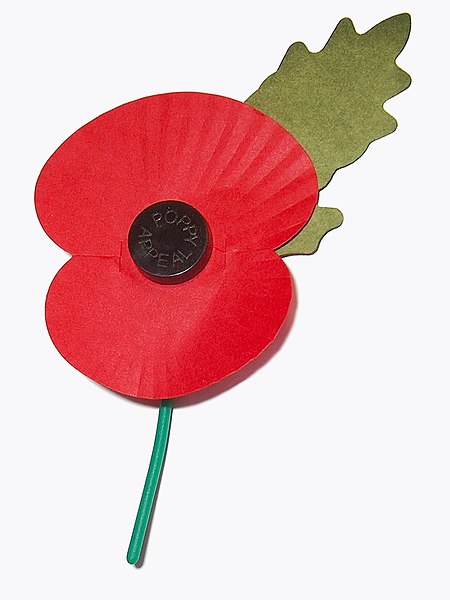
The 11th hour of the 11th day of the 11th month of 1918 marked the end of World War I. For years we called it Armistice Day, and each year when the clock in every corner of the globe rang 11 am, everything stopped for two minutes. No one would forget. At work, at home, in subways and trolleys, in church, in palaces and hovels, everything stopped. Even in schools–it didn’t matter if you were a kindergartner or in university, you stood up and were silent. Poppies were everywhere. After the Korean War the US changed the name from Armistice Day to Veterans Day to honor all the men and women who have served in the military. Poppies have become the symbol of both Veterans Day and Memorial Day (commemorating those who have died in the service our our country).
The red poppies remind us of the poppies found in Belgium and northern France, and were immortalized in Lt.-Col. John McCrae, MD, RCA’s 1915 poem “In Flanders Field” which he wrote after he presided at the funeral of a friend who died during the Second Battle of Ypres. (see poem below) After the War, thousands of disabled men came home, and in an effort to help support them and help in their occupational therapy, in 1921 the American Legion and it’s Auxiliaries began selling small red paper poppies which everyone wore their labels in remembrance. They are still worn today as a “thank you” for so many who have done so much for our country–though it currently seems to have become more of a day for sales than of gratitude.
After 9/11 there was a renewal in how Americans felt about the military. We hadn’t been attacked like that since Pearl Harbor, and it was a terrible wake-up call. We often thank members of the military for their service. And we do thank them!! They go places and do work to keep the country safe. But every now and then I had the uneasy feeling that words “thank you for your service” just don’t sound quite the right. I’ve struggled with that for years. Then I woke up on Veterans Day two years ago and heard Congressman Dan Crenshaw . . . on SNL of all things . . . make this quick monologue.
Dan Crenshaw and Pete Davidson on Saturday Night Live (NBC 11/11/2018)
“This is Veterans Day weekend, which means that it’s a good time for every American to connect with a veteran. Maybe say ‘Thanks for your service,’ but I would actually encourage you to say something else: Tell a veteran ‘never forget,’” . . . “When you say ‘never forget’ to a veteran, you are implying that as an American, you are in it with them, not separated by some imaginary barrier between civilians and veterans, but connected together as grateful fellow Americans. We’ll never forget the sacrifices made by veterans past and present.” Thank you Mr. Crenshaw! And to all of my students and friends who are veterans, Never Forget.
LtCol. John McCrae, MD, RCA
In Flanders Field, by Lt.Col John McCrea
In Flanders fields the poppies blow Between the crosses, row on row, That mark our place; and in the sky The larks, still bravely singing, fly Scarce heard amid the guns below.
We are the Dead. Short days ago We lived, felt dawn, saw sunset glow, Loved and were loved, and now we lie In Flanders fields.
Take up our quarrel with the foe: To you from failing hands we throw The torch; be yours to hold it high. If ye break faith with us who die We shall not sleep, though poppies grow In Flanders fields.
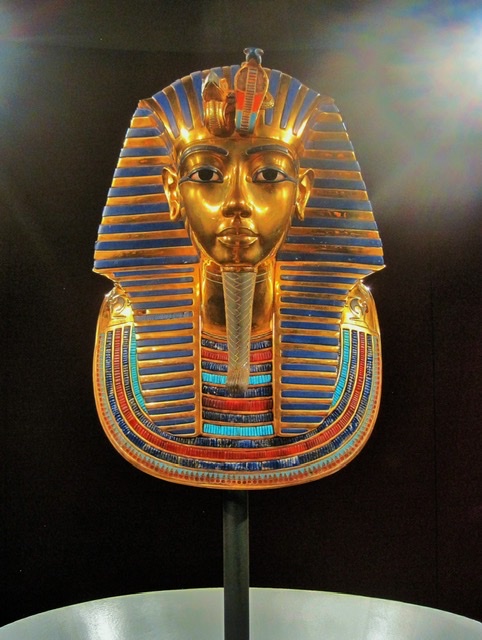
It’s been a a difficult 24 hours for many people, but no matter what the outcome, what everyone really needs to do is to stop and take a deep breath. Some people meditate. Others take a few minutes to look at something completely different. I’ve been looking for a five minute “no election” post. Let’s try this. Ninety-eight years ago today, Howard Carter found King Tut’s tomb—one of the world’s best kept secrets for 3250 years.
Tutankhamun (1342-1325 BC) was the last king of the 18th Dynasty, becoming king at age 8 or 9 after the death of his extremely controversial father, King Akhetetem. He had demanded that a new God, Aten, be the only God throughout Egypt. That caused confusion throughout the country, and massive upheaval among the priests and nobles. His son immediately returned everyone to polytheism, reconstructed statues, restored monuments and allowed all former festivals. The former King’s massive upheaval had also caused seriously economic issues, leaving the child Tutankhamun and his counselors to deal with issues both diplomatically and militarily, with campaigns in Nubia.
Cartouche in hieroglyphics spelling out “Tutankhamun, ruler of ON of Upper Egypt”
While Tut’s tomb contains body armor and campaign stools, it is unlikely that he rode into battle himself. CT scans done in 2005 and additional tests done at the same time have shown that Tut was about 5’6″ tall with a cleft hard palate and mild scoliosis. He was also missing at least one, possibly several, bone from his right foot and had a clubbed left foot, explaining why there were canes for him in his tomb. He also had numerous bouts of a severe strain of malaria. It appears that his death was due to his frail health, another bout of malaria, and a fall which caused a compound fracture of his left leg. Current thinking suggests that it was not due to foul play. While a few kings were placed in pyramids, many more were placed in tombs in the Valley of the Kings. And that’s where King Tut spent the following 3250 years.
Art from the Armarna period
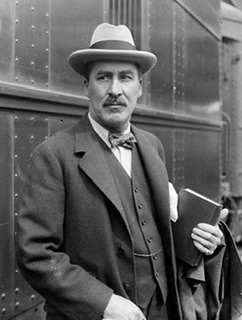
Fast forward 3200 years. Howard Carter was born in Britain on March 9, 1874. His father was a talented artist and Howard also developed serious creativity. In 1891, when he was just 17, he joined the Egypt Expedition Fund to help catalogue and assist with the excavation of Egyptian tombs found around Beni Hasan. In 1894 he moved to Deir el-Baharia to record reliefs in the temple of Hatshepsut. By 1899 Carter became the Inspector of Monuments of Upper Egypt for the Egyptian Antiquities Service, based in Luxor, and four years later he moved to Lower Egypt where he developed the grid-block system to logically look for additional tombs. He returned to Deir el-Baharia in 1907 working for George Edward Herbert, Lord Carnarvon, who was financially backing the excavations of noble tombs around Thebes. Carter started working in the Valley of the Kings in 1914, but everything stopped that September with the outbreak of World War I.
Howard Carter
During the War, Carter worked as a diplomatic courier and translator, but got back to his work at the end of 1917. However, by 1922, things had not been going well, and Carnarvon decided that he would only fund one more year of work in the Valleys of the Kings. In early November 1922, Carter’s crew was moving some debris . On the 4th, one of the water-boys slipped and when Carter went to see what had happened, he realized that he was standing at the top of a flight of stairs. He carefully dug out most of the steps till he found himself looking at mud-plastered door, with a cartouche stamped on it. He carefully refilled the staircase and sent a telegraph to Carnarvon telling him that they might have found something intriguing. Carnarvon arrived on the 23th, and on November 26, he and Carter went down the steps. With a small chisel and a candle they were able to see a jumble of gold and ebony implements. Most of the time, thieves had found, and robbed ,many of the tombs. To see something in such pristine condition was stunning.
There was a massive amount of work required, so Carter asked members of the Metropolitan Museum of Art in New York, who were then working in a different area of the Valley of the Kings, to help. They leapt at the change, and were particularly helpful in photographing all the items. It took over four months to catalogue all the artifacts in the first room. Finally, on February 16, 1923, Carter opened the second door. It was a sealed room with two statues standing guard—King Tut’s actual tomb! The pieces in the first space looked like trinkets compared to the artifacts in the main room, particularly the astonishing sarcophagus. It took over ten years to catalogue all the items, finally finishing the last details in February 1932. It had been Carter’s life’s work. With that, he retired, spending summers in London and winters in Egypt, dying in London on March 2, 1939.
Over the years, the Egyptian Ministry of Antiquities has worked tirelessly to preserve the stunning materials. Over the past ten years, in conjunction of the Getty Conservation Institute, the Egyptians have done tremendous work in preventing further wear, tear, decay and degradation, preserving Tutankhamum for posterity.
Is anyone going out for Halloween this year? I just saw the CDC guidelines which seemed reasonable. I’m a little old for that, but I do hope that parents find a way to allow their little ones to have some fun!! When I was reading the CDC site, you know me, I started thinking about how Halloween started. Sure, most of us know that it started as All Hallows Eve, but what else?
Halloween actually goes back more than 2000 years to the Celtic festival of Samhain (pronounced sah-win), meaning “summers end” in Gaelic. It was considered the end of the summer harvest, the time to bring the animals in from pasture, time to pay tribute to chiefs, and the possibility of having some type of contact with the dead. People would make massive bonfires and burn the chaff and some animals to thank the gods. Frequently they would wear what we would consider costumes looking like the heads of animals.
By 43 AD Roman legions held large parts of Britannia (current Britain.) With the Romans came their own festivals. One, Feralia, was held in late October, to remember the dead. The following day honored Pomona, goddess of fruit and trees (generally seen with apples.) Eventually all three festivals were rolled into one, held in late October.) In 603 AD Pope Boniface IV established All Martyrs Day, celebrated on May 13, and in 731 AD, Pope Gregory III added All Saints Day on November 1, and moved All Martyrs Day to join All Saints Day. By 1000 AD, All Souls Day was celebrated on November 2, All Saints Day (sometimes called All Hallows) remained on November 1, and All Hallows Eve was held on October 31.
Pope Gregory III
In the early days of the American colonies, those in New England and the Mid-Atlantic colonies had nothing to do with All Hallows Eve, because of the very stern beliefs in those areas. However, Maryland, the one Catholic colony, and the southern states, which were largely Anglican, were more involved with All Hallows Eve. They would frequently have “play parties” that would celebrate the harvest with singing and dancing, with a few fortune telling, apple bobbing (a hold-over from the goddess Pomona) and ghost stories. Autumn festivals continued into the early 19th century. One of the most famous stories is the Legend of Sleepy Hollow by Washington Irving. By the mid-1800s October 31th was generally seen as an autumn festival.
Toward the end of the 19th century, All Hallows Eve was changing, largely because of the start of a huge swell of immigration from Europe. The Potato Famine earlier in the century had brought Irish traditions of the festival, and as more immigrants from other areas of Europe arrived they put their own stamp on the holiday. By the beginning of the 20th century All Hallows Eve had morphed into Halloween. Costumes, not just of saints, became standard. Rather than community get together, people would visit different homes asking for food (often apples), or small change, which gradually changed to “trick or treat.”
During the 1920s and 1930s there were local parades and costumes, largely for children. However, it wasn’t until the end of World War II that more elaborate costumes, parades at schools, parties at homes, and wide-spread trick-or-treating became a major event. Unfortunately, during the early 80’s, children would sometimes receive candy which had been laced with shards of glass, so in an abundance of caution, Halloween now often holds events for the whole family at community centers, schools, and houses. As I said, this year is going to be odd, but I do hope that the children will be able to enjoy what’s become a classic for most of us.
Let me tell you a true story. I had two wonderful Grandmothers. One was born in 1895 and the other in 1900. Very smart, calm, quiet ladies, true steel blue violets (violets are the state flower of New Jersey). I went to see both of them shortly before I went back to college in September 1972–in the middle of an election. I arrived at Grandma’s house (the older of the two) one afternoon. It was hot, so we took some pineapple juice and went and sat down in the porch to chat.
My paternal grandparents, 1916
We talked about family, what I classes I was taking, who I was rooming with and so on. The she said that there was something important she wanted to tell me. “You’re going to be able to vote this year, and I expect you to vote. Not just then, but every time you can for the rest of your life.” I think I looked puzzled because I had never thought about not voting. Everyone I knew voted in all the elections. She went on. “Remember, when I was your age I wasn’t allowed to vote. Your Grandpa could, my father and all five of my brothers could, but my mother and I could’t. That. Was. Not. Right. I’ve made certain that your Aunts vote, and I expect you to so as well. I can’t tell you how bad it feels not to be able to vote.” There was a look in her eyes that told me she meant it!
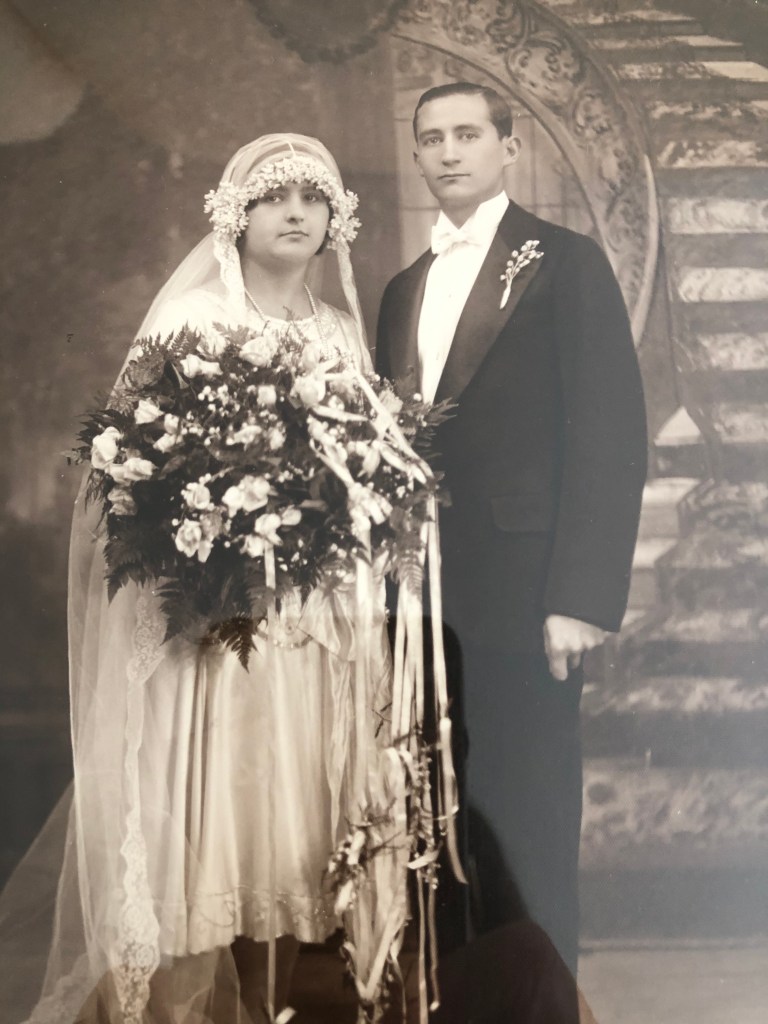
My maternal grandparents, 1926
A couple of days later I went to see my other Grandma. It had cooled down a bit, so she made some tea and her fantastic poundcake and we sat at the table talking. We covered much of the same things, plus she gave me her recipe for ruggelach (fantastic!) Then she said, “You’re going to be able to vote this year. That was one of the best days of my life! My mother and my older sister couldn’t vote until 1920. Obviously I’m younger, and I didn’t have to wait. When you go into the booth to write in your ballot, no one–NO ONE–can tell you what to do. I made sure that your mother understands how important that is and I expect you will always vote–for everything–from president to dog catcher. Now, let’s have some more tea.” See a variations on a theme? I got home and went to find my mother.
Now, I should tell you that I vividly remember going with my mother to vote when I was four. Later, my parents and all my friends’ parents, voted at the gym in our school. And in those days kids were in school on Election Day, so we could understand what our parents were doing. Mom was working upstairs so I plopped down on a chair and waited for her to finish the line of braille she was working on (my mother is a braillest.) I asked her what was the deal with voting–both grandmothers were way more steel than violet! That got a laugh. The gist of her comments were that they both wanted me be sure not to take voting for granted. And then she added that I should remember that my great grandparents had come to the US from countries where NO ONE could vote. She turned back to work with her loveliest smile and the words “I expect you to vote all the time. Otherwise I your grandmothers will haunt you forever–and I might too!”
Well, what goes around comes around, and when my own children where little I took them to vote with me as well. They’ve heard what their great-grandmothers said to me, and I’ve added that their grandfathers and uncles didn’t slog from Iwo Jima to the Battle of the Bulge for members of their family to stay home. The kids “all grown up” now, and I was speaking with both of them today. One’s already voted and the other will vote on Election Day itself. Well done! Of course, if they didn’t, I might have to haunt them myself. 👻
I had a wonderful history teacher in high school, Dana L. Stivers. Everyone loved him–and I do mean EVERYONE. Even the kids who hated history loved his classes. I still have all of his notes because they are that good. Whenever we were moving on to a new topic he’d start with a joke or a game. One time he came in and told us we were going to play charades. We would had 9 minutes to figure it out–three word, the middle one was “the,” and it was something that happened during FDR’s second term. It took a while, but Brian finally guessed the first word was “pack.” We never got the third word which was “court.” We were going to spend the hour discussing Roosevelt’s 1937 attempt to pact the court. Mr. S. also explained why it would have been a disaster for the country. I learned much more about it in college and grad school but I’ve never forgotten Mr. Stiver’s funny but very wise words–but apparently some people have. Let me give you his five-minute version.
Front row–Justices Brandies, Van Devater, Hughes, Reynolds, Sutherland Back row, Justices Roberts, Butler, Stone, Cardozo
Having had a stunning victory in the 1936 election, also sweeping a democratic majority in both the Senate and House of Representatives, Franklin Roosevelt was still not a happy camper. He was extremely annoyed because the Supreme Court had struck down some of the bills that he felt were at the core of the New Deal, particularly the National Recovery Administration and pieces of the Agricultural Adjustment Act. FDR decided that he would do whatever was needed to push through his regulations, even if it meant changing the Supreme Court from an independent judiciary to an arm of the legislative branch. He came up with a bill, the Judicial Procedures Reform Bill of 1937 (the court packing bill) which stated that for every Justice who was 70 or older, the president would nominate another Justice–but no more than six. (I can hear Gary now–a smart kid and great football player shouting out–“So Roosevelt was a sore looser!) I don’t think Justice Ruth Bader Ginsburg would put it those terms, but she did comment to NPR last year that not packing the court would maintain “the safeguards of judicial independence . . . that are as great or greater than anyplace else in the world.”
Justice Ruth Bader Ginsburg
FDR’s attempt to pack the court went nowhere. The Senate Judiciary Committee (his own Democratic majority) believed “ultimately the effect would undermine the independence of the court . . . and expand political control over the judicial department.” And Republicans wanted no part of it either. Both sides understood that it would be a short term solution, and a terrible one at that! The Court would loose its credibility, and the public would not accept its rulings. People throughout the country understood that it was a blatant power grab. An independent judiciary was one of the reasons that the US broke from Great Britain. Roosevelt said that he only wanted to make those reforms was because the Court was bogged down. However, Chief Justice Charles Evans Hughes spoke to Congress and made it very clear that the Court was up to date with all its work, and didn’t need any help.
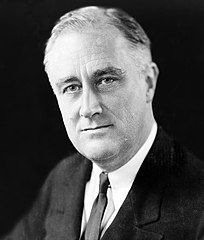
Franklin Delano Roosevelt
If Roosevelt had taken a longer view, he would have understood that eventually the Republicans would hold the majority and they would simply pack the court even more–and on and on. So the US would end up with an increasingly large number of Justices of the Supreme Court. How would they get anything done? Who would believe their judgment? The Judiciary Committee concluded that “It is far better that we (in 1937) await orderly but inevitable change of personnel than that we impatiently overwhelm them with new members.” And low and behold, in the coming years, seven Justices retired and Roosevelt was able to calmly nominate even more new Justices that he had hoped for.
Chief Justice William Rehnquist
Over the past 83 years, people have agreed that packing the court is NOT a good idea. Why change now? Are the current Senators more intelligent than those from 1937? Some of them may think they are, but most Americans don’t!! Are we in more dire straights now than in the depths of the Great Depression? Things are difficult, but not quite to that level. What is the same is the way both Roosevelt and a small number of Congressmen and Senators want what they want IMMEDIATELY. Both FDR and the current group of “court packers” seem to believe that their particular issues are more important than an independent judiciary. Again, look at the long term implications–a quick, down and dirty change that will eventually end up toppling the entire court system. That’s not the thoughts of some fringe groups of conspiracy theorists. It’s coming from judges and lawyers on both sides of the aisle, from common-sense members of Congress, from historians who understand that this has happened in other nations, and it didn’t end up well, and from average people who were lucky enough to learn civics in school. Congressional leaders need to act for the good of the whole country, not their own partisan interests. Chief Justice William Rehnquist said that “judicial independence is the crown jewel of our system of government.” We need to listen to people like Rehnquist and Ginsberg and not petulant children who want what they want when they want it.














 Historical Lense