Doc–I’m done–I need HELP đŸ˜«

About two weeks ago I was working on a new post when one of my former grad students called me. Normally a calm, thoughtful man who always seems to have a plan and a back-up, he sounded harassed–and with no plan.😕 I told him to take a deep breath and tell me how I could help. I suspect that some of you will understand his problem, or something similar to it.

He has two teenagers, and when school went online in March he and his wife made sure that the children were “going to school,” and completing all their tests and papers. No one was happy. The kids enjoy school and missed their classes and friends–even their teachers. Mom and Dad made sure that the kids did what they should, but both parents were working 12-14 hour days seven days a week trying keep their small business alive. School ended in late May,đŸ€“ and thankfully the parents were able to pivot and keep the business above water. When school started again, Dad was able to spend a little time taking a really good look at what the kids were learning. In fact, this was the first time in years that he really checked to see what the school is teaching the kids. He just assumed that they were providing good content. Math and science are fine, and French is well done, but both parents are furious with what they found in English and History. No great books like Macbeth, or 1984. No good books like Pride and Prejudice or A Farewell to Arms. All current books with a very clear point of view.😠 But the reason he called me was because he started reading their US history textbook, A People’s History of the United States by Howard Zinn. What did I think of it.

Me: “Well, I do have some thoughts, but you know that I keep my thoughts to myself . You really should decide for yourselves once you’ve read through the material.”

Him: “You always did Doc, but I’m specifically asking. I am DONE with what they’re teaching my kids. I need some help!!”

Me: “Ok… (deep breath)… Zinn wrote a one-dimensional book, not looking at anything in the context of the times. He had a doctrinaire point of view–what I consider a hard left bent which I never used for my classes. A textbook should contain facts. Some may be a little dull but they need to be inclusive. His book seems to contain only the facts he prefers.”

Him: Thank goodness! I thought it was just me!!!😹

No, it wasn’t just him. While Zinn’s book have something of a cult following, many other people–and not just professors–find the book seriously flawed. First published in 1980, it was initially used as a college text, and in the past 10 or so years has shown up in high schools. It is a biased book, based largely on secondary sources. Rather than a thoughtful history text, it reads more like a crusade, with few heroes, but many villains from the Pilgrims to the 21st century. Important information is frequently left out or is a side note or throw-away comment. Apparently the Founding Documents were put together strictly for economic motives?!?! The rest of the book follows in the same vein. If it’s your first real foray into history, well, you have no comparison. Add to that the sad fact that kids frequently believe the teacher rather than their parents. How many times have you heard “But the teacher said…?! I can easily understand why my friend was upset!

Regardless of a professor’s personal beliefs, it’s important that we teach our students the facts–ALL of the facts, not just the one’s we prefer–and stand back to allow them to decide for themselves what they believe. Too many professors do everything possible to basically indoctrinate their students–and Zinn’s book is a big part of it. When presented with a different point of view it is made clear that grades would be effected if someone doesn’t follow the party line. Shame on those teachers! It sound very much like what my friends who left Russia, Hungary, Albania, Czechoslovakia, and Cuba say about their schools.

The Dad asked me if I knew any of the kind of books that he’s looking for. I suggested Paul Johnson’s A History of the American People which is a thoughtful, measured book discussing topics from various points of view. Apparently he and a number of the other parents discussed their problems with the school board, and were told that is what children learn in that district. With that, the parents spent a wild week setting up their own “bubble” for twelve children and a teacher who believes in actual teaching. He promised to keep me posted. Interestingly, there are a number of families across the country who are doing similar things, from bubbles, to home schooling to the old one-room school house. And good for them! I always thought that parents are in charge, not the state or the teachers’ union.
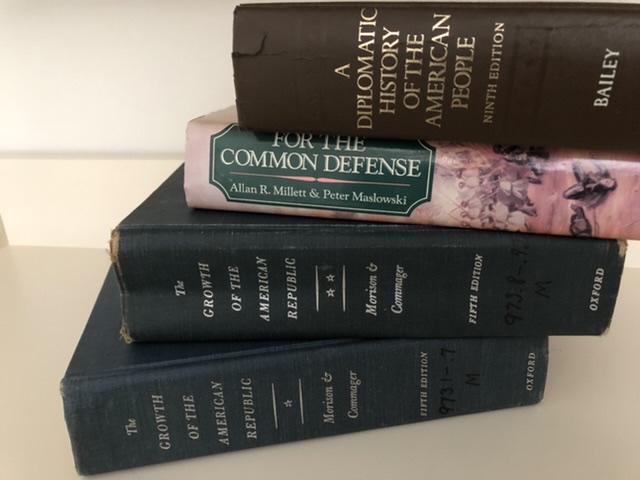
Some of “Doc’s” ancient books

Q, didn’t you teach them ANYTHING?!

I just got off the phone with a friend (yes, Q is her real nickname) and I don’t know if I’m more đŸ˜© or đŸ€Ż but I know that I’m 😳 that such a long-standing professor is so surprised that a standing President can, in fact is supposed, to nominate a Justice of the Supreme Court close to an election. She knows better. In face, I’ve heard her discuss that with her own students. It’s nothing new–it goes back to John Adams in 1801.

President John Adams

Adams was a lame-duck president, having lost to Thomas Jefferson in November 1800. In those days the inauguration didn’t take place until March 4, so Jefferson knew that he couldn’t appoint anyone until that day, though the sitting President could, until 12 noon on March 4. No one even though about the Supreme Court until December 1800, when the Chief Justice, Oliver Ellsworth, resigned because of his health. Earlier, John Jay had been a member of the Supreme Court, and Adams now asked him to lead the Court again. Jay had originally left the job because he had not found it interesting. Regardless, Adams believed that he had done an excellent job, and wrote to Jay, offering him the position.

Marshall, who was the Secretary of State at that time, was with Adams when he received the letter from Jay on January 20, 1801, saying that he respectfully declined. It was less than two month before Jefferson would take office and Adams wanted to find someone to fill the position while he was still in office. Marshall suggested that he nominate Associate Justice William Patterson to become the Chief Justice, but Adams turned around and said that he preferred Marshall himself.

Chief Justice John Marshall

Adams was a member of the Federalist Party, while Jefferson was a Democratic-Republican–and the two men cordially loathed each other. Adams was anxious to have a man in whom he had confidence before Jefferson took over. Marshall would fill the bill. Adams nominated him, the Senate confirmed him on the 27th of January and he took office on February 4. Adam always believed that putting Marshall on the Supreme Court was the most important decision he made during his presidency. The man who had never thought about it ended up being the finest Chief Justice we’ve ever had, starting with the Marbury v. Madison decision. Marshall remained Chief Justice for 34 years.

My friend kept saying “OMG how could I have forgotten?” and actually suggested that I put it in the blog to remind people that this has happened before. What bothers both of us–tremendously–is that people are acting as though this is the end of the world–or maybe just the end of the country. It’s not. Everyone needs to CALM DOWN!! It is possible to discuss and debate without going to extremes. We can speak to people with civility, and come to a consensus without threats of mayhem. I’ve said it before, and I sadly need to say it again—where are the grown-ups?

đŸ”„đŸ”„đŸ”„đŸ”„đŸ”„đŸ”„đŸ”„đŸ”„đŸ”„đŸ”„đŸ”„đŸ”„đŸ”„đŸ”„đŸ”„đŸ”„

Having had family who lived in Southern California, and having lived in Washington State ourselves, it’s terrible to watch the fires–the infernos–up and down the western states. The loss of life is staggering. Volunteers with bulldozers and Forest Fire Services from as far away as New Jersey, even Israel, are arriving to help battle the blazes. California’s Governor Gavin Newsom has expressed the gratitude of the state to everyone who has come to help. At the same time, he has said that climate change is the problem. Period. Full Stop. I respectfully disagree. Yes, climate change is a part of the problem, but there are other serious factors involved, especially inadequate forest management and the crumbling electric infrastructure.

Forest management goes back to the General Land Office which started in 1812. Along with the US Grazing Service, it was reorganized into the Bureau of Land Management in the Department of the Interior in 1946. States also have their own versions of land management. The US had terrible fires during the 19th century, very similar to those we’re battling today. But starting in the lat 19th and early 20th centuries, most state universities started teaching agriculture/forestry. They began to clear out areas of underbrush that could quickly go up in flames. They thinned specific trees, and used controlled burns that ultimately maintain the health of the ecosystem. And during World War II, we saw programs in Idaho and Montana teaching the first smokejumpers (parachuters) programs which are still used today. By the end of the 20th century, there were many fewer, and smaller, fires in large areas of the west.

Smokejumpers, c. 1946

But by the early 21st century, fires have grown back to the level they were during the 19th century–only we now have millions more people trying to live and work in that same land. So what’s the issue? Well, part of the problem has to do with climate change, though not for the reasons you may think. Many private and public groups have demanded that all land be left in as natural a state as possible. That sounds reasonable. But when you drill down a bit you find serious problems. To have healthy forests you need to do many of the same things that have been done before we knew anything about climate change. Get rid of the underbrush. Build fire breaks. Cut specific trees. Provide for proper road access, and yes, do carefully controlled burns. (As they say in Church, be good stewards of the earth.) That will keep healthy forests, keep fires to a minimum, and still allow people to live with nature. Don’t do that and you’re made massive fires, deaths, property loss, and deadly mudslides.

The other major problem is electricity. We need electricity so much more than we did even thirty years ago. We used to need it for lights, appliances like refrigerators, and heat. Even telephones used to run on copper wires so you could use the phone even if the lights went out. (I do miss that!!) Now add many more appliances like microwaves and air conditioners, to say nothing of the internet, and smartphones, and when the power goes out, we’re dead in the water.

Yet, the electrical grid hasn’t kept pace with current demand. Last year the American Society of Civil Engineers gave California a D- 😳 in the Infrastructure Energy Sector. In many cases it’s been 60 years or more since there has been a serious upgrade. There are problems with the cables and low-voltage, sub-stations, transformers and on and on. In desperations, they are turning off the electricity (the fancy term is “de-energizing”) to millions of people to try to avoid arcing or sparks which can start fires. That’s a draconian measure and a very short-term solution. Wind and solar can help, though they bring their own issues–how many miles of solar panels would be needed to provide electricity to even a fraction of the state?? What happens where the wind is calm–how many batteries would be needed to replace just one wind turbine? Are we ok with tens of thousands of birds, including eagles, being killed by wind turbines? Those are just a few of the questions that need to be answered. Remember, there are tradeoffs to everything in life.

While PG&E’s numerous issues caused such a disaster in 2017 and 2018–and ended up in bankruptcy–most of the state’s power companies have similar issues. We need to promptly start updating and hardening our electric grid in California, and frankly, throughout the entire country. Is it costly? Yes. Is it less closely than the lives of 35 people (as of this morning)? I think so!! Interestingly, private lands has been maintained properly, and has a fraction of the issues of public lands. Fix the grid, and properly maintain the forests and you’ll have much safer, and happier, states. Then, and only then, should anyone even thing about spending money on things like the “train to nowhere” for a mere $77 billion dollars, or other interesting but unnecessary ideas.

The Frei Korp was not Antifa

A few weeks ago, I was talking with one of my former grad students about the end of World War I, and he asked me if the Frei Korp was the precursor of Antifa. Nope–just the opposite. The Frei Korp opposed the communists. Antifa doesn’t. We spent about half an hour discussing both groups–I promise that the following is the short version.

Frei Korps, Berlin, January 1919

Immediately after the November 1918 Armistice, with the Kaiser in exile in the Netherlands and the German government falling apart, the Spartacus League, a communist group headed by Rosa Luxemburg and Karl Leibknecht, tried to seize power, similar to the way the Bolsheviks in Russia had done barely a year ago. Communism was a bridge too far for most Germans. Ultimately the way they pushed back and defeated the Spartacus’ was with the Frei Korp. Thousands of the officers and enlisted men who were returning home from the Western front, were reconstructed into what was called the Frei Korp. Ultimately 68 corps, some quite large, were used to stop the rebellions in Berlin, and later in a number of cities including Bremen, Hamburg, Leipzig and several areas in the Ruhr. Eventually, the Weimar Government took control.

Fast-forward 90 years. Antifa seems to have grown out of groups in Europe in the ’80s, the Anti-Racist Action organization that appeared in the US around 1987, and the 1999 protests and riots during the Seattle World Trade Organization (WTO) meetings. The oldest Antifa group is the Rose City Antifa that started in Portland, Oregon, in 2007. Antifa is a horizontal rather than a vertical “organization,” that’s extremely decentralized with numerous small groups. They call themselves anarchists, communists, socialists, and marxists. Others consider themselves anti-capitalist, anti-elitist, anti-government, and revolutionaries.

Members of Antifa have found the digital age extremely useful. We all know how easy it is to send all kinds of information online literally with the push of a button. Member of Antifa can easily share all types of information such as where to get equipment, where, how, and when to find people, who may join them, etc. One thing which they do frequently is “doxxing” people–giving out names, addresses and phone numbers in order to harass individuals and their families to the point that people have moved and/or installed serious security measures. Antifa members have no problem destroying private property and denying freedom of speech.

Sometimes members of Antifa join a crowd and ratchet up the looting and arson. (Looks too much like Kristallnacht) Other times, hundreds, occasionally thousands, of people all in black including sunglasses, helmets and shields–full riot gear–take to the streets, trying to burn down buildings, attacking police, even firefighters, and using high-grade fireworks, Molotov cocktails, bricks, ball bearings, clubs, a range of dangerous liquids, slingshots, and lasers which have caused blindness. Those are running battles with law enforcement, not simple protests.

As diffuse as Antifa is, the individual cells are starting to set up specific activities, often called blocs. The best know is a “black” bloc, where everyone is in head-to-toe black, making it very difficult to see who someone is. They also use snack blocs, which provide food and water, “online” blocs which supply a huge amount of data and propaganda to both local and national groups, and medic blocs to help anyone who needs medical assistance.

Clearly, this is much more than rag-tag groups of ruffians. An interesting questions is–who is paying them? There are crowd funding platforms which frequently provide them with bail (like hundreds of thousands of dollars). Some people feel sorry for rioters–others believe in their cause. There are also pop-up kitchens. One food truck, known as Riot Ribs, parked near the Portland courthouse, and made a great amount of money. Is that enough? I seriously doubt it. It’s clear that significant funds are coming from somewhere, but I’m an historian, not a forensic accountant. Nor do I walk the halls of power. But common sense (which really isn’t that common these days), and almost 50 years of study tell me that power and money are intimately involved in Antifa. Want to stop the riots? You know the old, but accurate line–follow the money!

The word “revolution” keeps rearing its head during these riots. Antifa seems to think it’s a good idea. Just stop and thing a minute. Is revolution really a good idea? The Russian Revolution killed roughly 8 million people, many of them civilians. The Chinese Cultural Revolution killed around 3 million (though the Great Leap Forward took at lease 40 million lives.) And what about the French Revolution? Only around 50,000 lives. But what’s particularly interesting is that Robespierre, one the the best-known members of the French Revolution, ended up dying on the guillotine himself because he demanded that the Reign of Terror continue. So think about Antifa, revolution and the rule of law and remember–be careful what you ask for–you might get it!

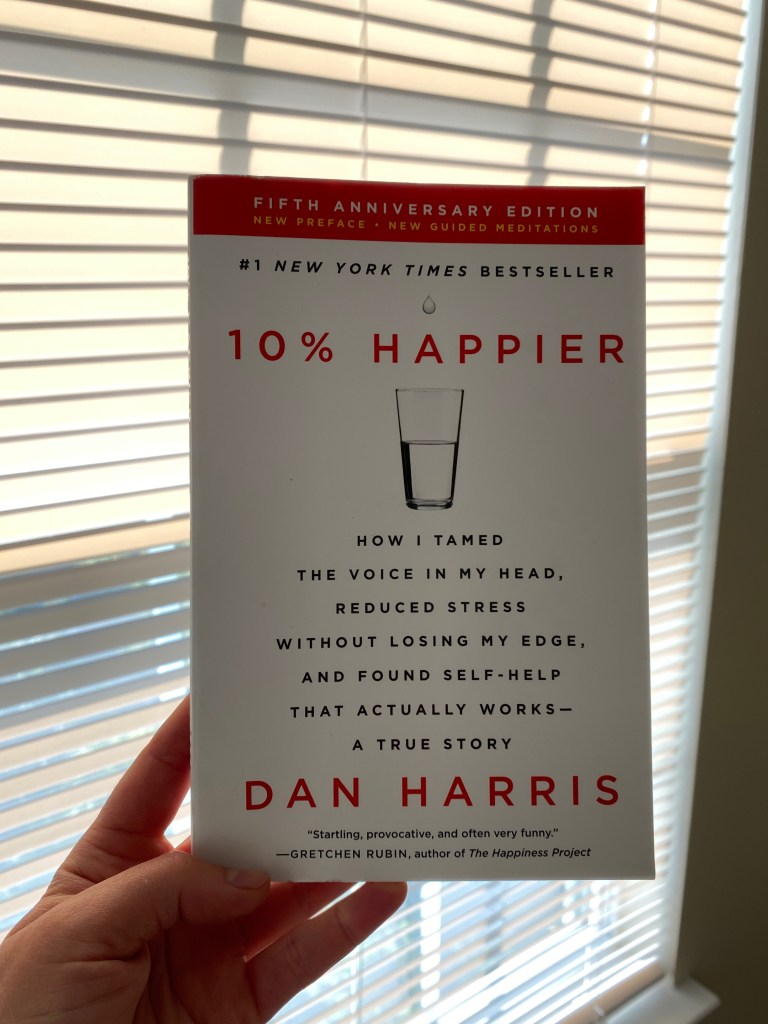
Review of 10% HAPPIER

I think we’d all agree when I say most everyone is stressed these days. Between my four-year-old friend across the hall who is extremely sad that she can’t play with her friends at school😔 to my 92-year-old mother who is extremely annoyed because the virus has changed her routine,😠 and everyone in between, we’re all stressed. A couple of weeks ago I was complaining to my daughter who told me, “Mom, you should start meditation.” Sure. I should also start scuba-diving. But I asked “so why should I meditate?” Well, she’s a Nurse Practitioner and a Functional Medicine provider, so I got chapter and verse about randomized controlled trials, etc., that show how mindful meditation can actually lower your blood pressure and help with anxiety, depression, insomnia and IBS. Maybe I should think about it.

Two days later a book arrived (from guess who) 10% Happier by Dan Harris. I had just finished a book so why not take a look? Harris was a war correspondent for ABC in Afghanistan and did investigative reporting in Israel/Palestine, Haiti, Cambodia and Congo. He’s co-anchor for the weekend edition of Good Morning America and has been the anchor of Sunday World News. A real gung-ho journalist. And then came his panic attack on national TV. At that point he knew he had to make some changes.

It was about that time that he had been assigned to look into the faith communities in the US. Harris was skeptical, but did his research, delving into everything from evangelical preachers to the Dalai Lama. Everyone he spoke to had helpful pieces, but from gurus to neuroscientists he was missing something. Then a friend suggested that he come with him to a seminar on mindful meditation. Swamis sitting on the floor chanting “ommm” didn’t sound useful, or any fun, but his friend, who himself uses mindful meditation, convinced him to go. It turned out that they were a group of middle-aged men and women who spoke softly, some with a good sense of humor, and gave him much to think about, ultimately putting him on his path to a calmer and “10% happier” life.

This is not the kind of book that I normally read. But it’s exactly what I NEEDED to read. Harris is brutally honest, extremely funny, with more than a touch of sarcasm–an excellent writer. I read it in two days, and then went back and read it again. It’s not a “how to” book (I hate how-to book👿) For me at least, it helped put me in the right frame of mind to get started with meditation. It’s not a pie in the sky approach, but practical ways of looking at things. It’s been a month, and as skeptical as I was, I do find mindful meditation to be very helpful. It doesn’t fix things, but it does help me to calm down and keep things in a more useful perspective. I hope you’re real it–even if you don’t think that meditation is for you, it’s a really good read!

Bamiyan, Book-burning and Kristallnaacht=❓❓❓

Today, rather than discussing a particular issue, I want to explain why I believe that history matters—today more than ever!

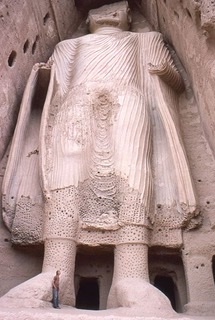
Smaller Buddha of Bamiyan in Afghanistan, pre-2001

This was one of the Buddhas of Bamiyan. There were two of them, both made in the 6th century, carved out of sandstone on the cliffs of the Bamiyan Valley of Hazarajat about 140 miles from Kabul, Afghanistan. The smaller of the two statues was 115 feet high. The larger was 174 feet high. The statues remained there for 1400 years.

Between the 2d and 6th centuries, a thriving Buddhist community, including numerous monasteries, lived around Bamiyan, along the Silk Road. By the 10th century, Islam had become the main religion in Afghanistan. In 1221 Genghis Khan barreled across Afghanistan, but spared the statues. Babur, in 1528, and King Nader in the 17th century, took pot shots at the statues, but most of the time they were ignored or seen as curiosities. Then during the Afghan Civil War in the late 1990s, the Taliban, ultra-conservative fundamentalist militia, decided that they had to get rid of the Bamiyan Buddhas. The Talibans considered the statues idolatrous and evil. Even UNESCO and the 54 members of the Organization of the Islamic Confederation protested. It didn’t matter. The statues were reminders of a part of their history that was anathema to the Taliban. Look below, to see what’s left of that the Bamiyan Buddhas.

To the left, the pre-2001 picture of the large Bamiyan Buddha—to the right, what is left of the statues

Let’s move on. In April 1933, the German Student Union called for a nation-wide purge of all books with which they disagreed. On May 10, 25,000 books were burned outside the State Opera House in Berlin. Other book-burnings took place in over 30 universities throughout Germany, incinerating thousands more. Want to know the authors of some of these hateful tomes? Albert Einstein, Sigmund Freud, Berthold Brecht, Thomas Mann, Erick Maria Remarque, and Franz Kafka to name just a few. And it wasn’t just German authors—H.C. Wells, John Dos Passos, F. Scott Fitzgerald, Ernest Hemingway, Jack London, Marcel Proust and on and on. But why should their teachers demand that they read books that made them upset, or that they disagreed with? Or even worst, made them THINK? Nasty book. Boring book—burn it.

Book-burning in Berlin, May 1933

Just one more, I promise. November 9-10, 1938–Kristallhaacht. The night of broken glass. Most everyone reading this post knows the basics. On the morning of November 7, 1938, a 17-year-old Polish/German Jewish boy living in Paris shot Ernst vom Rath, the 3d Secretary of the German Embassy in Paris. He died two days later. Once the news reached Germany, cities throughout the country began attacking Jewish shops, hospitals, offices, schools, synagogues and other buildings. In roughly 24 hours, 7000 businesses were ransacked, severely damaged, or completely destroyed and burned to the ground. At least 91 people were murdered.

Kristallnaacht, November 9-10, 1938

So why am I talking about these very different things? Bamiyan is gone. Not placed in a museum where people could learn about what happened there for 500 years. Nothing about the Silk Road. Nothing about Buddhism. No context. No nuance. The Taliban’s hated them and got rid of them.

Book-burning. Some books made people think and—gasp—disagree with the then current norms. Some people had different points of view. No, No. Don’t like what’s said in a book? Burn it! (Thankfully, unlike the statues at Bamiyan, there are copies of these books which are still read, enjoyed, and even argued, today.)

Kristallnaacht—hate a group of people? Destroy their livelihood, their homes, their houses of worship. What difference does it make?

Many people find history dull. It’s a bunch of boring names and dates. It doesn’t make any sense. Others think it’s a waste of time—STEM is the way to go. But at the end of the day, there’s one reason we should care about history—care A LOT! You learn history to avoid making the same mistakes again! And if you abolish history, you will learn nothing—and repeat those mistakes.

Think about the books and statues and broken glass. Think that can’t happen here? It already has! Protests and riots are two very different things. You don’t have to like everything or everyone, but there’s a huge difference between thoughtful, important, change and destruction for the sake destruction.

It’s Pulaski Day! đŸ‡șđŸ‡žđŸ‡”đŸ‡±

Several members of my family recently sent me some pictures from a trip they took to Savanah, Georgia, and asked me what I knew about Casimir Pulaski. Well, Monday, March 2, is Pulaski Day in Chicago, so I though I’d give everyone a very short course on the Father of the American Cavalry.

Plaque in Savannah, Georgia

Kazimiarz Michael Wladyslaw Wiktor Pulaski was born on March 4, 1745, in Warsaw, Poland, the son of Count Joseph Pulaski. The Count was a member of the Bar Confederation (1768-1772) that was trying to defend Poland against Russia. (Sadly it ended with the 1st Partition of Poland.) The young Casimir fought valiantly as a cavalry officer, but ultimately he had to flee Poland. He spent the years 1771 to 1775 traveling Europe and the Ottoman Empire trying to put together enough money and troops to return to Poland. Instead, he ended up in debtors prison in France.

Luckily, some of his friends bailed him out and introduced him to Benjamin Franklin, then in France as an agent of the Second Continental Congress. Franklin was always looking for outstanding European officers to train Americans in the Continental Army, most of whom grew up as farmers or merchants, not soldiers. Franklin liked the man, and send a letter introducing Pulaski to George Washington. Pulaski sailed from Nantes and arrived in Boston on June 23, 1777. He immediately headed to Philadelphia where, in August, he requested a commission from Congress—but like virtually everything else, Congress took its time.

Portrait of General Casimir Pulaski from the Great Generals series.
Portrait of General Casimir Pulaski from the Great Generals series

Pulaski was not a man to wait patiently so on August 20th, while Congress inched along, he rode out to Neshaminy Falls and met Washington. Early in September, the British began moving on Washington’s men. On September 11, the Redcoats started a flanking maneuver in an effort to cut off some of the Continental troops. Pulaski didn’t care about a commission. He asked permission from Washington to take some of the General’s personal guards and deal with the British. Washington agreed, so Pulaski led 50 men in a countercharge that bought enough time for the Americans to retreat in an almost-orderly fashion. Regardless of the best efforts of the American cavalry, the British won the Battle of Brandywine. Just four days later, Pulaski received his commission as a Brigadier General. He immediately began reforming and training an American cavalry unit.

Pulaski joined Washington and his men that frozen winter at Valley Forges. The Pole kept training his cavalry despite the desperate lack of food, clothing and heat. By the middle of February, Pulaski decided it was time to see what his men could do—and foraging for food was a good way to start. He and 50 of his cavalrymen headed toward Burlington, New Jersey, where they hooked up with General Anthony Wayne. On February 28, 1778, several British sentries saw what they thought was a large number of American cavalry, so they headed back toward the Delaware River. Pulaski and Wayne’s men attacked the Redcoats the next morning. It was actually a small skirmish, though Pulaski’s horse was shot out from under him. He and his men returned to Valley Force with some intelligent—and so desperately needed food.

Washington at Valley Forge

Working with the Americans chafed on Pulaski. His English was rudimentary at best, and he strenuously disagreed with much of the tactics and strategy developed by the men in Washington’s inner circle. By March 1778, he was so frustrated that he resigned his commission. But he shortly decided that he needed to take another shot with the American Cavalry. Ultimately Congress reinstated his commission. He formed a unit of 68 lancers and 200 infantrymen, many of whom were foreigners who he recruited in Baltimore.

While the new unit trained, American privateers seized British ships along the New Jersey coast and sailed them to ports along the Little Egg Harbor River. The courts sent all the materiel to Valley Forge, and sold the ships. After loosing close to 20 ships in just three months, the British, based in New York City, sent 15 ships with hundreds of soldiers to stop the privateers. They reached Little Egg Harbor in early October, and on the 7th torched a number of houses, confiscated the contents of the vessels, and destroyed 10 ships. They would have done more, but they heard that the Polish general and 250 men were on their way. In the early morning of October 15, 400 Redcoats attacked a 50-man detachment of Pulaski’s men, bayoneting almost of them (known to this day as the Little Egg Harbor Massacre), then hastily returned to New York harbor. The American cavalry continued to train in the Minisink region of the upper Delaware River over the winter.

In February 1779, Pulaski requested that Washington transfer him and his men to the Southern front. As much as Washington appreciated Pulaski’s skill, he was a very difficult man to deal with, so Washington was happy to oblige!! They arrived in Charleston, South Carolina, in May 1779. There he met Colonel John Laurens, and together they convinced the City Fathers to try to defend Charleston, rather than surrender it to the British. They did, in fact, hold Charleston, though the Americans, including Pulaski’s Cavalry Legion, paid a heavy price. However, what all the Americans were really aiming for was to retake Savannah, Georgia.

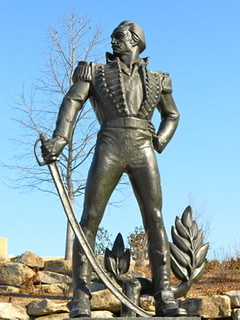
Monument to General Casimir Pulaski in Savannah, Georgia

Pulaski, like so many who lived in the South in those days, battled with malaria in the summer, but it didn’t stop him. By September he and his men reached Augusta, Georgia, where they joined General Lachlan McIntosh’s troops. As part of a joint French-American attempt to take Savannah, McIntosh and Pulaski would be the forward units for General Benjamin Lincoln’s men. On October 9, 1779, during a valiant but hopeless cavalry charge, Pulaski was hit by grapeshot. His men carried him from the field and put him aboard the brig Wasp, where he died two days later. Originally laid to rest on the Greenwich Plantation, he was reinterred at the Casimir Pulaski Monument in Savannah.

Statue of General Casimir Pulaski at Fairmount Park, Philadelphia.
Statue of General Casimir Pulaski, Fairmount Park, Philadelphia

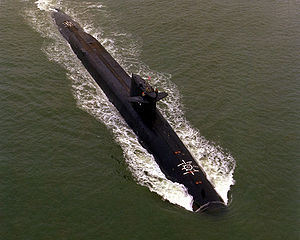
Though Pulaski’s life was cut short, he was not forgotten. Just two weeks after his death, Congress ordered a monument to be dedicated to him, though it wasn’t finished until 1854. The Marquis de Lafayette layer a cornerstone for Pulaski’s monument in Savannah in 1825. A bust of Pulaski has been in the U.S. Capital since 1867. There are a number of statues of Pulaski across the U.S. Numerous cities and counties are named for Pulaski, as are bridges and a skyway. Of course, as mentioned at the beginning of this discussion, Pulaski Day is celebrated on the first Monday in March in Chicago, as well as other cities. And one of the most interesting ways he is remember is the name of a U.S.Navy submarine—the U.S.S. Casimir Pulaski.

The U.S.S. Casimir Pulaski


As I said, this was a very short course. If you’re interested in more information on Pulaski, below are some very good books.

Leszek Szymanski. Casimir Pulaski: A Hero of the American Revolution.

Douglas Shores. Kazimierz Pulaski: General of Two Nations.

Francis Kajancki. Casimir Pulaski: Cavalry Commander of the American Revolution.

Impeachment 1.0

President Andrew Johnson

Impeachment is front and center today. It’s only happened three other times in our history—1868 (Johnson), 1974 (Nixon) and 1998 (Clinton). Most government officials, reporters and pundits spend much of their time discussing the Nixon and Clinton impeachments, which is understandable. Both happened in the past 46 years. But I think we should really spend at least a little time looking at the Johnson impeachment because there is an important parallels between the Congresses of 1868 and 2020.

Andrew Johnson was a Democrat from Tennessee who was elected to the U.S. Senate in 1857. Though Tennessee seceded from the Union on June 8, 1861, Johnson stayed in Washington, and in 1862, Abraham Lincoln made him the Military Governor of Tennessee. In the election of 1864 Lincoln was looking for a national unity running mate rather than a staunch Republican, and Johnson, known as a War Democrat or Southern Unionist, filled the bill. Lincoln and Johnson were inaugurated on March 4, 1865, but with Lincoln’s assassination on April 14, 1865, Johnson became our 17th president.

Like many presidents, Johnson had a short honeymoon period. The war was over—much of the country simply wanted things to return to normal. However, “normal” meant something different to Andrew Johnson than it did to the Republican majority. Johnson felt that the best way to heal the nation was to move toward reconstruction as rapidly as possible. That included allowing each individual state to decide its own laws for former slaves. The Republican had a different take on what should happen to the South. They wanted the national government to apply strong standards, including the 14th Amendment, to the entire country, while severely limiting the rights of the former secessionists.

The friction between the Executive and Legislative branches ratcheted up quickly, not only because Johnson vetoed a number of bills, but because he was a Democrat. The conciliatory Lincoln was gone. As far as the current Republicans (many of whom had been abolitionists) were concerned, the Democrats had caused the war and they should be punished. Johnson had to go! But how? They started by over-riding Johnson’s veto of the 1867 Tenure of Office Act. Simply put, under the Constitution, specific individuals such as cabinet members, ambassadors, certain judges, etc. had to have the advise and consent of the Senate. Under the new law, when the President wanted to remove any of those people, the Senate would again need to pass their advice and consent. (That is no longer the case!!) Then they waited to see what Johnson would do. It didn’t take long.

Many in Congress were well aware that Johnson wanted to force Edwin Stanton, the Secretary of War under Lincoln, to resign. They hoped that if he fired Stanton without the new advice and consent of the Senate, that would be enough to impeach the President. Initially Johnson suspended Stanton and put Gen. Ulysses Grant in his place—but the Senate reinstated Stanton and Grant, who was already planning to run for the Presidency in 1868, bowed out gracefully. Johnson was infuriated and fired Stanton outright, putting Gen. Lorenzo Thomas in his place. Stanton arrested Thomas and impeachment was on its way.

The Republicans hoped to do two things at the same time. Keep the Tenure of Office Act, which would give more power to the Senate, and impeach Johnson who they had come to loathe. Led by the aged Thaddeus Stevens, the House quickly put together an impeachment committee, drafted 11 articles, approved seven managers, passed it on a strictly party vote (126-47) and on February 24, 1868, shipped it off to the Senate.

Presided by the Chief Justice of the Supreme Court, Samuel Chase, the trial began on March 5, 1868. First came the House prosecutors (managers) explaining the reasons for their articles. The five members Johnson’s defense then argued that Johnson had done nothing to cause any injury, and that since he hadn’t appointed Stanton (Lincoln had), the Tenure of Office Act had nothing to with him. The Senate required a 2/3 majority, or 36 votes, to impeach the President. On May 26, 1868, the Senate had a roll-call vote. It was 35-19—Johnson was acquired.

Ultimately the Senate had to decide whether Johnson had, in fact, engaged in treason, bribery or a high crime or misdemeanor as defined in the Constitution, or did they just detest him so much that they wanted to get rid of him in any way possible—even though the next presidential race was well underway. In later years, two Senators explained their thoughts. James Grimes of Iowa commented, “I cannot agree to distracting the harmonious working of the Constitution for the sake of getting rid of an Unacceptable President.” Similarly, Senator Edmund G. Ross of Kansas wrote that had they impeached Johnson they would have “revolutionized our political fabric into a partisan Congressional autocracy.” A few months after the trial, a man much more to congressional liking, won. Think long and hard about what Grimes and Ross said as we watch what is going on before our eyes.

**The Tenure of Office Act was rescinded in 1887.