In Ukraine, everything old is new again–review of book BLOODLANDS

Watching the news these past days has been horrifying. War is bad enough. But there’s a huge difference between a military campaign and indiscriminate carnage and war crimes. Turning thriving cities into rubble is very similar to what the Russians did in Aleppo, Syria, and Grozny, Chechnya. It’s understandable that the Ukrainians are willing to fight to the end. It’s only been thirty years since the end of the Soviet state, and the Ukrainians well remember being under the boot of the Communists. Even more, they understand what happened when the USSR took control of Ukraine 90 years ago. If you haven’t heard about the Holodomor–the Terror-Famine–which decimated Ukraine, take a look at Bloodlands: Europe Between Hitler and Stalin by Timothy Snyder.

Starvation in Kyiv c. 1935

Snyder’s book covers the years 1930-1945, focusing on Ukraine, Poland, Belarus and the Baltic states. After the victory of the Red Army in 1921, the Soviets were in such dire straits that Lenin set up the New Economic Policy which allowed the peasant farmers, called Kulaks, in Ukraine to provide food for the country. It worked well and Ukraine was again the breadbasket of their nation. Unfortunately, by 1927 General Secretary Josef Stalin decided it was more important to exterminate the “capitalist” kulaks than it was to allow them to feed his people. He deliberately confiscated all of the food grown in Ukraine for several years. In the mid-1930s, over 4 million Ukrainians died of starvation, while many of those kulaks who managed to survived were simply shot because of their “capitalist tendencies.” At the same time, there were numerous rounds of purges in Ukraine. to finish the job

Starvation in southeastern Ukraine c. 1935

After World War II, Ukraine remained part of the Soviet Union with everything that goes with a communist country. However, Ukrainians have long memories, particularly memories of the Holodomor and purges of the ’30s and the disasters of the war. They were eager to break away when the USSR disintegrated in 1991. It’s been a difficult 30 years, with the country growing in fits and starts, but always with the goal of developing a stable democracy. When Vladimir Putin’s army crossed into their country, it’s an updated effort to take the country. Rather than starvation, it’s tanks and MIGs. But this time, Ukrainian civilians have joined the military to save their country. They need all the help we can give them!
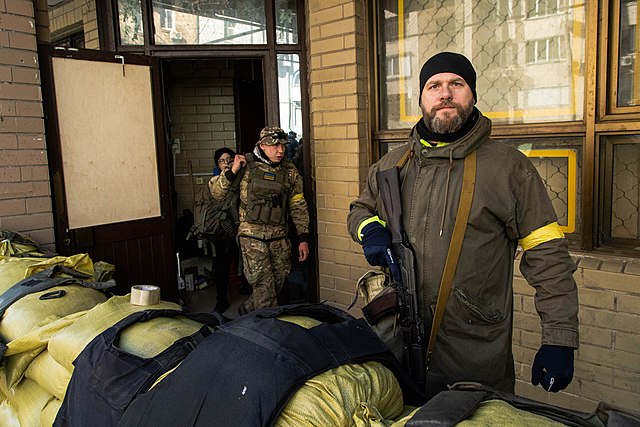
Armed civilians in Kyiv February 2022

If you don’t know much about Central Europe other than the chilling photos of bombs hitting maternity hospitals and cities with no food, heat, light, medical supplies or even water, take a look at Bloodlands. It becomes crystal clear why the Ukrainians are willing to fight for their freedom, and why the Poles and the Baltic states. are doing everything they can to help.

http://Timothy Snyder. Bloodlands: Europe Between Hitler and Stalin
Katyn Massacre–Never Forget đź™Ź

April marks the 81st year since more than 22,000 Polish military officers and other Polish intellectuals were killed in what became known as the Katyn Massacre. Their deaths quickly became an open mystery early on in the war, and remain that way until the 1990s.

Most of us know that Germany attacked Poland from the east on September 1, 1939. Just 16 days later, because of the Molotov-Ribbentrop Pact, the Soviet Union attacked Poland from the west. It’s difficult to know how many Poles were initially captured by the Soviets–estimates go between 250,000 and 455,000 men. In a relatively short time, many escaped and others were allowed to leave after interrogations, but by November 1939, Laeventia Beria, head of the Russian NKVD (precurser of the KGB) held about 40,000 men in prisons around Kozelsk and Karkiv, inside the USSR. On March 5, 1940, Stalin agreed with Beria, and they, with six other members of the Politburo, signed execution orders for over 25,000 “counter-revolutionaries.” During April and May, members of the Polish military, pilots, government officials, police, lawyers, doctors, engineers, professors, writers, journalists, large landowners and priests were killed, and thrown into unmarked graves, most of them in the Katyn Forest. Stalin hoped to get rid of individuals who could oppose the Soviet Union at the end of the war.

The “fog of war” regarding the missing Poles continued until June 1941, when Germany turned on its “friend” with Operation Barbarossa–the attempt to take over the Soviet Union. Despite their recent war with the Soviets, the Polish government-in-exile in London headed by President Wladyslaw Sikorski, signed the Sikorski-Mayski Agreement against Germany. The government-in-exile expected that the Polish POWs held in Russians would be released and fight with the Polish government. Sikorski asked Stalin where they were. The answer was that they had escapes, and the Russians had “lost track” of them, but they were probably in Manchuria. No one believed that, but the Soviets insisted that they simply didn’t know anything else.

General Wladyslaw Sikorski

However, when Germany pushed deep into the USSR around Smolensk in April 1943 they found a mass grave of thousands of men. Josef Goebbels, Hitler’s Minister of Propaganda and closed confident, was thrilled. He could tell the British, French, Poles in exile, and Americans that their ally, Stalin, had killed thousands of Poles. He brought in members of the “Katyn Commission” of the International Red Cross (IRC), with 12 forensic examiners, and even a number of Allied POWs, to examine the site. Now Sikorski demanded an explanation. Stalin replied that the Germans had actually massacred the Poles, and then cut all diplomatic relations with the Polish government-in-exile. Throughout the rest of the war, Stalin maintained that it was Germany which had massacred the Poles, regardless of the IRC’s extensive information.

In 1952, the US conducted a congressional enquiry about Katyn. It, too, found that the massacre had be done by the Soviets, but very little was said or done about it. And after the war, when Poland came under the controlled by the Kremlin, little more was said about it . . . in public. But behind closed doors, and among the Polish diaspora people continued to ask questions about what happened in the Katyn forest.

Over the decades, the questions of the massacre festered under the surface. In the 1970s, the Flying University in Poland, and the Workers Defense Committee started openly asking questions. Despite arrests and beatings, more and more people demanded that the documents be unsealed. In 1981, Solidarity took a significant step when it set up a Katyn memorial. The Polish Communist Party took it down, but every Zaduszki Day (All Souls Day) Poles would set up crosses with the same silent questions. Not until 1989, when real cracks appeared throughout the Warsaw Pact, did the USSR admit that Stalin had authorized the massacre. The following years, Mikhail Gorbachov explained that Stalin had agreed with Beria and had authorized the NKVD to exterminate so many of Poland’s elite. That year, the Kremlin also turned over a number of formerly top-secret documents to the Polish President, Lech Walesa.

Even so, it was another 20 years before Russia finally provided Poland with 81 volumes of material, though they still hold 35 more volumes of classified documents. On the 70th anniversary of the Massacre, the Polish Prime Minister, Donald Tusk, and the Russian Prime Minister Vladimir Putin attended a memorial service near the actual site. Yet, to this day, there are still many, many questions to be answered.

KATYN . . . NEVER FORGET.

Katyn Massacre Statue, Jersey City, NJ

If you’re interesting in getting more in-depth information, take a look at:

Adam Paul, Katyn: Stalin’s Massacre and the Triumph of Truth

https://www.quailridgebooks.com/book/9780875806341

STOP‼️

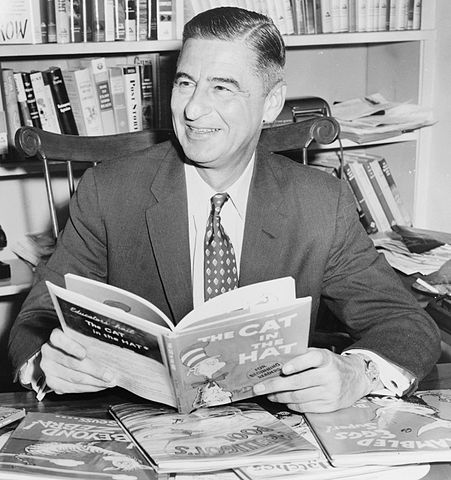
We’re arrived at a bridge too far. I’m not talking about the movie. It’s a great film, but we can talk about it another day. I’m talking about the huge brouhaha over Dr. Seuss. I can understand people trying to cancel things, but cancelling Dr. Seuss is a bridge too far. Apparently we can’t buy a copy of McElligot’s Pool, but can buy as many copies of Hitler’s Mein Kampf, of Mao’s Little Red Book as we want. Yes, early in his career some of Theodor Geisel’s work contained several ethnic or racial stereotypes that were offensive. But over the years he change his attitude. Read his entire body of work. Even better, listen to his own words. He was vehemently anti-fascist and anti-communist and opposed discrimination. Let’s take a look at some of his other books.

The Butter Battle Book–A metaphors for nuclear disarmament.

The Lorax–Encourages personal responsibility for a clean environment.

The Sneetches–Satirical book attacking discrimination between races.

Yertle the Turtle–Opposition to Hitler, and all types of authoritarianism.

Oh the Places You’ll Go–Uplifting book for ALL ages.

Green Eggs and Ham–Personal favorite. Best way to get kids to at least try vegetables.

And those are just a few. What’s particularly ironic is that fact the Geisel understood that kids understand the moral of a story faster than some of their parents!

So I ask again, why ban six Dr. Suess books that he himself came to see contained pages which could be upsetting to readers, yet works by Hitler, Stalin and Mao can be purchased almost anywhere? That says more about the “cancellers” than it does about Geisel. And while I at it, which adults actually read the anti-Semitic screed The Protocols of the Elders of Zion, or Stalin’s The Foundation of Leninism? I’m willing to bet that many of the people who ban Dr. Suess haven’t even read those books which remain available. Books that are truly deplorable, written by truly deplorable people who NEVER changed their minds. Theodor Geisel DID change his.

How about this–no more book banning–more book reading. And then discuss them. Calmly. With a variety of people, not just those who agree with you. No drowning out other people. THINK about what the other guy is saying. Is there anything you like in the book? What parts do you disagree with? How would you improve or change what’s in it? Are there any points where you may both agree? If not, then I seriously suggest that you learn to calmly agree to disagree and move on. Unless, of course, you think that going to war with neighbors, friends, relatives and the general public every time you see anything that doesn’t many you warm and fuzzy is a great idea.

Theodor Seuss Geisel