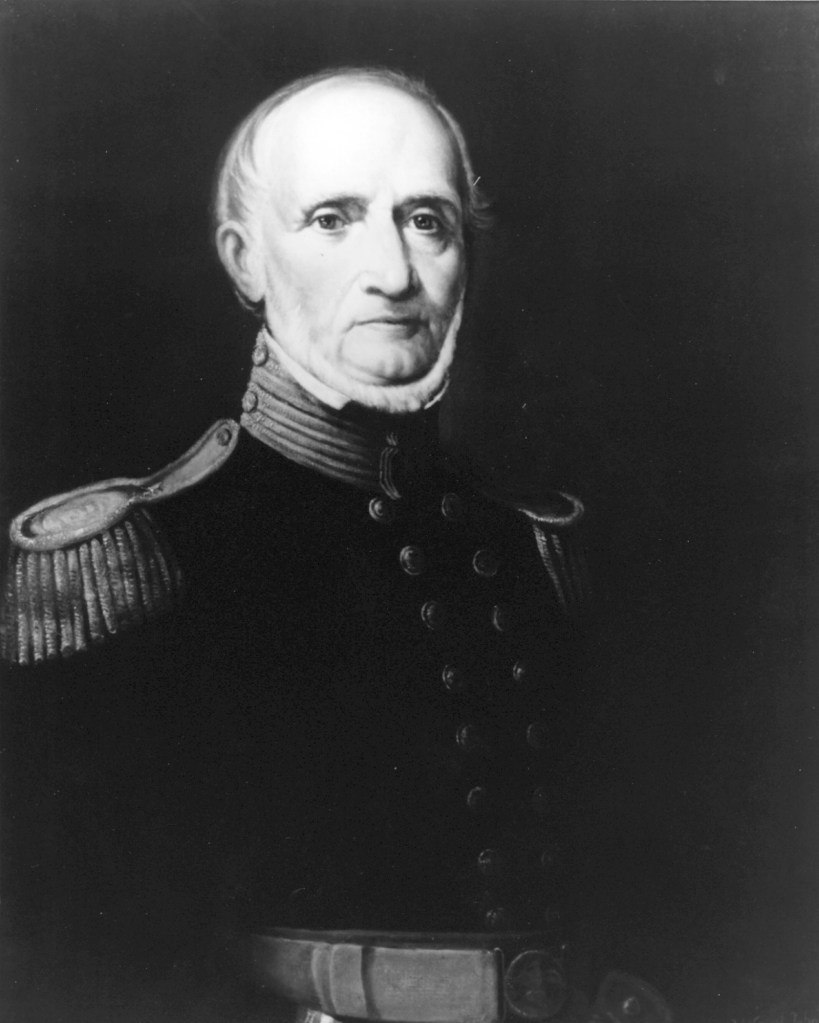
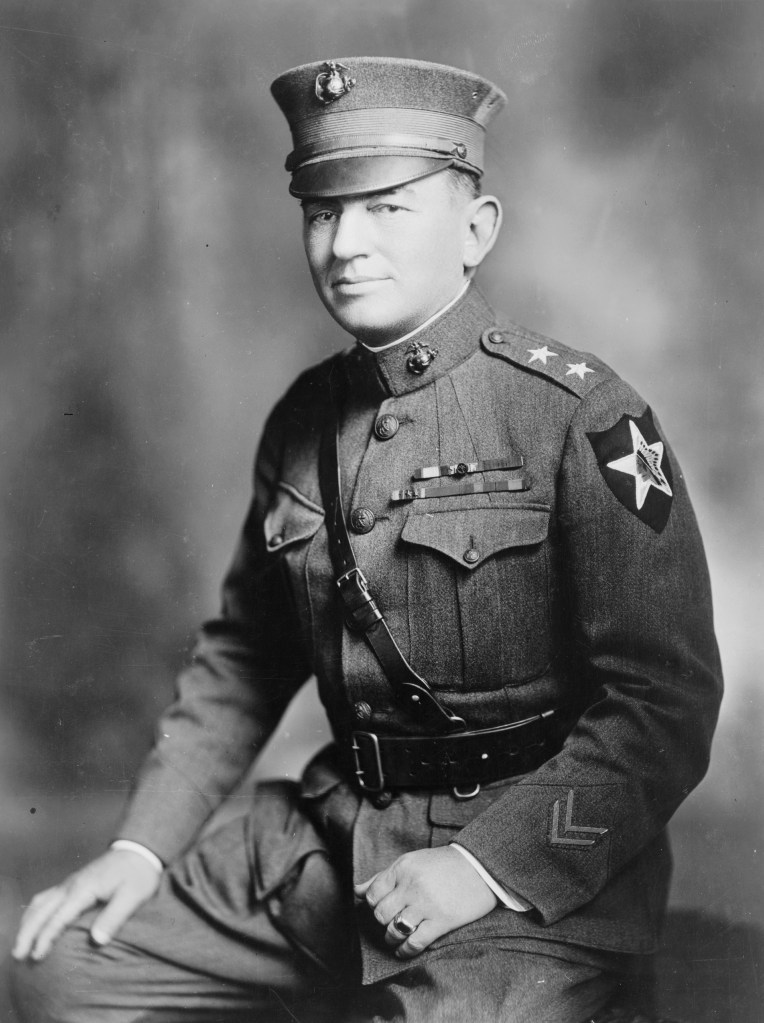
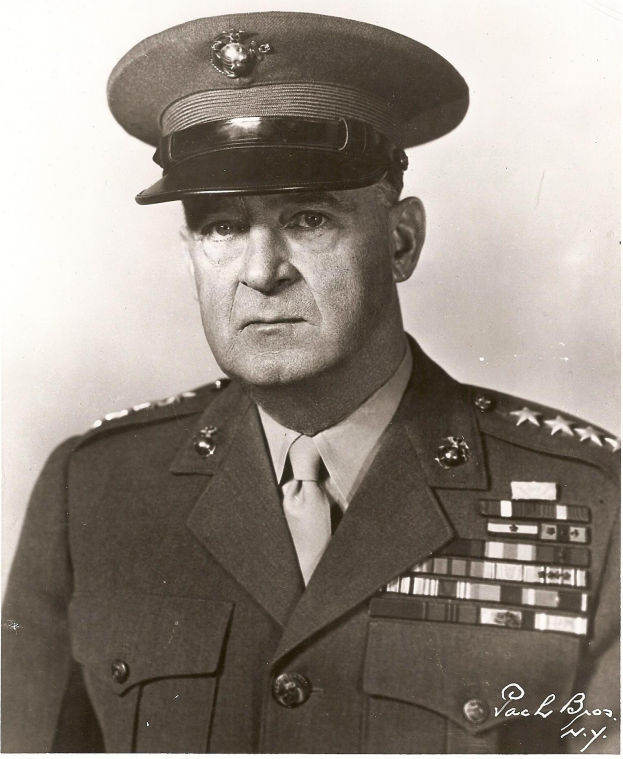
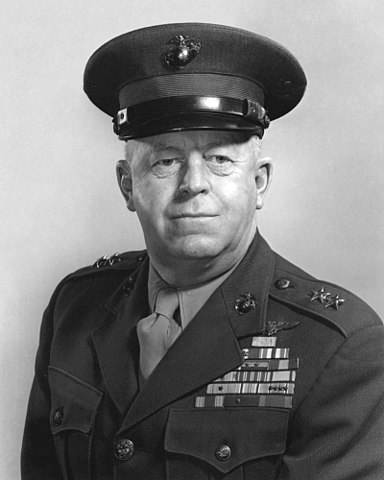
It was 246 days ago today that Captain Samuel Nicholas started recruiting Marines at Tun Tavern located at Water Street in Philadelphia. They have had a long and storied career with no end in sight. (You might want to take a look at last year’s birthday post.) Here are a few portraits/photos of some of the past Commandants of the United States Marine Corps.
Guadalcanal Diary–a movie based on a memoir written by war correspondent Richard Tregaskis. Why am I posting about a movie made 77 years ago, when there are so many current issues that need our attention? Because I’m done hearing words like defund, defame, slander, woke, and on and on. And there is absolutely NO excuse for any elected official to tolerate violence from either the right or the left. Whether we’re happy or furious with the election, we are all Americans and as such, we must treat all Americans with respect. The Marines at Guadalcanal came from every walk of life, every state of the Union, every denomination (or no denomination), had dropped out of school or held advanced degrees, had voted for Republicans or Democrats, and noneof it mattered to them. They were Americans. Would they be proud of any of us today????
So what about Guadalcanal Diary? The movie is one of the most intense and realistic films that ever came out of the war, and actually was opened on November 5, 1943, just months after the end of the campaign that lasted from August 7, 1942 to February 9, 1943. Guadalcanal is one of a chain of islands in the eastern Solomon Islands. After the Battles of the Coral Seas and Midway, the US began its “island hopping” campaign to eventually reach Tokyo.
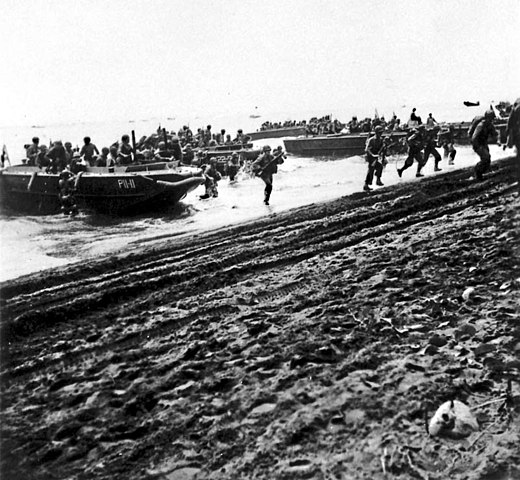
1st Division, USMC landing at Guadalcanal, August 7, 1942
Seventy-five warships and transports arrive at Guadalcanal, with 11,000 Marines, led by MajGen. Alexander A. Vandegrift. They surprising the Japanese in what’s known as the “Midnight Raid of Guadalcanal.” They quickly secured the area around Lunga Point and found that the Japanese had been in the process of setting up an airstrip. The Marines immediately took charge of it, renaming it Henderson Field. By August 30th there were Wildcats, Dauntlesses, Aircobras and assorted other planes, all part of the Cactus Air Force (Cactus was the codename of Guadalcanal). They would attack ships in the “Tokyo Express” which were delivering men and materiel from Rabaul to the Guadalcanal, as well as provide support for the Marines.
On the 8th, it became clear that Japanese aircraft and naval vessels at Rabaul were close enough to do significant damage to the Americans. Seamen and Marines off-loaded as much of the supplies as possible, but the Navy sailed away early on August 9, taking with them roughly half of the supplies needed by the Marines. That left some bad feelings for years. In defense of the Navy, one Australian cruiser was sunk and three US cruisers and two destroyers were badly damaged that same night in what’s called the Battle of Savo Island. Over the following months tens of ships sank into what we still call Ironbottom Sound.
BGen. Merritt Edson
Over the next four month, the Japanese attempted to retake Guadalcanal, while the Americans kept expanding their perimeter. During the Battle of Tenaru on August 21, the Americans counterattacked several companies of Japanese infantry, killing two-thirds of then near the Lunga River. Early in September, coast watchers informed the Marines that the Japanese were planning another massive raid. Major “Red Mike” (Merritt) Edson and his men carried out several raids, bringing back information that 3000 Japanese were planning to move from Lunga River to Henderson Field. With that, he and more than 800 Marines took up their places on what became know as Edson Ridge. Over the next three days, the fighting on and around the Ridge was brutal—often hand-to-hand. By the 14th, when the Japanese began to pull back, they had lost 850 men—the Marines has lost 104.
Henderson Field
The Marines began strengthening and expanding their perimeter, with sporadic Navy convoys bringing much needed supplies and ammunition. At the same time, the Japanese were moving 20,000 troops from Rabaul to Guadalcanal. By October 17, they were ready to take Henderson Field. They were expecting about 10,000 US troops. Actually there were about 23,000 Americans. The fighting began on the 23d and for the following two nights there were constant attacks all around the Lunga River. A few Japanese troops even managed to break through to the airfield, but the Marines, some Army infantry, cooks, Navy medics–anyone who could use a rifle–won the Battle of Henderson Field.
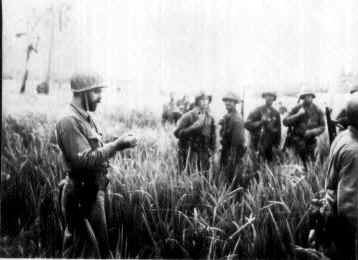
Group of Carlson’s Raiders, Guadalcanal
From there, the Marines went on the offensive, and by early November the Japanese were trying to blend into the jungle. By the 12th the remaining Japanese were at Koli Point. Evan Carlson (of Carlson’s Raiders) made a 29-day trek along the expanding American perimeter, carrying out a number of small engagements and forcing the Japanese to constantly retreat. By the time the Japanese had returned to the Lunga River, only 700-800 of the 20,000 troops remained.
By the end of the month, the Japanese were truly desperate, with virtually no supplies or food. Intelligence told the US that Japanese destroyers were going to attempt to resupply them. Task Force 64, with four cruisers and six destroyers, attempted to torpedo the Japanese ships, but in just four minutes, the Japanese destroyers turn and torpedo the American ships, severely damaging three cruisers, and sinking one at Iron Bottom Sound during the short Battle of Tassafaronga. Nonetheless, the Japanese realized that they could not retake Guadalcanal. Though they limped along until February the Japanese began to abandon Guadalcanal to the Americans in December 1942.
So watch the movie and then really, honestly think about how we are acting. Are we really trying to work together, or prefer to tear the nation apart? And if you want some additional information, you can read Tregaskis’ book. It really gives us something to think about this Thanksgiving.
As an historian, I spend a lot of time reading military history, particularly Marine Corps history. It’s fairly easy to find a lot of great books on the American Revolution, the Civil War, World Wars I and II, and an amazing number of books on our current military. What’s hard to find is information on what happened between the end of the Civil War, when the Marines were basically a small constabulary, and World War I, when the Marines were an elite fighting force of 72,000 men.
Well, actually several things changed after the Civil War. The U.S. went from sail to steam meaning larger, faster ships which needed additional sailors—and Marines (often called “soldiers of the sea.”) Marines also received several new and improved weapons like the Maxim gun, precursor of the machine gun. After 1865, the country began growing at a massive rate, as did our foreign trade. And with that foreign trade went both the Navy and Marines. Even so, the Marines were different by the beginning of the Great War—and I recently read a book which, at least in part, explained why.
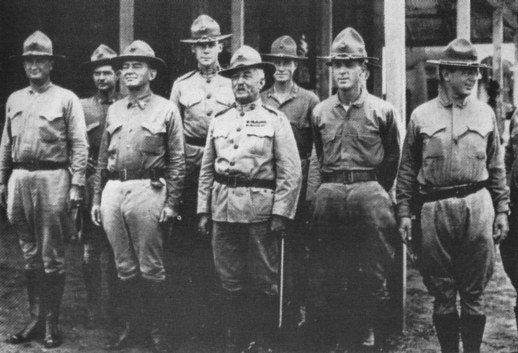
From left to right, Wendell Neville, John Lejeune, Littleton Waller and Smedley Butler circa 1914
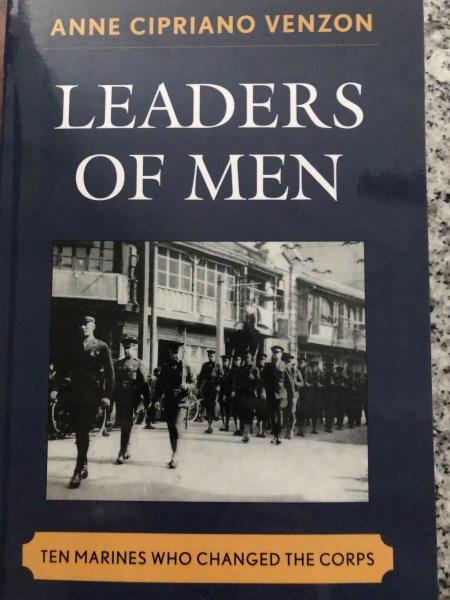
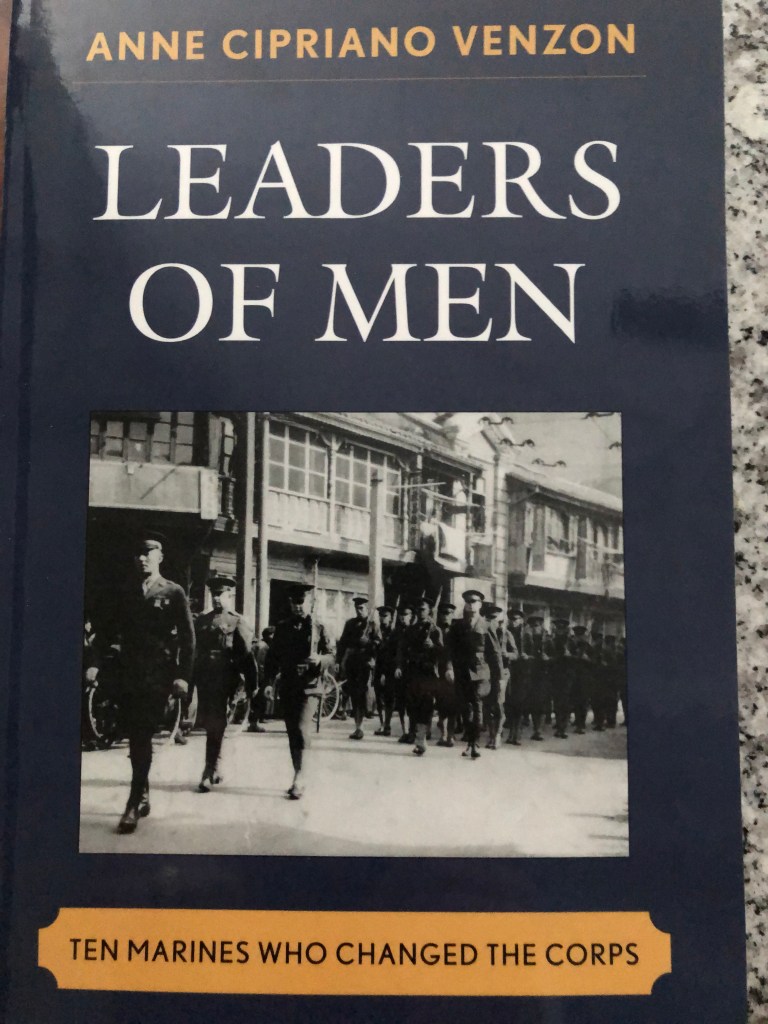
Leaders of Men by Dr. A.C. Venzon discusses 10 Marine officers who overlapped the years 1861 to 1923 and explains how their natural leadership abilities gradually changed the attitudes, training, and morale of the Marine Corps. From Col. Robert Huntington, who joined the minuscule 3,000-man Marine Corps in June 1861 and started his career at First Manassas, to Col. Fritz Wise, who fought with his men at Belleau Woods in 1918, each of these men learned from their elders and, in turn, trained those who followed them.
A portrait of Marines at Belleau Woods, 1918
It’s a fascinating, eclectic group. In addition to Huntington and Wise, there’s the indomitable Smedley D. Butler. But Venzon includes other men who’s names have been shoved into dusty corners of libraries. These men, like Littleton W.T. Waller, Joseph (Uncle Joe) Pendleton, Wendell (Buck) Neville, “Hiking” Hiram Bears, John (Handsome Jack) Myers, and George Thorpe, fought in Egypt, Alaska, Panama, China, Ethiopia, Djibouti, Honduras, Nicaragua, Cuba, the Philippines, Mexico and Haiti. One was an absolute martinet. One or two drank too much. Some were wounded. Some dealt with malaria or dengue fever. One had a breakdown. All had their foibles. But well after they retired, the men they had trained and fought with would tell anyone who would listen that they had become better Marines, real Marines, because of these men.
The author has used extensive, little-known documents and rare photographs to reintroduce these men who had such an important part of the USMC in the 20th century and beyond. A relatively short book has given the reader a much better understanding of what actually made the Marine Corps what it is today.
Anne Cipriano Venzon. Leaders of Men: Ten Men Who Changed the Corps. Latham, MD: Roman & Littlefield, 2008.
This Sunday, November 10, is the 244th birthday of the United States Marine Corps. As a child, I learned about the men who joined the very first Marines at Tun Tavern in Philadelphia (November 10, 1775). About Presley O’Bannon and the Barbary Pirates. How BGen. Archibald Henderson left a note on his door “Have gone to Florida to fight Indians. Will be back when war is over.” How 50 Marines led by Capt. John T. Myers, with a small group of British, Russian, German and French soldiers held the Legations at Peking for 55 days. And of course there was Belleau Wood, where Sgt. Dan Daly—who already had received two Medals of Honor—is said to have hollered to his men, “come on you sons of bitches, do you want to live forever?“
BGen. John T. Myers
I learned about places like Chapultepec, Sumatra, Addis Ababa, Tampico, Tientsin, Cavite, Chateau Thierry, Guam, Guadalcanal, Iwo Jima, and Chosin Reservoir. I heard names like Robert Huntington, Littleton W.T. Waller, Smedley Butler, Fritz Wise, Alexander A. Vandegrift, “Red Mike” Edson, and so many more. I was rearranging some books over the weekend to make room for two new ones. (My father used to say that I buy my books by the pound). One of them is about General Clifton Cates who, as 2d Lieutenant Clifton B. Cates told his battalion HQ “I will hold” during the carnage of Belleau Wood, on July 19, 1918.
Born in Tiptonville, Tennessee on August 31, 1893, Cates was graduated from the Missouri Military Academy in 1910. He later graduated from the University of Tennessee College of Law in 1916, and was admitted to the Bar that same year. While the Great War raged in Europe, the US only felt below-the-surface rumblings. But when the Germans announced they would begin Unrestricted Submarine Warfare on February 1, 1917, followed immediately by the Zimmerman Telegram which suggesting an alliance between Mexico and Germany, it became crystal clear that the Americans were going to war. (Congress declared war on April 6, 1917.) Cates, like so many of his friends, wanted to serve, and one young man told him that a group called Marines were looking for men. Cates asked him “what is a Marine?” It didn’t matter—he wanted to fight for his country, and after passing all the tests and physicals he was commissioned as a 2d Lieutenant in the Marine Corps Reserve on June 13, 1917.
Naval Hospital, Parris Island c. 1919 (NH series NH1000000, NH100843)
He and his buddies ended up in Parris Island, near Beaufort, South Carolina. It wasn’t the Parris we know today, but the Parris Island that was little more than a swamp with a few ancient plantation houses. Not only did the men learn to be Marines—drills, the rifle range, more drills, more rifle range—but they also built everything from schools and barracks to latrines. From Parris Island his cohort moved north to Quantico in northern Virginia. More instruction, more drills, more rifle range, though now they could occasionally go into the town of Quantico for a good meal and enjoy the ladies at the dance hall.
Finally they were ready to go “Over There” aboard the USS Henderson. Part of a convoy for four transports and a battleship, they arrived at St. Nazaire, France, on February 5, 1918, and after some time learning about trench warfare from the French, ended up along the Paris-Metz highway on June 1, 1918, as part of the 96th Company, 6th Regiment. Over the coming weeks, they took massive casualties at Bouresches and Belleau Wood. He and a few men ended up in an abandoned French trench where he scrippled a quick note and send a runner to the Battalion HQ. It’s worth reading:
“I have only two men out of my company and 20 of other companies. We need support, but it is almost suicidal to try to get it here as we are swept by machine-gun fire and a constant artillery barrage is on us. I have no one on my left and very few on my right. I WILL HOLD.”
He did. And those words continue to inspire Marines to this day. Later that afternoon some men from a French battalion pushed forward and hooked up with the beleaguered Marines. Cates and his men were part of the troops to win the campaigns of Soisson, Blanc Mont Ridge, the St. Mihiel Salient and the Meuse-Argonne. By the end of World War I, Cates had received the Navy Cross, Distinuished Service Cross with oak leaf cluster, the Purple Heart, Silver Star and the French Croix de Guerre.
Among the survivors of the 2d Battalion, 6th Regiment were Maj. Thomas Holcomb, 1st Lt. Clifton Cates, and 1st Lt. Graves Erskine (Naval History and Heritage Command)
After a year of occupation duty in Germany, Cates returned to the States. He expected to spend the rest of his live as a lawyer in Tennessee. While waiting for his discharge order he ran into Commandant George Barnett who suggested that maybe Cates would like to serve as the Commandant’s Aide-de-Camp. He said yes, and never looked back. After working for Barnett, Cates had sea duty on the USS California, served in Shanghai twice, worked at the War Plan’s section at Headquarters, Marine Corps, and as war clouds loomed again, became Director of the Marine Corps Basic School at the Philadelphia Navy Yard.
On August 4, 1942, Cates, now a colonel in charge of the 1st Marine Regiment, used everything he’d learned during the 1st World War—better training, security, tactics and weapons—and spent the next five months retaking Guadalcanal. Then it was back to the States to command the Marine Corps School at Quantico. In June 1944, General Cates returned to the Pacific in command of the 4th Marine Division. Retaking Tinian Island was tough, but fast. The 4th Division quickly headed back to Maui for R+R and then serious training because they, along with the 3d and 5th Marine Divisions, would face General Kuribayashi and 22,000 Japanese soldiers on the black volcanic sand of Iwo Jima on February 19, 1945. It took another 37 days to secure the island—one of the toughest in Marine Corps history.
After the war and a number of short assignments, he again commanded the Marine Barracks at Quantico. On January 1, 1948, Cates arrived at the pinnacle of his career, becoming the 19th Commandant of the Marine Corps. In the middle of his term as Commandant, the North Korean army flooded across the 38th Parallel, starting the Korean War, and again the Marines were in the thick of it. He made several tours of the Korean front, and after his friend General Lemuel Shepherd became the 20th Commandant in 1952, Cates went back to his Marines at Quantico until he retired on June 24, 1954. Cates died at the US Naval Hospital at Annapolis on June 4, 1970 and was laid to rest at Arlington National Cemetery on June 8.
Marine Commandant Clifton B. Cates
General Cates (sometimes known as Lucky Cliff) would agree with me in saying that there are many truly amazing men and women Marines. And there are some great books about the Marines I’ve mentioned—and many more. (And none of them weigh much at all🙄) You can use an actual book, a Kindle, even Audible books, but try reading one—though I bet you’ll find that they’re like potato chips—you can’t stop with just one. I’ve listed just a few of those books below, but if you’re looking for something else, just let me know—I’m happy to help.
James Nelson, I Will Hold
Dirk Ballendorf, Pete Ellis
Roger Willock, Unaccustomed to Fear: A biography of the Late General Roy Geiger
David Ulbrich, Preparing for Victory: Thomas Holcomp
Victor Krulak, First to Fight: Lt.Gen. Victor H. Krulak
John Lejeune, The Reminiscences of a Marine
Jon Hoffman, Chesty
Holland Smith, Coral and Brass
Jon Hoffman, Once a Legend: “Red Mike” Edson and the Marine Raiders
Hans Schmidt, Maverick Marine: General Smedley D. Butler
Merrill Twining, No Bended Knee
A.A. Vandegrift, Once a Marine
Frederic Wise, A Marine Tells it to You
Bernard Cole, Gunboats and Marines
Allan Millett, In Many a Strife: General Gerald C. Thomas
Albertus Catlin, “With the Help of God and a Few Marines”







 Historical Lense