January 17 is Rev. Martin Luther King Jr.’s Day–a day when we celebrate one of America’s guiding lights who helped changed the direction of our country for the better. We can learn a great deal about Dr. King’s life and work, but as a teacher, I though it might be interesting to take a look at Morehouse College, Dr. King’s alma mater and one of the first historically black men’s colleges.
In 1867, just two years after the end of the Civil War, Willian J. White, with help from James Tate, Rev. Richard Coulter and Rev. Edmund Turner, established the National Theological Institute in Augusta, Georgia. With assistance from the American Baptist Home Mission, the Institute moved to Atlanta, GA, in 1879 where Rev. Joseph Roberts served as its first President. The Institute also changed its name to the Atlanta Baptist Seminary.
Obelisk near the King Chapel of Morehouse College
Eight years later, Samuel Graves became its second President. With the help of John D. Rockefeller, the industrialist and a Baptist himself, the Seminary moved to what is now its main campus in Atlanta. George Sale served as it’s third President from 1890 to 1906, when John Hope became the fourth President, and the first African-American President of the Seminary. It wasn’t until 1913 that the Atlanta Baptist Seminary changed it name to Morehouse College in honor of Henry Morehouse who had been the secretary of the American Baptist Home Mission and who had worked closely with Rockefeller to expand the college. Samuel Archer became the sixth President during the nadir of the Depression from 1931 to 1940.
President Benjamin Mays (1940-1967)
In 1940 Benjamin Mays became the sixth president of Morehouse. During his tenure he expanded the number of students, including international students. Dr. King entered Morehouse in 1944, following his father’s and maternal grandfather’s footsteps. Years later he commented that Mays was “one of the greatest influences in my life.” Mays preached every Tuesday morning at the chapel. It was there that he explained Gandhi’s methods of non-violence. In addition, Mays made a number of speeches during the 1950s that helped students and faculty decide what direction they would follow in the emerging Civil Rights issues.
Dr. King was graduated in 1948, and we all know how his work improved, and continues to improve, our nation. Morehouse has also grown into an important institution. There have been 11 Fulbright scholars, five Rhodes scholars and five Marshall scholars, and in addition to Dr. King there have been men like Julian Bond, Spike Lee, Samuel L. Jackson, and countless scientists, doctors, state and federal officials and important industrialists and entrepreneurs. The next century at Morehouse should be a bright one.
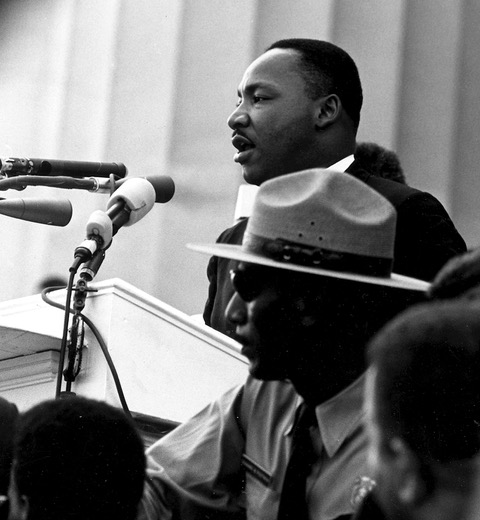
Dr. Martin Luther King, Jr. at the March on Washington, August 1963
This year we’re celebrating Rev. Martin Luther King, Jr’s 92d birthday. I’m sure that he would say that there’s still work to do, but that we have, thanks to him and so many other people, made significant changes for the better. Yet it’s been more than fifty years since his assassination. Since then too many people have forgotten some of what he stood for–specifically non-violence. At such a difficult time as this, maybe we should remind ourselves of some of his core beliefs.
King was born on January 15, 1929. Both his father and grandfather had been pastors at the Ebenezer Baptist Church in Atlanta, Georgia. King himself attended the Booker T. Washington High School in Atlanta, where people first realized that he was an outstanding public speaker. In 1944, at the end of his junior year, he became a freshman at Morehouse College, one of the Historically Black Colleges. He earned a degree in Sociology in 1949, and had decided that he, too, wanted to go into the ministry. He attended Crozier Theological Seminary in Pennsylvania, graduating in 1951, and moved to Boston College where he earned a doctorate in 1955.
The Montgomery Bus Boycott began in December of that same year and continued for 385 days. King’s home was bombed and he was jailed, but finally the US District Court ended racial segregation on buses. During the boycott, King had become an important orator and major figure in the work to end segregation. In 1957, he, along with Ralph Abernathy, Fred Shuttlesworth, Joseph Lowery and others established the Southern Christian Leadership Conference (SCLC). Largely made up of black churches, they set about using nonviolent protests to end segregation. At the same time, he wrote an important book–Strive Toward Freedom.
Sit-ins in lunch-counters in Atlanta starting in 1960, ultimately resulted in desecrated in the fall of 1961. Then in 1963 the SCLC started a campaign to end segretion in Birmingham, Alabama–using non-violent actions including marches and sit-ins. Even children were involved. The Chief of Police, Eugene (Bull) Connor condoned using high-pressure hoses and police K9s against protesters. Both black and white Americans could now see this on TV and were horrified. Finally Connor left the force, and many of the Jim Crow Laws were repealed. During the time that MLK was in jail in Birmingham, (the 13th of 29 times he was jailed) he wrote the famous “Letter from Birmingham Jail.”
Scene of the March on Washington August 1963
Though King’s reputation grew, he was not happy with the slow pace of desegregation and hoped the the upcoming March on Washington for Jobs and Freedom could make a significant difference. On August 28, 1963, 250,000 people of every race and creed arrived at the National Mall in Washington, D.C. King delivered a memorable17-minute speech, but the part that we all remember was given extemporaneously. (I was listening to it on the radio as my Mother and I were washing the windows–some thing you never forget!) The March and that speech made it impossible to ignore the issues on a national level. The Civil Rights Act was passed in 1964, and the Voting Rights Act was passed in 1965.
I Have a Dream speech at the March on Washington
King couldn’t be at the Edmund Pettus Bridge between Selma and Montgomery on March 7, 1965–known as Bloody Sunday. Learning what had happened, he got there as soon as he could and began working. On March 25 the marchers finally were able to walk all the way without more violence. He briefly moved to Chicago in 1966 to help with desegregation in parts of the city, and in March 1968, went to Memphis, Tennessee, to support black sanitation and public workers who were on strike. On April 3, he delivered the important “I’ve Been to the Mountain” speech. The following day, at 6 pm, James Earl Ray shot King on the second floor balcony at the Lorraine Motel. He died at St. Joseph Hospital an hour later.
Riots erupted almost immediately from Washington, D.C., Baltimore, Chicago, Louisville, Kansas City and many other cities, large and small. President Johnson declared April 7th a national day of mourning, and Vice President Hubert Humphrey attended the funeral. Dr. King rests at the Martin Luther King, Jr. National Historical Park.
Martin Luther King Jr. Memorial, Washington, D.C.
Below is the extemporaneous part of King’s “I Have a Dream” speech. Read it carefully. What do his words truly mean. I think you’ll find that he hoped that we can all come together, not split apart. He would not have wanted to see riots after his death, and I believe that he would not have wanted to see the riots–any riots–of this past year. If we learn anything from him, I believe that it’s that violence creates more violence. Peaceful protest brings people together. Which do you prefer?
I say to you today, my friends, so even though we face the difficulties of today and tomorrow, I still have a dream. It is a dream deeply rooted in the American dream.
I have a dream that one day this nation will rise up and live out the true meaning of its creed: ‘We hold these truths to be self-evident: that all men are created equal.’
I have a dream that one day on the red hills of Georgia the sons of former slaves and the sons of former slave owners will be able to sit down together at the table of brotherhood.
I have a dream that one day even the state of Mississippi, a state sweltering with the heat of injustice, sweltering with the heat of oppression, will be transformed into an oasis of freedom and justice.
I have a dream that my four little children will one day live in a nation where they will not be judged by the color of their skin but by the content of their character.
I have a dream today.
I have a dream that one day, down in Alabama, with its vicious racists, with its governor having his lips dripping with the words of interposition and nullification; one day right there in Alabama, little black boys and black girls will be able to join hands with little white boys and white girls as sisters and brothers.




 Historical Lense