Hong Kong Update ðŸ˜¢

Jimmy Lai, owner of the Apple Daily

You may remember several months ago I spoke about the current crack-down on Hong Kong by the Beijing government. A number of democracy activists had ben thrown into prison for their involvement in an unauthorized protest on August 18, 2019 involving more than 1.7 million people. In April 2020, 72-year-old Jimmu Lai, the owner and publisher of the Apple Daily News, and 82-year-old Martin Lee, the founder of Hong Kong’s democracy movement and one of the people who put together the original Hong Kong constitution, and seven others, were jailed. In May, the Communist Party announced that it would try to pass a new National Security Law. Despite more protests and pushback from the Hong Kong legislature, they “passed” the new laws just before midnight on June 30, 2020.

The trials of the original nine individuals were relatively short, and everyone expected the outcome. On Friday, April 17, District Judge Amanda Woodcock passed the sentences–8 to 18 months. Mr. Lee and three other people got a suspended sentence because of their age, and as long as they didn’t commit any other crimes for the next two years. Mr. Lai, however, received a 12-month sentence. And that’s the least of his problems. While in jail awaiting his sentence, Beijing added new charges of foreign collusion and additional counts. That could end up with a life sentence.
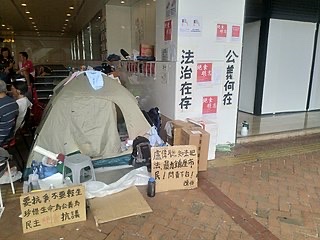
Hunger strikes in Hong Kong late 2019

Recently, Hong Kong’s prosecutors (the phrase Quisling— a person how collaborates with an enemy force that’s occupying that country–comes to mind) have charged 47 additional democratic activists with a variety of offensives, again using the National Security Laws. They tend to be younger individuals and it’s possible that they may receive longer terms. And of course, many of the young people who took to the street during the protests, are still waiting for their day in court. Many Hong Kongers have already left. Others are making their final arrangements ,to leave, but they know that the noose is getting tighter by the week. Still others have decided to stay and do what they can continue the insurrection–though largely underground.

It’s difficult to watch one of the most prosperous, beautiful cities turned into simply another large, grey, Chinese city. Have we done anything to help? Well, we’ve passed resolutions, and President Biden has said that the US seriously disagrees with Beijing’s behavior. Okay. Beijing doesn’t care. They’ve ignored the 1997 treaty with Great Britain. They haven take Tibet. They’ve put Uighurs in in slave-labor or concentration camps. They’ve decided they want Hong Kong and are in the process of absorbing it. And we’ve done nothing. How about we lobby for Mr. Lai? Lobby the Nobel Peace Prize for Mr. Lee? Make it clear that any Hong Konger goes to the head of the line when asking for asylum in the US. There is much we can do short of bullets to help.
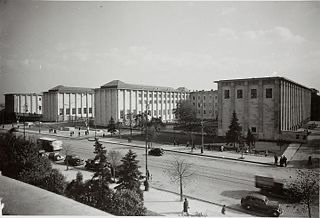
Poland, 1938

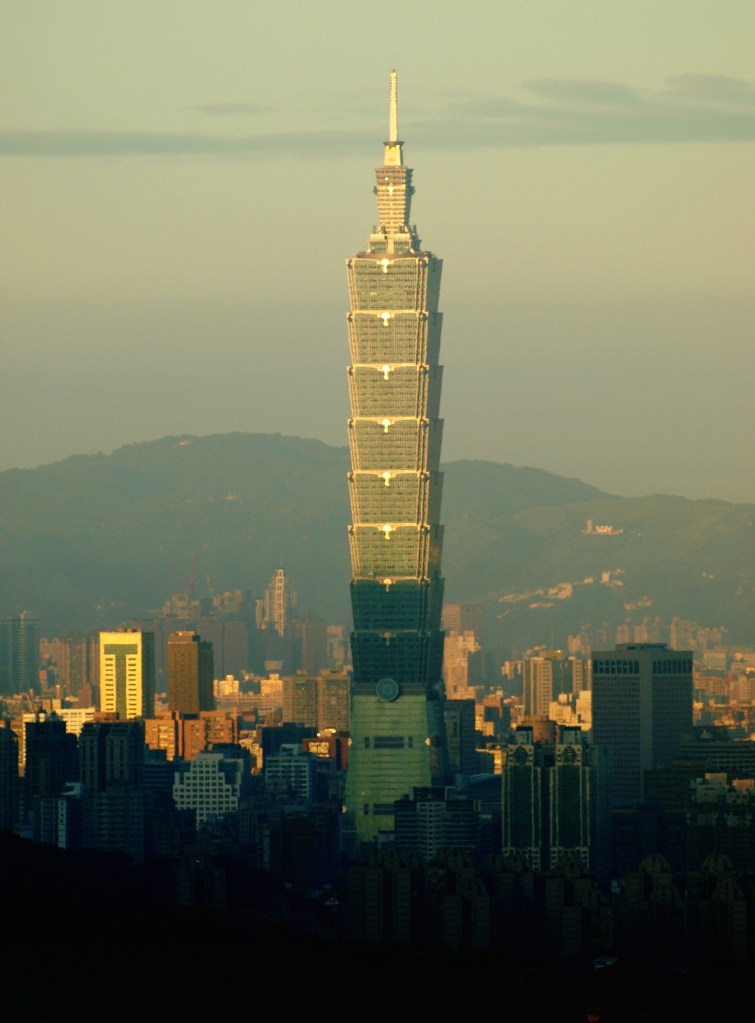
A logical questions is, what’s next. Well, if we paid attention we’d see that what Beijing really wants is Taiwan. They’ve made that very clear. Taiwan understands that. Two weeks ago, the Foreign Minister, Joseph Wu, announced that the nation will defend itself “to the very last day” if attacked by Beijing. And It’s good to see that the US, UK, and Australia seem to be paying attention. But this reminds we of Poland 82 years ago. The Poles intended to defend Poland to the end. And France and Great Britain signed treaty agreeing to come to their rescue if Germany attacked. What happened? Basically nothing. Are we going to help Taiwan in its time of need?
Taipei, Taiwan

Black History Month–we remember Ralph J. Bunche

Ralph Johnson Bunche, 1904-1971

I was very surprised to learn that some student’s didn’t know who Ralph Bunche was, so Black History Month is the perfect time to learn about an extremely influential American—and international—leader.

Ralph Johnson Bunche was born in Detroit on August 7, 1904. His father, Fred, was not an involved parent, so when Ralph’s mother, Olive, developed serious medical issues in 1915, she moved to Albuquerque, NM, with her children, Ralph and Grace, was born in 1909, along with her mother Lucy Johnson, and the children’s uncle. However, Olive Bunche died in 1917 and three months later, her brother committed suicide. Looking for a better life for all of them, Ralph and Grace’s grandmother took both children to Los Angeles in 1918. There, Ralph was an excellent athlete, and an outstanding student, graduating as the valedictorian from Jefferson High School in 1923. He then attended UCLA, where he graduated summa cum laude, Phi Beta Kappa and valedictorian in 1927.

Bunche received a scholarship to Harvard University where he earned a Master’s degree in 1928 and Ph.D. in political science in 1934. In 1936 he published his first book, A World View of Race. He went on to do post-graduate work at the London School of Economics and the University of Cape Town, South Africa. While working on his dissertation at Harvard, he began teaching at Howard University in Washington, D.C. where he revamped the Political Science department. In addition, in 1940 he worked as the lead investigative research and writer for An American Dilemma with Swedish sociologist Gunner Myrdal. Also while working a Howard, Bunche became one of the new generation of Black American intellectuals who believed that integration was necessary and overdue in the US. He worked with men such as A. Philip Randolph, and Martin Luther King, Jr., and served on the board of the NAACP.

When World War II arrived at America’s shores, Bunche moved from Howard University to the Office of Strategic Services (OSS) where he served as the senior social analyst. He then moved over to the State Department where he was an adviser for the US delegation at the Dumbarton Oaks Conference. He also provided much preliminary work for the United Nations conference in San Francisco, particularly Chapter XI and XII of the UN Charter, and working closely with former First Lady Eleanor Roosevelt.

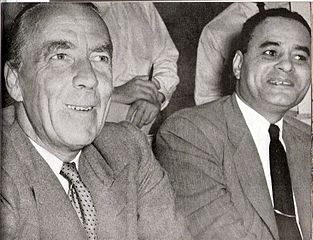
Count Folke Bernadotte and Ralph Bunche

In 1947, the first Secretary General of the UN, Trygve Lie asked Bunche to act as Director of the Trusteeship Committee. He accepted, and in 1948 joined the UN’s Special Committee on Palestine. On September 17, 1948, Count Folke Bernadotte of Sweden, the chief UN mediator of the Arab-Israeli conflict, was assassinated in Jerusalem. The Secretary General requested that Bunche take up Bernadotte’s work, and in 1949 he got both sides to agree to the Armistice Agreement between Israel and Egypt, Jordon, Lebanon and Syria. In 1950, Bunche became the first African American to received the Nobel Peace Prize. He was one of the most important, and famous, men in the US at that point. President Truman asked that he become Assistant Secretary of State, and later, President Kennedy asked Bunche to serve as Secretary of State. He preferred to continue his work in the United Nations.

Over the years, Bunche became the Director of Peacekeeping in the Suez Crisis in 1956, the Congo in 1960, and Cyprus in 1964. By the late 1960’s he was the Undersecretary-General for Special Political Affairs. He had received 69 honorary doctorates, and numerous awards, most importantly, the Presidential Medal of Freedom. It’s very possible that he could have gone on to be the Secretary General of the UN. Unfortunately, Bunche had diabetes, and other medical issues, and decided to retired in 1971. He died on December 9, 1971 and is buried at the Woodlawn Cemetery in New York City.

Hopefully, you’ll look a little deeper into a quiet man who did so much to make both the United States and the world a better place. If you’re looking for a good book about him, take a look at Brian Urquart’s Ralph Bunche: An American Odyssey.