Did you watch the Oscars? I confess I didn’t. It used to be fun/interesting. For me, they’ve become rather dull in the past few years. But that doesn’t mean that I didn’t watch anything at all this year. I’ve started working on a new book–a biography of a fascinating Polish Army/Air Force officer during World War II, and while looking for some information on his work, I stumbled across some material on Westerplatte. I’ve known about the battle for many years, but I didn’t know that anyone had made a movie, so I took some time off to watch 1939 Battle of Westerplatte.
Now we all know that I’m a military historian so I often watch that sort of movie, but this was outstanding. It’s a 2013 Polish film written and directed by Pawel Chochlew. Apparently the movie caused some debate, with some people saying it was anti-Polish, while others found it heroic. It particularly focuses on the leader of the battle and his deputy. Personally, that’s the kind of film that makes me want look deeper and find the real facts. In this case, I already knew a lot about the events, but in case you don’t, here’s the short version of the Battle of Westerplatte.
At the end of World War I, the League of Nations not only set up the second Republic of Poland (1918-1939), but provided for the Free City of Danzig, and allowed for the Depot of Polish Munitions in Transit in the Port of Danzig. The Poles built it on the Westerplatte Peninsula of the harbor. In March 1939, Germany took over an area of Lithuania very close to Danzig. That immediately put Westerplatte on alert. Very quietly, the Polish military began to add troops to the Depot and fortify the area. In late August, when it was clear that Germany was just a few days away from attacking Poland, additional troops joined the 88 men at the Depot.
Major Henryk Sucherski, Polish Army
Between 190 and 240 men and six officer, headed by Maj. Henryk Sucherski and his deputy, Capt. Franciszk Debrowski, were working at a fever pitch to prepare for a German attack. In addition to pistols, rifles and grenades, they brought in all the heavy weapons they could, including a 75 mm field gun, two 37 anti-tank guns, four 81 mm mortars, and 22 standard and 18 heavy machine guns. They also set up numerous tenches, barricades, massive amounts of barbed wire, and reinforce concrete in a number of buildings.
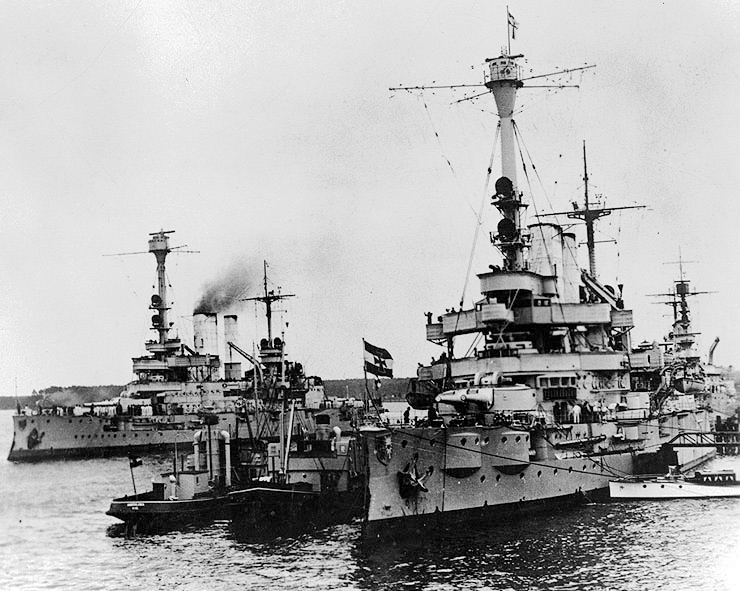
German pre-dreadnought Schleswig-Holstein in the foreground
At the same time, the German pre-dreadnought Schleswig-Holstein arrived at Danzig, allegedly for a “courtesy call,” and anchored just 150 yards away from the Westerplatte Peninsula. The ship carried 225 German Marines. In addition, 1500 Danzig Police (German soldiers) were there to support the Marines. They expected to begin operations on August 26th, but Hitler made a last minute decision to wait until September 1.
Before 5 am on September 1, 1939, the attack on Poland began throughout the German-Polish border, and in the Free City of Danzig. The Schleswig-Holstein let go with a massive broadside pf 12-inch guns against the Depot. The Germans expected it would take a few hours to seize the entire garrison. They were wrong. The Poles repelled 13 assaults, including serious naval bombardment and dive bombers. They held out for seven days.
Of course the film isn’t a documentary. The director uses significant creative license, and focused on the two major characters. Yet it’s thought-provoking as are movies like Greyhound, or Dunkirk, The Longest Day, or the Bridge on the River Kwai. And with that, I’ll go back to find what I was looking for originally.🤔
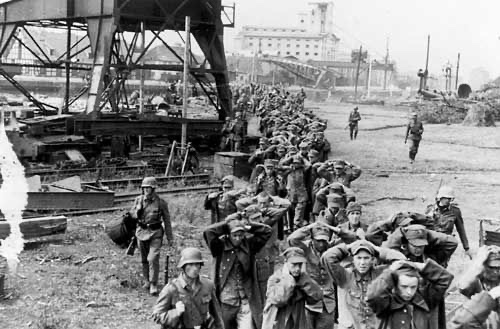
The remnants of the men of Westerplatte in September 1939
You may remember several months ago I spoke about the current crack-down on Hong Kong by the Beijing government. A number of democracy activists had ben thrown into prison for their involvement in an unauthorized protest on August 18, 2019 involving more than 1.7 million people. In April 2020, 72-year-old Jimmu Lai, the owner and publisher of the Apple Daily News, and 82-year-old Martin Lee, the founder of Hong Kong’s democracy movement and one of the people who put together the original Hong Kong constitution, and seven others, were jailed. In May, the Communist Party announced that it would try to pass a new National Security Law. Despite more protests and pushback from the Hong Kong legislature, they “passed” the new laws just before midnight on June 30, 2020.
The trials of the original nine individuals were relatively short, and everyone expected the outcome. On Friday, April 17, District Judge Amanda Woodcock passed the sentences–8 to 18 months. Mr. Lee and three other people got a suspended sentence because of their age, and as long as they didn’t commit any other crimes for the next two years. Mr. Lai, however, received a 12-month sentence. And that’s the least of his problems. While in jail awaiting his sentence, Beijing added new charges of foreign collusion and additional counts. That could end up with a life sentence.
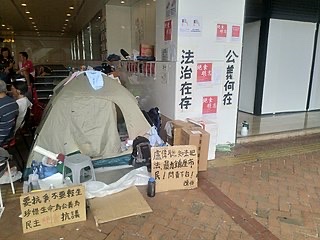
Hunger strikes in Hong Kong late 2019
Recently, Hong Kong’s prosecutors (the phrase Quisling— a person how collaborates with an enemy force that’s occupying that country–comes to mind) have charged 47 additional democratic activists with a variety of offensives, again using the National Security Laws. They tend to be younger individuals and it’s possible that they may receive longer terms. And of course, many of the young people who took to the street during the protests, are still waiting for their day in court. Many Hong Kongers have already left. Others are making their final arrangements ,to leave, but they know that the noose is getting tighter by the week. Still others have decided to stay and do what they can continue the insurrection–though largely underground.
It’s difficult to watch one of the most prosperous, beautiful cities turned into simply another large, grey, Chinese city. Have we done anything to help? Well, we’ve passed resolutions, and President Biden has said that the US seriously disagrees with Beijing’s behavior. Okay. Beijing doesn’t care. They’ve ignored the 1997 treaty with Great Britain. They haven take Tibet. They’ve put Uighurs in in slave-labor or concentration camps. They’ve decided they want Hong Kong and are in the process of absorbing it. And we’ve done nothing. How about we lobby for Mr. Lai? Lobby the Nobel Peace Prize for Mr. Lee? Make it clear that any Hong Konger goes to the head of the line when asking for asylum in the US. There is much we can do short of bullets to help.
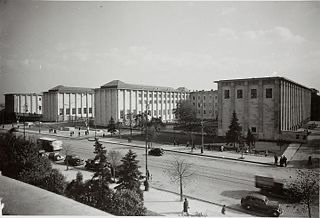
Poland, 1938
A logical questions is, what’s next. Well, if we paid attention we’d see that what Beijing really wants is Taiwan. They’ve made that very clear. Taiwan understands that. Two weeks ago, the Foreign Minister, Joseph Wu, announced that the nation will defend itself “to the very last day” if attacked by Beijing. And It’s good to see that the US, UK, and Australia seem to be paying attention. But this reminds we of Poland 82 years ago. The Poles intended to defend Poland to the end. And France and Great Britain signed treaty agreeing to come to their rescue if Germany attacked. What happened? Basically nothing. Are we going to help Taiwan in its time of need?
April marks the 81st year since more than 22,000 Polish military officers and other Polish intellectuals were killed in what became known as the Katyn Massacre. Their deaths quickly became an open mystery early on in the war, and remain that way until the 1990s.
Most of us know that Germany attacked Poland from the east on September 1, 1939. Just 16 days later, because of the Molotov-Ribbentrop Pact, the Soviet Union attacked Poland from the west. It’s difficult to know how many Poles were initially captured by the Soviets–estimates go between 250,000 and 455,000 men. In a relatively short time, many escaped and others were allowed to leave after interrogations, but by November 1939, Laeventia Beria, head of the Russian NKVD (precurser of the KGB) held about 40,000 men in prisons around Kozelsk and Karkiv, inside the USSR. On March 5, 1940, Stalin agreed with Beria, and they, with six other members of the Politburo, signed execution orders for over 25,000 “counter-revolutionaries.” During April and May, members of the Polish military, pilots, government officials, police, lawyers, doctors, engineers, professors, writers, journalists, large landowners and priests were killed, and thrown into unmarked graves, most of them in the Katyn Forest. Stalin hoped to get rid of individuals who could oppose the Soviet Union at the end of the war.
The “fog of war” regarding the missing Poles continued until June 1941, when Germany turned on its “friend” with Operation Barbarossa–the attempt to take over the Soviet Union. Despite their recent war with the Soviets, the Polish government-in-exile in London headed by President Wladyslaw Sikorski, signed the Sikorski-Mayski Agreement against Germany. The government-in-exile expected that the Polish POWs held in Russians would be released and fight with the Polish government. Sikorski asked Stalin where they were. The answer was that they had escapes, and the Russians had “lost track” of them, but they were probably in Manchuria. No one believed that, but the Soviets insisted that they simply didn’t know anything else.
General Wladyslaw Sikorski
However, when Germany pushed deep into the USSR around Smolensk in April 1943 they found a mass grave of thousands of men. Josef Goebbels, Hitler’s Minister of Propaganda and closed confident, was thrilled. He could tell the British, French, Poles in exile, and Americans that their ally, Stalin, had killed thousands of Poles. He brought in members of the “Katyn Commission” of the International Red Cross (IRC), with 12 forensic examiners, and even a number of Allied POWs, to examine the site. Now Sikorski demanded an explanation. Stalin replied that the Germans had actually massacred the Poles, and then cut all diplomatic relations with the Polish government-in-exile. Throughout the rest of the war, Stalin maintained that it was Germany which had massacred the Poles, regardless of the IRC’s extensive information.
In 1952, the US conducted a congressional enquiry about Katyn. It, too, found that the massacre had be done by the Soviets, but very little was said or done about it. And after the war, when Poland came under the controlled by the Kremlin, little more was said about it . . . in public. But behind closed doors, and among the Polish diaspora people continued to ask questions about what happened in the Katyn forest.
Over the decades, the questions of the massacre festered under the surface. In the 1970s, the Flying University in Poland, and the Workers Defense Committee started openly asking questions. Despite arrests and beatings, more and more people demanded that the documents be unsealed. In 1981, Solidarity took a significant step when it set up a Katyn memorial. The Polish Communist Party took it down, but every Zaduszki Day (All Souls Day) Poles would set up crosses with the same silent questions. Not until 1989, when real cracks appeared throughout the Warsaw Pact, did the USSR admit that Stalin had authorized the massacre. The following years, Mikhail Gorbachov explained that Stalin had agreed with Beria and had authorized the NKVD to exterminate so many of Poland’s elite. That year, the Kremlin also turned over a number of formerly top-secret documents to the Polish President, Lech Walesa.
Even so, it was another 20 years before Russia finally provided Poland with 81 volumes of material, though they still hold 35 more volumes of classified documents. On the 70th anniversary of the Massacre, the Polish Prime Minister, Donald Tusk, and the Russian Prime Minister Vladimir Putin attended a memorial service near the actual site. Yet, to this day, there are still many, many questions to be answered.
KATYN . . . NEVER FORGET.
Katyn Massacre Statue, Jersey City, NJ
If you’re interesting in getting more in-depth information, take a look at:
Adam Paul, Katyn: Stalin’s Massacre and the Triumph of Truth
Several members of my family recently sent me some pictures from a trip they took to Savanah, Georgia, and asked me what I knew about Casimir Pulaski. Well, Monday, March 2, is Pulaski Day in Chicago, so I though I’d give everyone a very short course on the Father of the American Cavalry.
Plaque in Savannah, Georgia
Kazimiarz Michael Wladyslaw Wiktor Pulaski was born on March 4, 1745, in Warsaw, Poland, the son of Count Joseph Pulaski. The Count was a member of the Bar Confederation (1768-1772) that was trying to defend Poland against Russia. (Sadly it ended with the 1st Partition of Poland.) The young Casimir fought valiantly as a cavalry officer, but ultimately he had to flee Poland. He spent the years 1771 to 1775 traveling Europe and the Ottoman Empire trying to put together enough money and troops to return to Poland. Instead, he ended up in debtors prison in France.
Luckily, some of his friends bailed him out and introduced him to Benjamin Franklin, then in France as an agent of the Second Continental Congress. Franklin was always looking for outstanding European officers to train Americans in the Continental Army, most of whom grew up as farmers or merchants, not soldiers. Franklin liked the man, and send a letter introducing Pulaski to George Washington. Pulaski sailed from Nantes and arrived in Boston on June 23, 1777. He immediately headed to Philadelphia where, in August, he requested a commission from Congress—but like virtually everything else, Congress took its time.
Portrait of General Casimir Pulaski from the Great Generals series
Pulaski was not a man to wait patiently so on August 20th, while Congress inched along, he rode out to Neshaminy Falls and met Washington. Early in September, the British began moving on Washington’s men. On September 11, the Redcoats started a flanking maneuver in an effort to cut off some of the Continental troops. Pulaski didn’t care about a commission. He asked permission from Washington to take some of the General’s personal guards and deal with the British. Washington agreed, so Pulaski led 50 men in a countercharge that bought enough time for the Americans to retreat in an almost-orderly fashion. Regardless of the best efforts of the American cavalry, the British won the Battle of Brandywine. Just four days later, Pulaski received his commission as a Brigadier General. He immediately began reforming and training an American cavalry unit.
Pulaski joined Washington and his men that frozen winter at Valley Forges. The Pole kept training his cavalry despite the desperate lack of food, clothing and heat. By the middle of February, Pulaski decided it was time to see what his men could do—and foraging for food was a good way to start. He and 50 of his cavalrymen headed toward Burlington, New Jersey, where they hooked up with General Anthony Wayne. On February 28, 1778, several British sentries saw what they thought was a large number of American cavalry, so they headed back toward the Delaware River. Pulaski and Wayne’s men attacked the Redcoats the next morning. It was actually a small skirmish, though Pulaski’s horse was shot out from under him. He and his men returned to Valley Force with some intelligent—and so desperately needed food.
Washington at Valley Forge
Working with the Americans chafed on Pulaski. His English was rudimentary at best, and he strenuously disagreed with much of the tactics and strategy developed by the men in Washington’s inner circle. By March 1778, he was so frustrated that he resigned his commission. But he shortly decided that he needed to take another shot with the American Cavalry. Ultimately Congress reinstated his commission. He formed a unit of 68 lancers and 200 infantrymen, many of whom were foreigners who he recruited in Baltimore.
While the new unit trained, American privateers seized British ships along the New Jersey coast and sailed them to ports along the Little Egg Harbor River. The courts sent all the materiel to Valley Forge, and sold the ships. After loosing close to 20 ships in just three months, the British, based in New York City, sent 15 ships with hundreds of soldiers to stop the privateers. They reached Little Egg Harbor in early October, and on the 7th torched a number of houses, confiscated the contents of the vessels, and destroyed 10 ships. They would have done more, but they heard that the Polish general and 250 men were on their way. In the early morning of October 15, 400 Redcoats attacked a 50-man detachment of Pulaski’s men, bayoneting almost of them (known to this day as the Little Egg Harbor Massacre), then hastily returned to New York harbor. The American cavalry continued to train in the Minisink region of the upper Delaware River over the winter.
In February 1779, Pulaski requested that Washington transfer him and his men to the Southern front. As much as Washington appreciated Pulaski’s skill, he was a very difficult man to deal with, so Washington was happy to oblige!! They arrived in Charleston, South Carolina, in May 1779. There he met Colonel John Laurens, and together they convinced the City Fathers to try to defend Charleston, rather than surrender it to the British. They did, in fact, hold Charleston, though the Americans, including Pulaski’s Cavalry Legion, paid a heavy price. However, what all the Americans were really aiming for was to retake Savannah, Georgia.
Monument to General Casimir Pulaski in Savannah, Georgia
Pulaski, like so many who lived in the South in those days, battled with malaria in the summer, but it didn’t stop him. By September he and his men reached Augusta, Georgia, where they joined General Lachlan McIntosh’s troops. As part of a joint French-American attempt to take Savannah, McIntosh and Pulaski would be the forward units for General Benjamin Lincoln’s men. On October 9, 1779, during a valiant but hopeless cavalry charge, Pulaski was hit by grapeshot. His men carried him from the field and put him aboard the brig Wasp, where he died two days later. Originally laid to rest on the Greenwich Plantation, he was reinterred at the Casimir Pulaski Monument in Savannah.
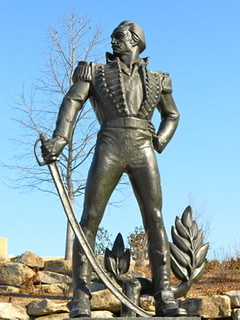
Statue of General Casimir Pulaski, Fairmount Park, Philadelphia
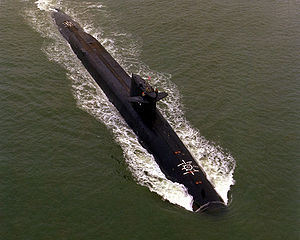
Though Pulaski’s life was cut short, he was not forgotten. Just two weeks after his death, Congress ordered a monument to be dedicated to him, though it wasn’t finished until 1854. The Marquis de Lafayette layer a cornerstone for Pulaski’s monument in Savannah in 1825. A bust of Pulaski has been in the U.S. Capital since 1867. There are a number of statues of Pulaski across the U.S. Numerous cities and counties are named for Pulaski, as are bridges and a skyway. Of course, as mentioned at the beginning of this discussion, Pulaski Day is celebrated on the first Monday in March in Chicago, as well as other cities. And one of the most interesting ways he is remember is the name of a U.S.Navy submarine—the U.S.S. Casimir Pulaski.
The U.S.S. Casimir Pulaski
As I said, this was a very short course. If you’re interested in more information on Pulaski, below are some very good books.
Leszek Szymanski. Casimir Pulaski: A Hero of the American Revolution.
Douglas Shores. Kazimierz Pulaski: General of Two Nations.
Francis Kajancki. Casimir Pulaski: Cavalry Commander of the American Revolution.
I’ve been a military historian for 45 years, and in that time I’ve read only a handful of books as powerful as Jack Fairweather’s The Volunteer—the story of Captain Witold Pilecki, who fought in the Polish-Soviet War (1919-1920). During the inter-war years he rebuilt his family’s property that was destroyed in World War I, and became an important leader of the community. He also was a reserve officer in the Polish 19th Infantry Division that was called up on August 26, 1939. On September 1, 1939, the Germans started barreling east toward Warsaw, and 17 days later the Soviets lumbered west toward the Vistula. Poland surrendered on September 28, 1939, and the Government went into exile in Great Britain.
At that point, most men tried to return to their families. However Fairweather suggests Pilecki held a different perspective. As much as he loved his wife and children, he also loved his country and he felt that he had an inner duty to defend it. So rather than going home, Pilecki and a friend set up the Secret Polish Army in Warsaw. The following spring, Pilecki entered discussions with the more mainstream Underground Home Army. Early that summer, the Underground began hearing that an old Polish Army barrack in the town of Oswiecim—the Germans called it Auschwitz—was being used as a concentration camp for Polish political prisoners. The Underground wanted to find out what was going on there, and if possible to set up an Underground cell. Though several members suggested it to Pilecki, no one would order anyone to go on such a dangerous mission. Witold thought long and hard but ultimately concluded that he would do what was right. On September 18, 1940, he packed a few belonging and calmly waited for the German raid that the Underground knew was on its way. That started a 2 1/2 year odyssey into the hell that was Auschwitz.
Using memoirs, diaries, letters, books, interviews, newly-opened papers from the post-Polish communist archives and, most fascinatingly, Witold’s own information smuggled out of the camp to the Underground, Fairweather has described Pilecki’s astonishing journey. The starvation, torture, beatings, freezing winters, and rampant disease became routine. Slowly he built a small Underground. Their most important work was keeping meticulous records of when people entered the camp, and when and how they died. Very occasionally family members managed to pay for a Polish prisoner to be released. Whenever possible they took the information out of the camp with them and managed to get it to the Home Army. From there couriers would get it to the Polish Government-in-Exile in Britain. Initially the Government could not believe what was happening in the camp. It was far fetched. They needed corroboration. Pilecki and his Underground had to be exaggerating. And then came the Final Solution.
Pilecki and the other inmates were set to building new barracks, infirmaries, other odd buildings and crematoria. Then came the trains—first a trickle, then a stream and then a floodgate. The Underground also learned about Zyklon B—the gas used to exterminate millions of people. The Underground continued keeping records, periodically getting it to Warsaw and on to London. By now it had become clear that Palecki’s information was correct and the Government-in-Exile was trying to convince the Allies to bomb Auschwitz.
By spring of 1943, Pilecki concluded that there was little more he could do in Auschwitz. He’d barely survived typhus, and knew that he simply wouldn’t last much longer. He had the same internal discussion that he’d had before volunteering for the camp, and ultimately decided that he could do more with the Home Army then in the camp. He and two friends made their escape an on August 25 Pilecki was back with the Home Army in Warsaw. One of his first tasks was to put together what is called Witold’s Report—an extremely accurate paper providing the number of people who arrived at Auschwitz, and those who were killed.
In November 1943, Pilecki became part of the secret anti-Soviet unit of the Home Army, the NIE, for it was clear that the Soviets had their eyes on Poland. Soviets, Bolsheviks—to Pilecki communists were communists. He’s fought them before and he would do it again. And if there had been any doubts about the Soviets, the fact that they patiently waited just across the Vistula in August and September 1944, allowing the Germans to destroy what was left of Warsaw made it crystal clear. Rather than being taken by the Soviets at the end of the Warsaw Uprising, Pilecki surrendered to the Germans, and was finally liberated by the US 12th Armored division in April 1945.
As soon as he was liberated, Pilecki joined the Intelligence Division of the the Polish II Corp then based in Italy under General Anders. During his down-time, he began a book on his time in Auschwitz. Sadly, toward the end of the war, Poland came under Soviet jurisdiction. However, for the time being the Polish Forces-in-Exile carried on. Anders ordered Pilecki to return to Warsaw to report on the Soviet situation. He arrived in Warsaw in December 1945 and started to put together an intelligence network. Apparently someone informed on him in the summer of 1946. Though Anders told him to leave, Pilecki refused and continued to provide intelligence to the Forces-in-Exile until he was arrested on May 8, 1947. He was interrogated and tortured for months, but refused to give up any serious information. On March 3, 1948, the first show trial began—he was presented with a whole host of charges, and sentenced to death on May 15. Witold Pilecki was shot ten days later.
The show trial was just a part of the campaign to replace the Home Army and the Government-in-Exile with the Lublin, or Polish People’s Republic. Immediately after the fall of the communist Poland in 1990, Pilecki and hundreds of others were rehabilitated. He was posthumously awarded the Order of Polonia Restituta and the order of the White Eagle, the highest Polish decoration. As Fairweather has shown us throughout the volume, Pilecki looked beyond himself, his family and friends, and tried to do what was needed for his country. It is a fascinating, horrifying, and ultimately an uplifting book that adds Witold Pilecki to the Polish Pantheon with Kazimierz Pulaski, Tadeusz Kosciusko and Ignacy Jan Paderewski.
This coming Monday, January 27, will be the 75th anniversary of the liberation of Auschwitz. Only those who were there can possibly understand what happened, but it is imperative that we remember.






 Historical Lense