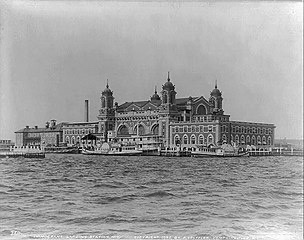
You know that I’m a newspaper nerd–both in paper and online–from a variety of points of view, left, right and center. Add to that that I watch the nightly news from several different outlets–again left, right and center. So it’s not surprising that last Friday I watched the Vice President’s visit to the US border at El Paso. One of the sound-bites came from Congresswoman Veronica Escobar (D-TX) who called El Paso the New Ellis Island. Hmmm. I’ve spent a lot of time over the past 50 years learning about Ellis Island–the original Ellis Island–and teaching about Ellis Island. My entire family–nuclear and extended–were immigrants who came through Ellis Island. Immigrants build this country. We welcome them with open arms. But I see significant differences between what went on in Ellis Island and what is going on in the Rio Grand. So, why don’t we take a look at the original Ellis Island.
Throughout the 19th century, immigrants arrived in the US by ship. The majority of them arriving in New York, and originally landing at Castle Island on the tip of Manhattan. But by the late 1880s the number of people arriving every day was too much to be dealt with in Manhattan, and it was decided to move everyone to Ellis Island. It opened on January 1, 1892, to strict standards. When ships arrived, inspectors would go aboard and give everyone individual tags with the appropriate information including the ship’s registration. Immigrants would then go ashore, and wait in massive lines–sometime for hours, and sometimes for days, even weeks. The first people they spoke to were medical inspectors. Anyone with physical or mental issues went to the doctors for further tests. Sometimes they spent time in the hospital until it was safe for them to go “upstairs.” Sometimes they were deported.
“Upstairs” was where other inspectors would match the information on the immigrant’s tags with the ships manifest, and ask a number of questions. Where did they come from? Could they support themselves? What was their name? Often the inspectors didn’t understand the name, or didn’t know how to spell it, so today many Americans’ surnames are shortened or spelled differently from the way their ancestors’ names were spelled in the “old country.” If all went well, they were free to go. They would start by taking one of the ferries that went to New York or New Jersey. Some stayed. Others moved throughout the country. However, people who were criminals, polygamists, had “loose morals,” were anarchists, had medical issues like TP, or who could not support themselves, were deported on the next available ship headed to their home country.

The government made all of the standards for immigrants very clear to all of the steamship lines. They were expected to have their own inspectors in the countries of origin, where they would screen the immigrants for health, morals and finances even before boarding. If a company did not have the proper inspectors, and someone managed to sail anyway, they would be deported immediately upon arrival, the company would be fined $100 ($3,300 today) and would also have to pay for the person’s passage home.
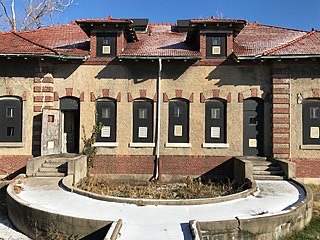
Over the years, Ellis Island was frequently expanded. After a massive fire in 1897 it was completely rebuilt as a “fireproof” building. (If you visit today, you’ll see it’s largely made of tile, brick, glass and iron.) They expanded kitchens, dormitories, a 250-bed hospital with a psychiatric ward, baggage conveyers, a ticket agency, and a small recreation area run by the Red Cross. Immigration fell to a trickle during World War I, when it was used to detain suspected aliens, and later was used for wounded soldiers. It reopened in 1920, but between the 1924 Immigration Act, and the start of the Great Depression in 1929, immigration fell dramatically. Ellis Island received a significant upgrade in 1934 with work done by the Works Progress Administration and in World War II, the US Coast Guard set up a base in Ellis Island. In addition, the Island also detained combatants during the war, and cared for wounded US soldiers.
Though Ellis Island reopened in 1947, it would have been far too expensive to properly upgrade the aging structures. By 1954, the last of the facilities had been moved to Manhattan, and the island gradually decayed. It wasn’t until 1976 and the hundredth anniversary of Declaration of Independence, that thoughts turned to rebuilding Ellis Island which is now a federally owned island, part of the Statue of Liberty National Monument. If you have the opportunity to visit, it’s well worth doing.
So I went back and did a deeper dive into not just El Paso, but much more importantly, the epicenter of immigration that’s taking place, and that’s around the Rio Grand. It’s also worth investigating Fort Bliss, where so many unaccompanied minors are living. It did take a little work, because we rarely see that information in news like The Washington Post or CNN. But it’s there if you look. And I hope you do, and come to your own decision, because the current borders are nothing at all like the real Ellis Island.
 Historical Lense