Happy Birthday Panama Canal đŸ„ł

August is the 107th anniversary of the commercial opening of the Panama Canal. It was initially discussed in 1513, when Vasco de Balboa was the first to walk across the Isthmus of Panama and people began thinking about ways to build a canal from the Atlantic to the Pacific. Yet it wasn’t until the 19th century that any serious work began.

Recently you may remember I was talking about Ferdinand de Lesseps who built the Suez Canal which began operations in 1869. Well, a few years later he decided that it would be a great ideal to build a canal across the Isthmus of Panama. In 1876 he set up La Societe international du Canal interoceanique. He received a concession from Colombia, of which Panama was a province in those days, and set to work.

De Lesseps believed that he would again be able to build the canal at sea-level, but he wasn’t an engineer. He didn’t realize that even at the best spot to do the work it was still more than 360 feet above sea level. In addition, they also and would have to divert several rivers, the largest of which was the Chagres. And on top of that, malaria and yellow fever were rampant. Regardless, work started on January 1, 1881, and by 1888 40,000 men were toiling away at various parts of the canal. Sadly, between 1881 and 1888, 22,000 men had died, largely from malaria, yellow fever, and accidents. The company went bankrupt in 1889, and while de Lesseps tried to start over in 1894, the new venture failed within a year. Millions of cubic yards of dirt, and hundreds of buildings, machinery, even trains, were left to the mosquitoes. But not ten years later, work on the Panama Canal was well on its way to completion.
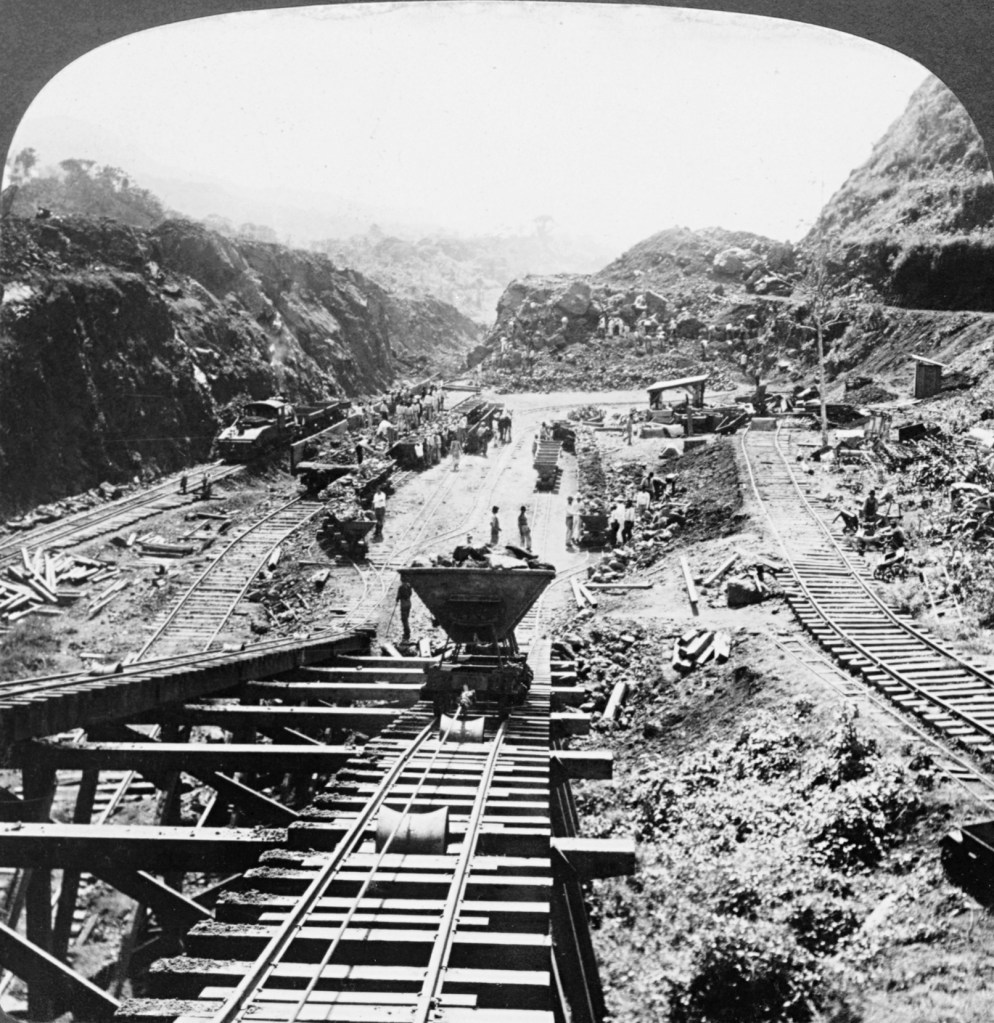
Panama Canal under construction, c. 1910

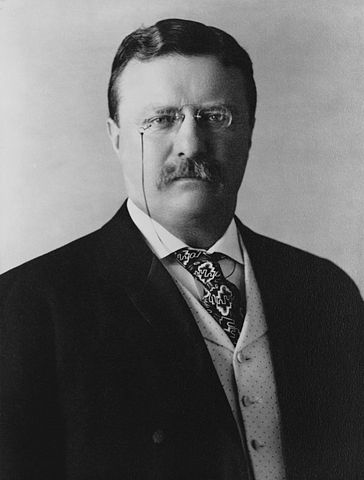
What happened was a combination of a break-away of Panamans from Colombia, and President Theodore Roosevelt. He believed that it would definitely be in the US strategic interest to have a canal so that ships could sail from the the east to the west of the US in a matter of weeks (less than a week these days), rather than having to take at least three months to sail all the way around Straits of Magellan. Negotiations between the US and Colombia resulted in the Hay-Herran Treaty in early 1903, but the Colombian Senate did not sign it. At that point, the Panamanians who were trying to break away from Colombia took the advantage to declare it’s independence on November 3, 1903. On the 18th of November, they signed the Hay-Bunau-Varilla Treaty before the Colombian military could even get their troops to either Colon or Balboa.
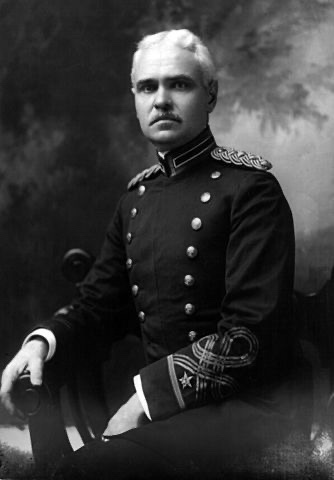
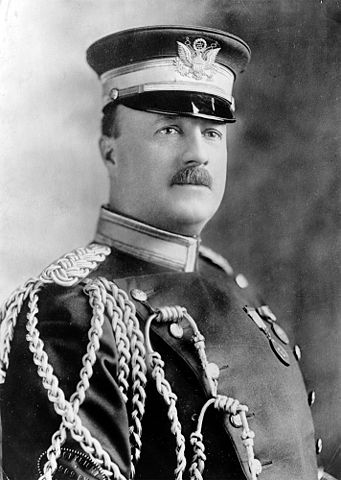
General George W. Goethels

By May 1904 the Isthmian Canal Commission was up and running. John F. Stevens, the engineer who had built the Great Northern Railroad took charge. He immediately started rebuilding the houses, cafeterias, hospitals, old water system, repair shops and trains that de Lesseps had left. In 1907 Stevens resigned, and then-Colonel George W. Goethels took over. He had graduated from West Point in 1880 and served in the Corps of Engineers. Under his watch, the canal was built with locks, which would raise and lower ships 85ft above sea level allowing passage between the Atlantic and the Pacific. Ultimately, the men had excavated 170,000,000 cu. yds. of dirt, in addition to the 30,000,000 that the French had moved, the locks worked well, they had finished the massive Culebra (aka Gaillard) Cut and were proud of the fact that they had finished the canal two years earlier than expected.

William Gorgas

One of the reasons that the work moved along quickly was thanks to Colonel William Gorgas, an expert in tropical diseases. He had worked with Walter Reed to find the origin of malaria and yellow fever, so when ordered to Panama, Gorgas went to war against mosquitos. He oversaw the building of a state-of-the-art water system, fumigated buildings, installed thousands of screens, ordered that people use mosquito netting when sleeping, eliminated stagnant water, and sprayed for insect infestations. Though more than 5,500 workers died by the time the canal opened, it was a massive improvement from the days of de Lesseps. Since then, the US has expanded the canal, and has turned it over the Panama, but we should still thank all those visionaries.

For some fascinating information, take a look at http://McCullough. The Path between the Sea

Army-Navy Game 2020

I love to see my family any time. Except in the afternoon of the second Saturday in December. The Army-Navy Game. I watch one, and only one sports event every year, and that’s the one. My father was a member of the class of 1944 (which graduated in June 1943) of the Naval Academy. I’ve watched the game since I was four, and have been able to attend it several times. Until I went to school, I thought the last words of our national anthem were “Beat Army!” As a military historian I’ve spent a lot of time with members of both services. (One of my closest friends graduated from West Point–I don’t hold that against him.) The game is so much more that a football game. It’s a brotherhood of very young people who have kept this country safe through some of the best and the darkest of times.

The Army-Navy game started in 1890 when Army Cadet Dennis Mahan Michie accepted a challenge from members of the Naval Academy. They played the first game on The Plain at West Point on November 29th that year. (The stadium at West Point is known as Michie Stadium). They alternated the game at Annapolis and West Point until 1893. That year, the Navy doctor told Midshipman Reeve that if he took another hit to his head it would cause brain damage, and quite possibly death. Reeve wasn’t about to stop playing, so he found a local shoemaker and had him put together a leather helmet–the first American football helmet. (Reeves survived and eventually became Admiral Joseph M. Reeves.)

A few days after the 1893 game, an Admiral and General met at the Army-Navy Club in Washington, D.C. Their discussion of the game turned into an argument, the argument turned to punches, and the punches only stopped when friends pried the two men apart after hearing the two of them loudly demanding a duel. A few days later this was brought up in a cabinet meeting and President Grover Cleveland told the Secretary of the Navy Hilary A. Herbert and Secretary of War Daniel S. Lamont to stop the games. That lasted until 1897 when Assistant Secretary of the Navy Teddy Roosevelt wrote to both President William McKinley and Secretary of War Russell Alger suggesting that within proper parameters it would be good for the young man to resume the game. McKinley and Alger agreed.

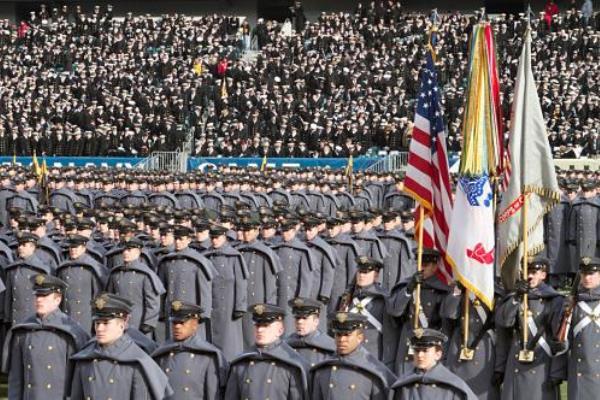
Cadets in the stands, Midshipmen March On, c. 1924

The game returned in 1899, but now was played in Philadelphia, which is roughly equidistant from both Annapolis and West Point. In 1901, now President Theodore Roosevelt attended the game, being sure to cross the field at half-time. Over the years many other presidents have attended the game, and all have crossed at half-time, but only one actually played in it. In 1912, then Cadet Dwight D. Eisenhower, played in the Army-Navy Game. (Ike graduated in 1915.) The game was not played in 1917 or 1918 because of World War I, but started up again in 1919. In 1926 they played at Soldier’s Field in Chicago which was dedicated to the men who had fought in World War I. More than 100,000 people attended and it ended in a 21-21 tie.

Midshipmen in the stands, Corps of Cadets March On

Since 1930 the game has been broadcast on the radio. Rather than stopping the game during World War II, it was played at Navy’s old Thompson Field in 1942 and at Army’s Michie Stadium in 1943. Only the players, coaches, trainers and staff members attended. However, when the Army team walked onto the field in November 1942, they found that their side had been fill with Midshipman. They had learned all of the Cadets’ cheers and fight songs, and some of the men who were there have told me that the roars for the Cadets were noticeably louder than for their own classmates. The same thing happened in reverse the following year when the Midshipmen went to West Point. They might have been Cadets or Midshipmen, but more than that they were, and are, brothers-in-arms.

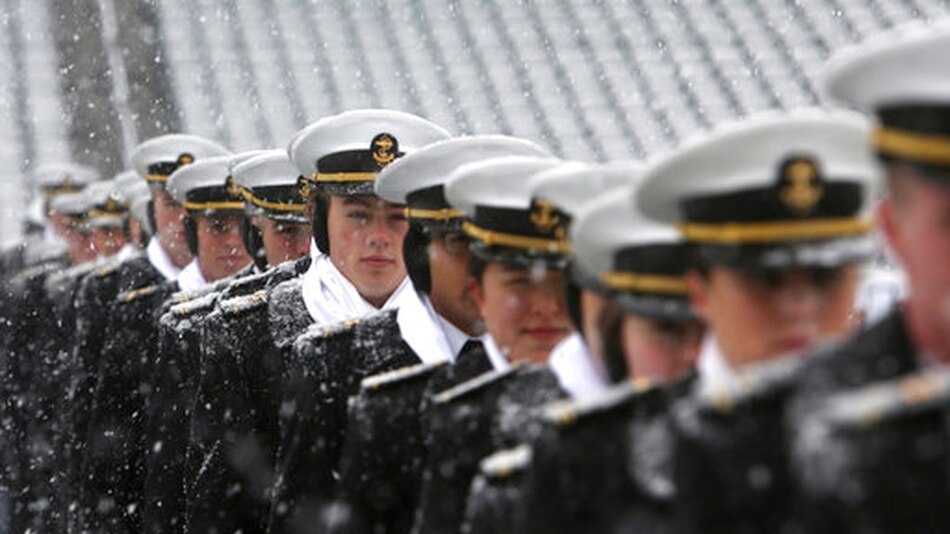
Navy March On in the snow

At the end of the war, not only were they back playing the Army-Navy Game in Philly, but 1945 was the first time the game was seen on TV. And 1963 was the first time there was an instant replay. Unfortunately it was also just weeks after the assassination of President John F. Kennedy. There were serious discussions that it should be suspended, but Mrs. Kennedy specifically asked that the game go one. Her husband had attended in 1961 and 1962, and had intended to be there. It was played in his memory.

So here we are in the middle of a pandemic. Back in late August some friends asked me if I thought they would play. Well, they’ve played in terrible weather, during a World War, at the tail end of the Spanish Flu epidemic . . . I thought they’d figure out a way to do it, and they have. Fingers crossed everyone will be well on Saturday, and even if it’s only the players and coaches, the 120th game will be played. It’s more than a game.

To my friends from West Point, I wish you good luck. For myself I can only say, BEAT ARMY!

The Magnificent Yankee (film)

With Associate Justice Ruth Bader Ginsburg’s passing, all eyes are on the Supreme Court. Only 114 people have sat on the Court since 1789. We know little about some of them, but others like John Marshall, Thurgood Marshall, and Sandra Day O’Conner, have been outstanding both as jurists and as individuals. One titan of the Court who we tend to overlook in the 21st century was Oliver Wendell Holmes. We briefly studied him in high school, and I remember that there actually was a movie about him, so I checked it out. Made in 1950, The Magnificent Yankee actually is a film about the man and only tangentially about the body of his work.

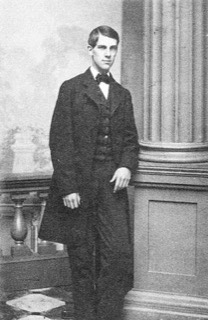
Oliver Wendell Holmes c.1861

Since the film begins with Holmes arriving in Washington D.C. to take his seat on the bench, we should have a bit of the back-story. He grew up in Boston in an Abolitionist family, and in the spring of 1861, just a few months before his graduation from Harvard University, he received a commission as a Lieutenant in the 20th Regiment of the Massachusetts Volunteer Cavalry. He served in the Peninsula Campaign, Battle of Fredericksburg, the Wilderness Campaign, Antietam, Balls Bluff and Chancellorsville. He was wounded twice and nearly died from dysentery. He returned to Boston as a Brevet Colonel when the the Regiment disbanded in 1864.

Fanny Bowditch Dixwell Holmes

After passing the bar in 1866, he went into private practice, and married Fanny Bowditch Dixwell in 1872. During those years, he was the editor of the American Law Review, and wrote The Common Law, first printed in 1881, and still in use. In August 1899 Holmes became the Chief Justice of the Massachusetts Supreme Judicial Court. Barely three years later, Teddy Roosevelt nominated him to the US Supreme Court, and the Senate confirmed him on December 4, 1902.

On the Court, he worked on the Insular Cases, Northern Security Co. v. US, Otis v. Park, Schenk v. US, and numerous other high profile cases. In the years he served on the bench, he wrote many of the 853 majority opinions, but was known as the “Great Dissenter” with his 72 dissenting opinions–most of which he wrote. His fellow jurists believed that Holmes was a fantastic writer in both dissent and majority opinions. He retired at the age of 90, having spent 29 years on the Supreme Court. Being too elderly to attend the inauguration in 1933, Franklin Roosevelt and his wife, Eleanor, visited him immediately after the ceremony. Holmes died of pneumonia on March 6, 1935, just two days short of his 94th birthday.

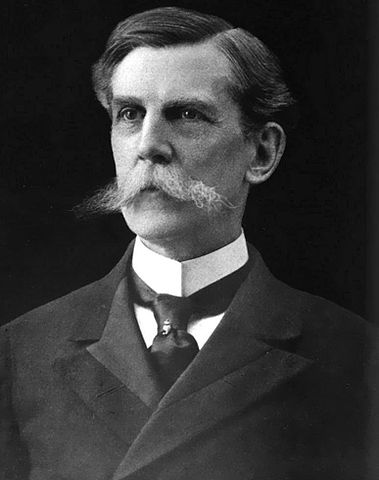
Associate Justice Oliver Wendell Holmes

The film focuses on the man more than the Supreme Court, though the viewers get a good idea of Holmes’ approach to the law and to many of his friends and colleagues. His butting heads with Teddy Roosevelt, his polite but frustrating conversations with Charles Francis Adams, Jr., his clerks who were “his sons,” and his, and Fanny’s, long-time close friendship with Louis Brandeis provide us with a good understanding of Holmes the man, and an insight to one segment of Washington D.C. at the turn of the 20th century. One of the most important scenes comes at the end of the movie, when Franklin Roosevelt went to see him. Holmes tells his secretary that while he’s a Republican and Roosevelt is a Democrat, he is also the President, so he will show the President the deference he deserves. Rather different from the way people tend to behave in the 21st century. Maybe we should thing about that.

If you’re interested in a solid book about Oliver Wendell Homes, take a look at: Catherine Drinker Bowen, Yankee from Olympus.

Eggnog and Archie Butt

Christmas, Hanukkah and New Years are only a few days away. We’re thinking about the importance of these holidays, friends and family, Christmas trees, menorahs, carols and dreidels. One of the wonderful things of the holidays is the food. My aunt made a fantastic stolen. My grandmother made amazing cucidati cookies. A dear friend’s ruggala was delicious. Two of my uncles had a competition to see who would make the best eggnog, but eventually they agreed that the best eggnog ever came from one my old, tattered book (you know me and my ancient books) called Taft and Roosevelt: The Intimate Life of Archie Butt. So who was Archie Butt and exactly how did he make his eggnog?

Captain Archie Butt, c. 1910

Archie Butt (aka Archibald Willingham DeGraffe Clarendon Butt) was born in Augusta, GA, on September 26, 1865, the middle of five children. He went to the University of the South at Sewanee where he became Editor the college newspaper. He graduated in 1888 and moved to Louisville, KY, where he worked for the Louisville Courier-Journal for three years, and then wrote for the Macon Telegraph. The Telegraph sent him to Washington, D.C., where he wrote for the Atlanta Constitution, Augusta Chronicle, Nashville Banner, and Sewenee Morning News. Everywhere he went, Butt made friends easily. One of them was former Senator Matthew Ransom who became U.S. Minister to Mexico in August 1895. He promptly made Archie his 1st Secretary. Butt worked with Ransom for the next two years, returning to Washington when Ransom resigned.

When the U.S.S. Maine blew up in Havana harbor on the night of February 15, 1898, Butt used his numerous contacts to receive a commission as a Lieutenant in the U.S. Army Volunteers at the start of the Spanish-American War. He became Assistant Quartermaster and ended up—with 500 mules in tow—in the Philippines. He was discharged in June 1901, but he’d found his true calling and managed to receive a commission as a Captain in the regular U.S. Army. He returned to Washington in 1904 and became the Depot Quartermaster there. In 1906 he sailed to Havana where he served as the U.S. Depot Quartermaster during the revolt against Tomas Estrada Palma, but was back in DC in March 1908.

Theodore Roosevelt c. 1904

Teddy Roosevelt had known Butt in Washington before he went to Havana, and upon his return, asked him to serve as the President’s military aide-de-camp (ADC). He knew that Butt would do a excellent job of keeping TR on track. Besides, Archie was one of the men who could keep up with the President as he hiked, swam, rode his horses and played tennis with gusto. Butt was only in the White House for a year when William Howard Taft became president, but Taft asked Butt to stay on as ADC. Butt continued to do an outstanding job for Taft—though Taft was not interested in the same “strenuous life” as Roosevelt!! And that brings us to New Year’s Day, 1910.

William Howard Taft, c. 1909

Early that afternoon Butt, as the Taft’s aide-de-camp, attended a New Year’s reception for about 5,500 people. As soon as that was over, Butt raced home to get ready for an “eggnog party” for his own friends. It was a good think that he had a large house because his 50 invited guests ended up being 300 people!! In a letter to his sister, Clara, he told her that he’d used their mother’s recipe, reminding here that it was so stiff you couldn’t drink it, but had to eat it with a spoon.😳 Apparently it was a great success because he told Clara that not a drop was left over.

In honor of the season, I’ve included the actual recipe that Butt included to his sister. I wish you all the very best of holidays!!

From Taft and Roosevelt: The Intimate Letters of Archie Butt, Military Aide (Garden City, NY: Doubleday, Doran and Co., 1930), Vol. 1, page 248. For one dozen eggs, use one quart double thick cream, nearly one quart of whisky and two tablespoons of Jamaican rum. Beat the yolks to a cream, add a dessert spoon of sugar to each egg, and whip again. Then add whisky and rum slowly. The cream should be whipped very stiff, and so should the whites of the eggs. When mixed it will remain indefinitely without separating.

(Sadly, Major Butt died on the RMS Titanic on April 15, 1912.)