Though a play on the iconic comment in the 1988 Vice-Presidential debate between Dan Quayle and Lloyd Bentsen in which Bentsen commented that Quayle was no Jack Kennedy, there is truth in this comment. President Biden’s catastrophe of leaving thousands of Americans and our allies behind enemy lines, was completely different from President Jefferson’s decision. When diplomacy ground to a halt, and resulted in Americans being taken prisoner, he didn’t dither and make the military leave while US civilians stayed, but ordered Army, Navy and Marine elements to retrieve Americans. And remember that was in 1801-1085, when the US was a fledgling country, not a superpower!
After the American Revolution, trade with Europe was a small but important part of the US economy, and moving into the Mediterranean would expand our commerce. However, the sea lanes in North Africa were not always safe. It was wise to sail under the watchful eye of French or British warships, but that was not always possible. Pirates from Algeria, Tunis, and Tripoli would often seize our commercial vessels, bring them into port, sell the goods, and demand ransom for the crew. In July 1801 four US ships headed by Commodore Richard Dale arrived in Gibraltar and began to convoy US merchant vessels, while American envoys tried to develop treaties with the heads of the various states. Algeria and Tunis started discussions, but the Pasha of Tripoli felt that he was not getting the appropriate attention from the Americans, and declared war.

It was clear that four US warships would not be enough, so Jefferson send additional ships, most notably the USS Vixen and USS Philadelphia. In October 1803, the Philadelphia, commanded by Capt. William Bainbridge, pursued several corsairs from Tripoli, but got stuck on some massive hidden boulders. They spent four hours madly trying to dislodge the ship, but ultimately the crew, including 43 Marines, surrendered and were taken prisoner–actually held as slaves. The harbor pilots who knew the area intently re-floated Philadelphia and sailed it into harbor as a prize.
The Americans were enraged. Blockading Tripoli was not enough. On the night of February 16, 1804, Lt. Stephen Decatur with several officer, sailors and Marines, quietly sailed into the harbor in the ketch Intrepid and waited below decks. The following night, they boarded the Philadelphia, set fire to it, and once it was completely ablaze, sailed away leaving the Pasha furious and the ship burning to the ground.
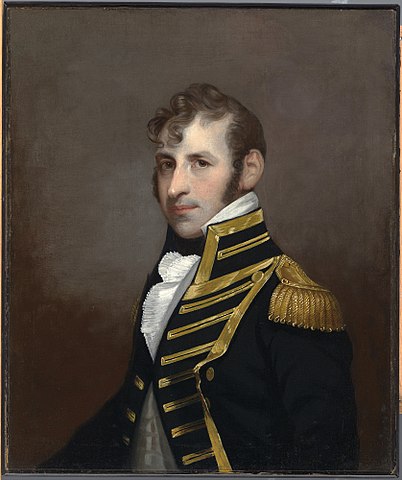
Before the war Yusuf Karamali, the current Pasha, had killed his older brother and drove his next older brother, Hamet, out of Tripoli to Egypt. Both brothers had been more favorable toward the US than Yusuf. Washington wanted to get the rightful heir where he belonged. In November 1804, the US sent William Eaton, a former Captain in the US Army and consular official, Marine Lt. Presley O’Bannon, and six Marines aboard the Argus, to find Hamet. They found him about 100 miles south of Alexandria. Eaton, O’Bannon, the Marines, Hamet and ninety of his cavalrymen, and 38 Greek mercenaries, would march 600 miles west across the desert and met up with the Argus shortly before reaching Derne.
They moved out on March 8, 1805. It ended up taking twice as long as they had expected, and along the way, had everything from problems with camel drivers, near mutinies, to a serious food shortage. By April 15, when they arrived at Bambe, which is near Derne, they literally have run out of food. Thankfully, the following day the Argus arrived with some supplies. On the 17th USS Hornet sailed into harbor with all the food and equipment they needed. They took a week to rest and resupply, and marched on Derne on April 25 with Argus and Hornet sailing with them. That evening they camped on a hill to the southeast of Derne, from which they could see roughly 800 of Yusuf’s troops.
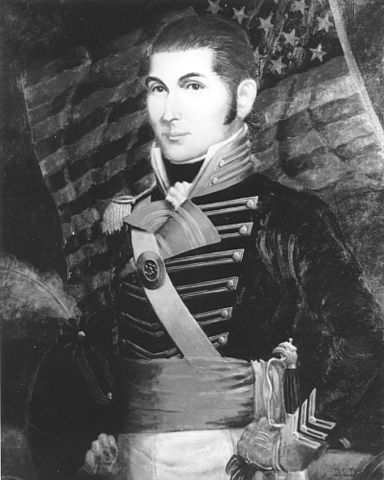
The following morning, the Marines, 24 cannoneers with a gun, and the Greek mercenaries, all under O’Bannon, attached Derne from the southwest, as the Argus, Hornet, and the Nautilus that had joined them, all bombarded the harbor, and part of the town. O’Bannon’s men were under serious fire, but had no intention of retreating. Earon heard the firing, and with his troops moved toward the O’Bannon. He moved his troops to be in a better line with Eaton, and both groups attached. The Marines took the fort in the harbor, and managed to turn the guns toward the castle. After a few shells, Yusuf’s men began to desert. Hamet and his men arrived early in the afternoon, and within two hours, they held the entire town, at which point his cavalry went in pursuit of what was left of Yusuf’s men. The Americans and Hamet’s men held Derne until June, when Commodore Rodgers ordered them to leave.
Between the burning of the Philadelphia, the US blockage, the finding of Hamet and the Battle of Derna, it had become clear to the leaders in Tripoli that they needed to return their hostages and come to terms with the Americans. Though issues remained tense between the two nations, Tripoli understood that the Americans would not leave their people in harms way. President Jefferson was not a bellicose man. He was not Teddy Roosevelt who demanded Perdicaris alive or Raisuli dead.(That’s for another day). But he was the President of the United States. He would never leave Americans languishing in dungeons even if it meant the military would have to fight their way in to retrieve them.
In the past month our Commander-in-Chief has left our citizens, and our allies who fought side by side us, stranded. Hiding. Americans don’t do that! It’s certainly understandable if those who helped us for 20 years believe that we lied to them, because ultimately, that’s what happened. The Brits, the French, even the Dutch went and got their people. Shame on our leadership. t
And now what do we hear? The State Department will take care of it. Hah! 😡 Communication directors, many in the media and others in leadership suggest that we should just “move on” to Hurricane Ida, which of course was a DISASTER or ramming another “package” through Congress. I don’t think that’s going to work. We didn’t leave our people in Tripoli, and we mustn’t leave them in Afghanistan. It’s time for real leadership to stand up and do what’s right.


 Historical Lense