historical LenseThis afternoon I will be watching the 122d meeting of the Army-Navy Game. Members of my family have graduated from the United States Naval Academy since 1944 (and one is hoping to attend with the class of 2029) so clearly I root–loudly–for Navy. But I was taught early on–like at age five–that at the end of the game, both Midshipman and Cadets, stand together. They are brothers in arms. The are all Americans. It is a wonderful display of the best of the US.
I’ve watched the game since 1957, through all sorts of serious issues both domestic and foreign. At the end of the game, people in the stands stood there quietly as both teams moved over to the side of the looser, and together sang the song of their alma mater, and then jogged back to the winning side, and again, both of them sang their alma mater. Ofter there were groups of Congressmen and Senators, cabinet members, and diplomats, standing there next to veterans, active duty military, and people who simply loved the game. There was no arguing about current issues. No snide comments. We were all Americans. Sadly in the recent past that attitude seems to have changed. From Congress to family members. And it’s not changed for the better. I hope that people on both sides can truly pay attention to the REAL meaning of the game.
There’s more to history than diplomacy, politics and battles. I had a great time talking about football–yes, football– with my Uber driver yesterday. He’s actually more interested in the coaches than the players. Knute Rockne, Ara Parsegian, Tom Landry, Joe Gibbs, Bill Parcell–it was a long ride and he was great. But the one we spent the most time talking about was Vince Lombardi. And today, June 11, is his birthday, so Happy Birthday Coach Lombardi!
Lombardi was the oldest of five children, and was born on June 11, 1913 to Harry and Matilda Lombardi in Sheepshead Bay, an area of Brooklyn, New York. He attended public school, and joined a local football league when he was 12. He went on and attended the Cathedral Preparatory Seminary, expecting to become a priest. The administrators discouraged the boys from playing football, so he played both basketball and baseball–not very well. But to the priests’ dismay, he did continue to play in his old football league. Ultimately he transferred to St. Francis Preparatory High School and played fullback for the St. Francis Terriers.
In 1933 Lombardi received a football scholarship for Fordham University where he played right guard, and met head coach Jim Crowley, who had been one of the Four Horses of Notre Dame. He graduated in June, 1937, but that was basically the second wave of the Depression. He took a variety of jobs but finally found a position teaching Latin, chemistry, physics . . . and assistant football coach🤓 at St. Cecilia Catholic High School in Englewood, N.J. In the next eight years, the team won six championships. 1947 saw him become coach of Fordham‘s freshman team, and the following year he became the assistant coach of Fordham’s varsity football team. Lombardi really came into his own in 1949, when he served as the assistant coach at the United States Military Academy at West Point.
Five years later, Coach Lombardi moved from collegiate to professional football, becoming assistant coach – – now called an offensive coordinator – – to the New York Giants. The following year, he and defensive coordinator Tom Landry led the Giants into a championship season. He, the staff and most of the players believed that he was a terrific coach, but he felt that he would never get a head coach position, because of his Italian origin. (Believe it or not, it’s an issue which still has pockets of resistance) Finally, however, the Green Bay Packers offered him the head coast position and he happily took it . . . though at that point Green Bay was the worst team in the conference.
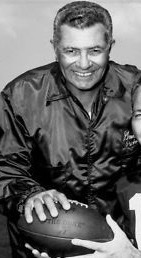
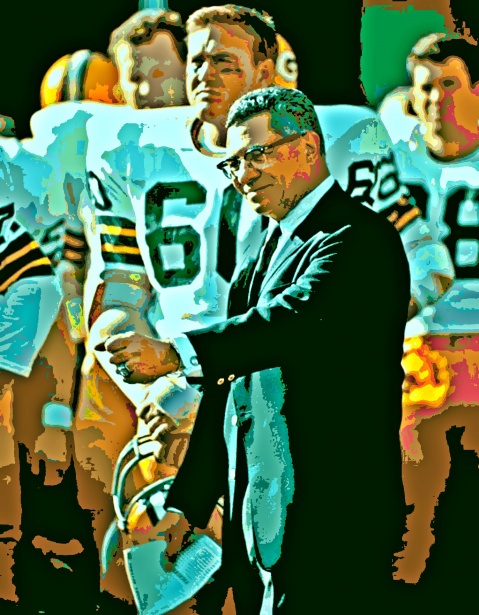
Coach Vince Lombardi and quarterback Bart Starr
Lombardi was a tough and demanding coach, but in 1959, the Packers went from 1-10-1 to 7-5, and he was named Coach of the year. In 1960, the team won the Western Conference for the first time since 1944, and people started calling him “the Pope.“ though they did lose the 1960 championship game to the Philadelphia Eagles. However, the Packers did win the next nine years. Then came the Super Bowl. Green Bay won the first Super Bowl in 1966, as well as the second Super Bowl in 1967– – known as the ice bowl because it was a chilly 13° below zero that day.
“The Pope” left coaching in 1968 but continued as the general manager of the Green Bay Packers. He had no intention of coaching again, but in 1969 the then Washington Redskins (now Washington’s Football Team) practically begged him to coach. They had not had a winning season since 1955. He took over as both head coach and general managed. And they won🤩
Unfortunately, doctors at Georgetown University Hospital found that he had terminal colon cancer in June, 1970. He died on September 3, 1970, at the age of 57. We all know that the name of the Super Bowl trophy is the Lombardi trophy. But possibly more important is The Lombardi Cancer Center at Georgetown University Hospital which provides life-saving therapies for so many people every year.


 Historical Lense