Should He Stay or Should He Go?

Next week, the head of the Joint Chiefs of Staff(JCS), General Mark Milley, is going to be on the hot seat in Congress regarding his involvement in the US debacle in Afghanistan. Add to that the comments in the new Woodward and Costa book regarding the General’s conversations with his opposite numbers in China. Some say they were standard discussions. Others believe that he was trying to overthrow the duly elected president and at the very lease should resign immediately. Should he stay? Or should he go? The Congressional hearings will be key to his future.

U.S. Army Gen. Mark A. Milley, 20th Chairman, Joint Chiefs of Staff, poses for a command portrait in the Army portrait studio at the Pentagon in Arlington, Va., Sept. 26, 2019. (U.S. Army photo by Monica King)

Yet a number of my students—friends, too, don’t really know how the JCS came about. For that we really should go back to the War of 1812. The war’s ground campaigns were key, yet the naval battles on Lake Champlain under Capt. Thomas MacDonough were a major component of the ultimate success of the War. President Madison and the Secretaries of War and the Navy understood that joint operations were vital. Nor can we forget the importance of the joint operations of General Ulysses S. Grant and Admiral David D. Porter during the Battle of Vicksburg. By 1900, war had become so complicated that it was clear that joint operations could not be done on an “as needed” basis. In 1903, the US established a Joint Army and Navy Board that could set up joint ops. However, it wasn’t a fully integrated Board. Rather it was simply a planning board which could discuss issues. By the Great War, is still was not truly involved in the actual conduct of joint operations. After the War, the Secretaries of War and of the Navy redefined the Joint Board. It now included the two services’ Chiefs, Deputy Chiefs, the Chief of War Plans Division of the Army and the Director of Plans Division of the Navy. The Joint Board could now make recommendations for joint operations.
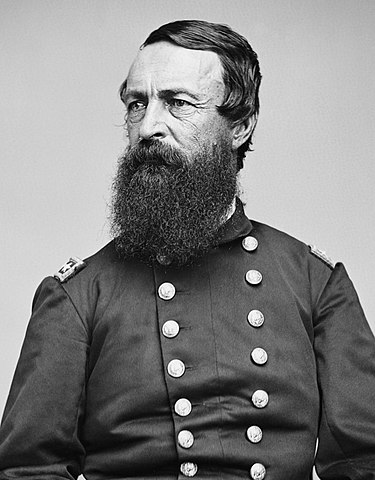
Admiral David D. Porter

This was headed in the right direction, until the attack on Pearl Harbor on December 7, 1941. In the Arcadia Conference (December 22, 1941-January 14, 1942) President Franklin Roosevelt and Prime Minister Winston Churchill set up the Combined Chiefs of Staff. For some time, the British Chiefs of Staff had established administrative, strategic and tactical coordination. It was clear to the Americans that to work closely with the Combined Chiefs, they would finally have to expand and coordinate the US Army and Navy planning and intelligence structures in an effort to provide advice to the Secretaries of War and the Navy, and to the President himself. To do so, the US set up a combined high command in 1942 that was called the US Joint Chiefs of Staff. Roosevelt wanted someone to be in charge, and looked to Admiral William Leahy.

Leahy was born in Iowa in May, 1875, and was graduated from the US Naval Academy in 1897. He served in the Spanish-American War, the Philippines, China, Nicaragua, Haiti and Mexico. During World War I, Leahy captained a dispatch boat that the Assistant Secretary of the Navy, Franklin Roosevelt used, and they developed a lifelong friendship. During the inter-war years Leahy held numerous posts and by 1937 he became the Chief of Naval Operation which he held until his retirement in 1939. Roosevelt then named him governor of Puerto Rico which he held until January 1941 when the President found that Leahy would be the best man to serve as ambassador to France–that is Vichy France. As ambassador he worked tirelessly to try to lessen the grip the Nazis held Vichy, but to no avail. After Pearl Harbor, Roosevelt ordered Leahy home, to serve as his senior military officer who would liaise with the chiefs of the Army and Navy. The US needed someone to work both with the President, and the chiefs, as well as the Combined Chiefs. All agreed that Admiral Leahy was the man for the job. He became the Chief of Staff to the Command-in-Chief of the United States on July 6, 1942.

Admiral William Leahy

With years of experience as a naval officer, and an innate understanding of diplomacy, he was able to wrangle all three US chiefs of staff–General George Marshall (USA), General Henry (Hap) Arnold (USAAF) and Admiral Ernest King (USN), and worked extremely well the the Combined Chiefs from the UK. When President Roosevelt died in April, 1945, President Truman requested that Leahy continue as Chief of Staff which he held until he retired again in March, 1949. He died at the Bethesda Naval Hospital in July 1959.

After the war, Leahy published his memoir, I Was There, which is one of the most honest memoirs I’ve read. He was not trying to add “spin” to any answers, wasn’t trying to “cover his six” by shifting responsibility to others. He was not a “political Admiral” like so many are these days. What would Leahy have thought about General Milley?

You may be interested in Leahy’s book, or a full biography of the Admiral as listed below
http://William Leahy, I Was There. (1950)

http://William Adams, Witness to Power, 1985

Marque? Do You Mean Mark?

No, I mean Marque, part of a Letter of Marque and Reprisal. I’ve been thinking about it because of the recent massive problems of the Colonial Pipeline. Remember, a few weeks ago a group of hackers stopped a 5000-mile gas pipeline, leaving much of the east coast with no gas. What does a Letters of Marque have to do with a pipeline? Just keep readings-it will all make sense.

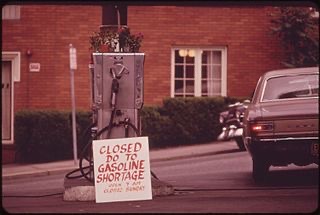
If you recall, the pipeline was stopped when hackers extort $4 million from the company to get the gas flowing again. In some ways, it was worse that the energy crisis of the 1970s. Then you might get gas on an odd or even day, or only get a certain number of gallons, and there were always huge lines. The worst thing was when it was your turn, and you’d pulled up to the pump just as the light turned red–no gas😢. Hopefully they’d have some the next day, or a station close by was open. This time it was worse. Stations closed in 80 percent of a state., and there was no information as to when it would be available. How could you get to work? The market? The doctor? School? How could truckers deliver anything? How could planes move cross-country? What about the military? The ultimate goal is to harden our infrastructure so that it can’t happen again. But that’s going to take some time. What do we do in the meantime, to prevent hackers from trying it again?

So, here’s a question. What is piracy? According to Merriam-Webster, it’s “the unauthorized use of another’s production, investment or conception.” I think we could make a pretty good case that hacking is a form of piracy. We all know something about piracy–if nothing else, we’re seen films like Pirates of the Caribbean or Captain Blood, of The Sea Hawk and so many more. And how the governments stop piracy? Well, long before there were large navies that could deal with pirates, there were Letters of Marque and Reprisal. A government literally would put together a Letter of Marque allowing a private shipowner to use his own vessel to seize a ship that was stealing goods–even people–from other vessels. They would bring the ship in to port, and share the profits between the owner, the seamen, and the government. Letters of Marque and Reprisal were first used in 1293 under Edward I of Great Britain, but over the years were used by the French, the Dutch, and other countries.

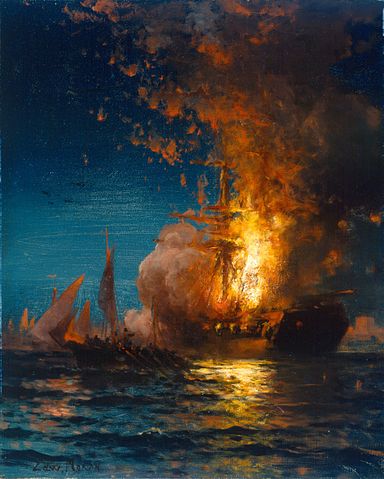
Burning of the USS Philadelphia during the Barbary Wars

As written in our Constitution, Article 1 Section 8 includes enumerated powers– taxation, the power to declare war, and the ability to give Letters of Marque and Reprisal. With a very small Navy in our nation’s early days, Letters of Marque were used frequently, especially during the American Revolution, Barbary Wars and the War of 1812. But as navies grew, the need for Letters of Marque and Reprisal diminished. Part of the Paris Declaration of 1856 included a ban on Letters of Marque, but the US wasn’t ready to sign on. In fact, during the Civil War, both the Union and Confederacy used Letters of Marque. However, Americans really haven’t been used them since 1865.

Hacking

Fast forward to 9/11. Al Qada seemed reminiscent to the Barbary Pirates, and there was considerable discussion about the possibility of bringing a new version of Letters of Marque out of mothballs. Though it wasn’t used at that point, it’s been sitting in the wings and people have periodically discussed it since then. At the same time, many companies and government agencies have been dealing with an increasing number of hackers recently–including the police department of Washington, D.C.😡And then came the Continental pipeline. As I said before, hardening the infrastructure is the first order of business. Much has been done behind the scenes, but it needs to be an all-hands-on-deck priority. In addition, it also may be a very good idea to make it clear to hackers that they need to look somewhere else, just as they learned during the Age of Sail. In fact in a recent Op-Ed in the Wall Street Journal, Thomas Ayres suggested just that in “A Maritime Solution for Cyber Piracy.” Letters of Marque and Reprisal should be expanded to include cyber-security companies which can keep the US safer from hackers. It’s an interesting possibility, and one which deserves serious discussion.

Votes From Gettysburg to Afghanistan

Photo by Gabriela Palai on Pexels.com

Last week was the first time in five month that I got on a train to visit family. There were about 25 people on the entire train so I had immense “social distancing.” But would you believe that two people plopped down about 30 feet away from me and started a LOUD discussion on, of all things, mail-in ballots? According to both Ajax and Lysol (names have been changed to protect the stupid!!!) mail-in and absentee ballots are the same thing. 🤯 No, no, no! Did they learn nothing in 5th grade–or any time since then?

Mrs. H. Fifth grade. Steel grey glasses, steel grey hair, steel grey dresses–the only thing that wasn’t steel grey was the brown wooden ruler that she held as she walked around the classroom. On Monday, November 7, the day before elections, we were learning about voting. She took us–quietly and in a straight line–down to the gym where the election officials were putting up the Diebold voting machines. Each of us got a turn to go into the booth, close the curtain and push the various buttons. Then we went back upstairs and Mrs. H. continued.

Wyoming School–no AC when I was there!

Many of us had elderly relatives. Some of our fathers were in the military, and others worked in different states. She asked us how they would vote. Paul raised his hand (NO ONE shouted out in that class!) The mail? Well, close. She explained how to use an absentee ballot. You have to write or call (or go online today) the state election board and ask for one. They send you a form. You fill it out and send back. Then they send you the ballot, which you fill out, sign (on the ballot and on the envelope) and send it back so it arrives by Election Day. Each state has different rules, but you have to ASK for an absentee ballot. It doesn’t just arrive like junk mail and catalogues.

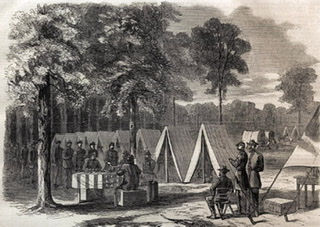
Voting in the 1864 election

It wasn’t always done that way. Prior to the Civil War, people went to town and simply told the election officials who they were voting for. Nothing was private. During both the American Revolution and the War of 1812 a few men in New Hampshire, New York, Pennsylvania and New Jersey asked if they could vote in absentia, but they were challenged in court and lost. It wasn’t until the election of 1864, in the middle of the Civil War, that individual states decided that men in the military could vote absentee. It was largely done by the Union states, many of whom sent election commissioners with the ballots so that the soldiers could vote in their camps or hospitals.

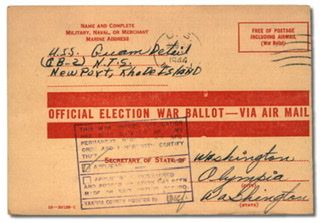
Absentee ballot circa 1944

During World War I, many soldiers and sailors were able to get absentee ballots in the US–it was hit or miss for the men overseas. World War II was different. With 5 million men and women in the military, the Soldier Voting Act passed by Congress in 1942 required all states to provide special postcards to all servicemen, at home or overseas, so they could request an absentee ballot. The ballot would arrive, along with free postage. In fact I remember my father telling us that in October, 1944, when he was on Guadalcanal getting ready for Iwo Jima, he and most of his men voted by absentee ballots. Absentee ballots for anyone in the military is standard to this day.

Voting overseas in World War II

After the war, most states passed legislation allowing anyone in the military and their dependents, and anyone with a good reason–someone who was elderly, sick, or working out of state–to easily get an absentee ballot. It wasn’t until the ’70s that some states allowed people to get “no-excuse” absentee ballots–though they still have to request one and fill out the form. There’s a very good reason for that. As we discussed in the May 20th post, a 2005 bipartisan Election Reform Commission (remember Jimmy Carter?) found that absentee-ballots are safe and effective–plain mail-in ballots cause very serious problems. Let’s take a quick look at just a few.

1) Last May, the state of Maryland sent out ballots for the primary. One million ballots didn’t arrive. The governor demanded the state Electoral Commission show him how the ballots will arrive in November.

2) Mail-in ballots for New York had to be in on or before June 23–and they just finished counting the ballots on August 4. Roughly 20% were thrown out because they weren’t postmarked, weren’t properly signed, or arrived too late.

3) Parts of Pennsylvania ballots are still being counted.

4) Nevada recently passed both all-mail-in ballots as well as ballot-harvesting, while not requiring postmarks that will show that they were send in on time.

5) 500,000 Virginia voters received absentee ballot application with the wrong information–and they came from an outside group, NOT from the Department of Election.

6) Charges have been brought against four people due to voter intimidation and ballot theft in New Jersey.

NOT GOOD

When we look deeper, we find that only California, Colorado, Hawaii, Iowa, Utah, and Washington State have done what they needed to do to make actual mail-in ballots safe. Arizona, Florida, Montana and Oregon are just about there. They have spent the past TEN YEARS carefully purging the voter rolls so that they don’t send ballots to people who are dead, have moved, children, even pets–all of which happens much more frequently than you think!

So here’s a thought. 1918 was a year for Congressional and Senatorial elections. It was also in the middle of the Spanish Flu which killed 675,000 Americans. There was a lower turnout, but people still voted. But they didn’t have the absentee ballots that we have today. Go online, or call your state Department of Elections and ask for an absentee ballot. It may take five minutes to fill out. When you get the ballot it may take you, what, ten minutes, to carefully fill it out and send it in. You don’t even need a stamp! But your vote will count, and that’s the whole point, isn’t it?