We’ve Seen this Before

Sadly this is not the first time that Russia has attacked a sovereign nation. There’s a long history going back a millennium. Just in the past fifteen years it’s happened in Georgia, Chechnya, and Syria. The utter devastation, towns turned into rubble and civilians killed in horrifying ways, is unimaginable. What we’ve been seeing in Ukraine–in Mariupol, Bucha and other cities–is more reminiscent of Tamerlane than even World War I. What’s different about this war is that Ukraine decided to stand and fight. Thinking about that, there are definite parallels with the Poles who did the same in the Polish-Bolshevik War of 1920-1921.

Remember, Russia, Prussia and Austria-Hungary had dismembered Poland between 1772 and 1796. There was no “Polish State” for more than 150 years, despite a significant Polish underground network, riots, petitions and millions who resettled overseas, many in the US, who still wanted to see a true Poland. It wasn’t until the end of World War I that the Poles in exile, headed by the famed pianist, Ignace Jan Paderewski, managed to convince Woodrow Wilson to include an independent Poland as the 13th of his 14 Points. The Big Four (Wilson, Clemenceau, Lloyd George and Orlando) discussed a reconstituted Poland during the Paris Peace Conference, which finally became Article 82 of the Treaty of Versailles.

Photos from the Polish-Bolshevik War c. 1920

Despite the Treaty of Versailles, and the fact that the Western Allies opposed the Soviets, the new Bolshevik government wanted to keep the Polish territory that the Czars had held for 150 years. Initially the Red Army took over Ukraine, and in June 1920, began forcing the Polish Army west, all the way to the capital, Warsaw. The second Polish Republic was on the verge of complete collapse in mid-August 1920. But led by General Jozef Pilsudski, the new Polish Army, with volunteers, and contingents of the Blue Army (Haller’s Army) that transferred from France to Warsaw, the Poles won the Battle of Warsaw, (sometimes known as the Miracle on the Vistula). By August 25, the Reds were in retreat, and they continued to fall back to the east until the cease-fire on October 18, 1920. Poland and the Soviet Union signed the Treaty of Riga on March 18, 1921, which established the eastern border until World War II.

Polish soldiers in the Battle of Warsaw

However, World War II was very different. Again, the Poles fought bravely–and it wasn’t romantic cavalry charges. The Germans had to deal with Polish aircraft, tanks, infantry and an outstanding intelligence service. What they thought would be a quick run to Warsaw ended up being a real fight. But there were problems. Though the Poles had treaties with both the UK and France in which the two promised to join Poland if Germany attacked, neither France nor Britain were able to did anything. And then, on September 17, 1939, the Soviets attacked Poland from the east. With no assistance at all, there was little the Polish Army could do. Crushed between Germany and the Soviet Union, Poland became a wasteland.
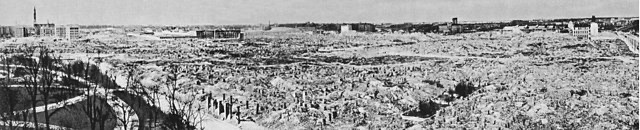
The rubble that was Warsaw c. 1944

Does any of this sound familiar? Russia has always wanted a buffer from the West. And that’s understandable. But decimating a nation, carrying out war crimes, pulverizing whole cities into submission is NOT the way to do it. That is why Poland, along with Moldova, Hungary, Romania, Estonia, Lithuania and other Central European nations are assisting Ukraine in every way possible. They’ve seen this before, and they understand that if it Russia is not stopped now, they will be next.
The Tomb of the Unknown Soldier 1921-2021

One of the tragedies of war is the death of so many soldiers and sailors. Even worse is the fact that there are so many who are unknown. Going back to the Peloponnesian War, there have been monuments for soldiers who remained unknown. In many wars, large numbers were buried in mass graves, often with monuments with the appropriate dates. Things changed during World War I.

At that time, most nations started requiring their men to wear ”dog tags” of some sort. (The Americans tags were made of aluminum and literally held the person’s name, rank and serial number.) The armies also set up new units which would keep track of those who had died. (Graves Registration Services in the US) At the end of the war, many of the deceased were re-interned in their own nation. However, there were so many who had died during the war, that it would have been impossible to repatriate everyone. Many families decided to allow their service member to remain with their brothers-in-arms and are buried in national cemeteries in France.

In 1920, Great Britain brought one of the Unknown Soldiers home and solemnly re-interned the soldier in Westminster Abby. Similarly, an Unknown Soldier is guarded at the base of the Arc de Triomphe in Paris. In early 1921, Hamilton Fish, Jr., a World War I veteran and member of Congress offered legislation ”To bring home the body of an unknown American warrior who in himself represents no section, creed or race in the late war and who typifies moreover, the soul of America and the supreme sacrifice of her heroic deeds.” The legislation passed, and it was decided that the Soldier would be placed in a tomb in Arlington National Cemetery.

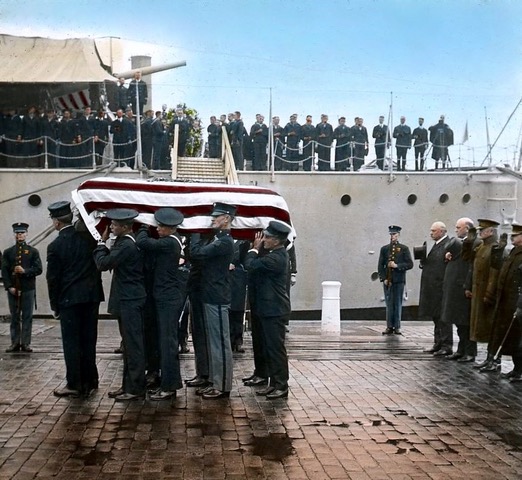
Work began on the tomb that spring, and in October, 1921, four bodies of unknown soldiers were exhumed from four different cemeteries in France. On the 23th they arrived at Chalon-sur-Marne. The following day, Maj. Robert Harbord, USA, with a group of French and US soldiers, placed each casket on top of a shipping case. The Major then asked Sgt. Edward F. Younger to select one of the men. Younger walked gravely around the four caskets several times, then stopped and put a spray of white roses on one. The others were returned to the cemeteries they had left, while the fourth casket was placed in its shipping case and was moved on a caisson, and later by train, to the port of La Havre. From there it boarded the USS Olympia bound for the US.

Unknown Soldier from World War I being taken from the USS Olympia at the Washington Navy Yard and transported to the US Capitol to lay in state. On November 11, 1921 the body was intered at Arlington National Cemetery (photographed by E.B. Thompson) http://www.flickr.com/photos/dcplcommons/3423377913/ http://www.flickr.com/people/dcplcommons/ District of Columbia Public Library

The Olympia arrived at Washington D.C. on November 9th. From there the coffin moved to the Capital where it lay in state at the Capital Rotunda. Over 90,000 people paid their respect on the 10th. The following day, the Unknown Soldier was placed on another horse-drawn caisson and slowly wended its way through Washington, D.C., crossed the Potomac, and moved on to the Arlington National Cemetery. President Warren G. Harding presided at the state funeral at the Arlington Memorial Amphitheater which included the two minutes of silence to commemorate the end of the War (Known as Armistice day–the 11th hour of the 11th day of the 11th month.)

Soldiers from Ft. Myers began guarding the Tomb in March 1926. They only did so during the day to make sure that family members didn’t become distraught, and that others remained respectful. In 1937 soldiers began guarding the Tomb 24/7, and in 1948 the 3d US Infantry Regiment, known as the ”Old Guard” took charge of the Tomb. Since then, the US has added men from both World War II and the Korean War to the Tomb. It can be the dead of night, in blazing sun or two feet of snow, the Old Guard is on duty.

Changing of the Guard at the Tomb of the Unknown Soldier

Thursday, November 2021 is the 100th anniversary of the Tomb of the Unknown Solder—Never Forget!

Fall Back–AND STAY THERE!! ⏰

The US and about 40% of the nations in the world switch between standard time and daylight savings time. This Saturday/Sunday, November 6/7 is the day when the US turns our clocks back one hour–we “fall back.” Then we “spring forward” an hour on the second Saturday/Sunday in March. I did a quick survey this week–asked over 45 people I ran into when I was out and about–if they think this is a good idea. Two said yes. Forty-three said no. (With a variety of expletives which I can’t say in polite society.) Where did this idea come from? And is it really a good idea?

Benjamin Franklin first came up with the idea. He believed that having another hour of daylight would save money on candles, but it didn’t take off the way so many of his other ideas did. It really came to national attention in May, 1916, in the middle of World War I, when the German government believed that daylight savings would save fuel. The British and French started doing the same in 1917, and in 1918, the US joined them. At the end of the war, President Wilson wanted to continue that system, but many people, particularly in the rural US, hated the idea because they would loose an hour of daylight they needed on their farms. Wilson relented. Daylight Savings Time–then called War Time–returned during World War II, again because the government believed it would save fuel.

Daylight savings remained after the war, though the times were different in different parts of the country. In 1966 Congress passed the Uniform Time Act in which Daylight Savings Time began on the first Saturday/Sunday in April and changed to Standard Time on the last Saturday/Sunday of October. Congress again changed it in 2007 to the current November and March system. Why do we do this? Largely because the Department of Transportation (DOT) thinks that it saves energy and prevents accidents. As usual, I dod some research. It does NOT seems to work out like the DOT believes it does. In fact it’s pretty much the opposite.

Perhaps the use of energy in the World Wars, when we used mountains of coal, was a factor, but it really isn’t these days when we use natural gas renewables and even clean coal. In fact, the energy saving these days is from slim to zero. Work at the Oak Ridge National Laboratory finds that since electricity has become so efficient in the recent past, the cost savings of power is negligible.

Now let’s take a look at accidents. Peer-reviewed information from Current Biology shows that there is a 6% increase in car accidents for several days when we “spring forward.” (There are lots more journal articles–I just don’t want to bore you.) And that also means a significant increase in ER visits. Everything from a few bumps and bruises to traumatic injuries and death. And ever if we didn’t care about peoples, (though I believe most of do) the increase in medical costs is significant.

Why all the accidents? Because of sleep deprivation. And one hour can definitely make a difference. We all have a circadian rhythm–and internal clock–which tells each of us when we need sleep. What happens when we don’t? If we’re lucky we just feel tired and out of sorts for several days. But we can also end up in the ER. And if we drill down a bit, according to the Journal of Clinical Medicine in a 2019 report, they find higher numbers of heart attacks when both “sprinting forward” and “falling back.” The American Association of Cancer Research journal Cancer Epidemiology, Biomarkers and Prevention discussed the influence on Daylight Savings and Standard time with cancer. A 2015 Finnish study Sleep Medicine discusses the fact that in addition to cancer and heart attacks, there is an 8% increase in strokes in the days after the transition in DST. Most people who do shift work will tell you that even if they are careful and try to get sleep during the day, it’s still more difficult to work at night.

Because of these, and so many more issues, 15 states want Congress to stop changing the time twice a year. They don’t care which one, just pick on and stay there!!!

🎬 Lights! Action! Camera! 🎬

Did you watch the Oscars? I confess I didn’t. It used to be fun/interesting. For me, they’ve become rather dull in the past few years. But that doesn’t mean that I didn’t watch anything at all this year. I’ve started working on a new book–a biography of a fascinating Polish Army/Air Force officer during World War II, and while looking for some information on his work, I stumbled across some material on Westerplatte. I’ve known about the battle for many years, but I didn’t know that anyone had made a movie, so I took some time off to watch 1939 Battle of Westerplatte.

Now we all know that I’m a military historian so I often watch that sort of movie, but this was outstanding. It’s a 2013 Polish film written and directed by Pawel Chochlew. Apparently the movie caused some debate, with some people saying it was anti-Polish, while others found it heroic. It particularly focuses on the leader of the battle and his deputy. Personally, that’s the kind of film that makes me want look deeper and find the real facts. In this case, I already knew a lot about the events, but in case you don’t, here’s the short version of the Battle of Westerplatte.

At the end of World War I, the League of Nations not only set up the second Republic of Poland (1918-1939), but provided for the Free City of Danzig, and allowed for the Depot of Polish Munitions in Transit in the Port of Danzig. The Poles built it on the Westerplatte Peninsula of the harbor. In March 1939, Germany took over an area of Lithuania very close to Danzig. That immediately put Westerplatte on alert. Very quietly, the Polish military began to add troops to the Depot and fortify the area. In late August, when it was clear that Germany was just a few days away from attacking Poland, additional troops joined the 88 men at the Depot.

Major Henryk Sucherski, Polish Army

Between 190 and 240 men and six officer, headed by Maj. Henryk Sucherski and his deputy, Capt. Franciszk Debrowski, were working at a fever pitch to prepare for a German attack. In addition to pistols, rifles and grenades, they brought in all the heavy weapons they could, including a 75 mm field gun, two 37 anti-tank guns, four 81 mm mortars, and 22 standard and 18 heavy machine guns. They also set up numerous tenches, barricades, massive amounts of barbed wire, and reinforce concrete in a number of buildings.

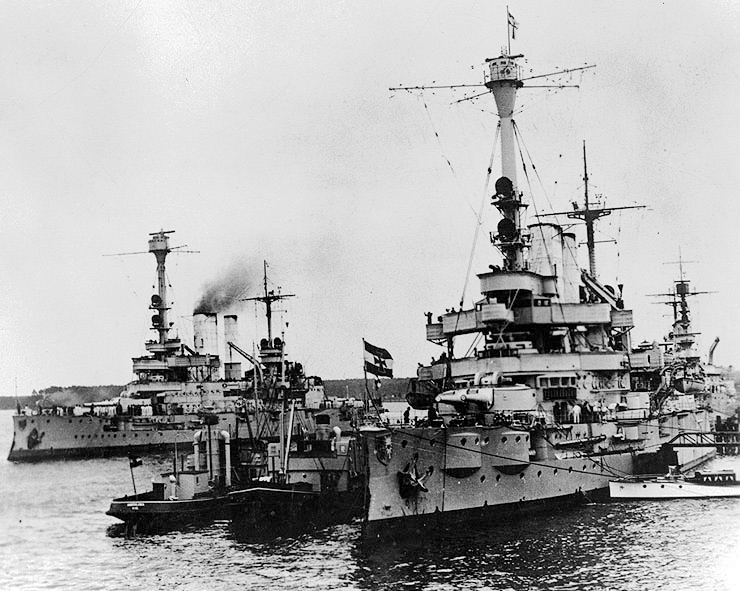
German pre-dreadnought Schleswig-Holstein in the foreground

At the same time, the German pre-dreadnought Schleswig-Holstein arrived at Danzig, allegedly for a “courtesy call,” and anchored just 150 yards away from the Westerplatte Peninsula. The ship carried 225 German Marines. In addition, 1500 Danzig Police (German soldiers) were there to support the Marines. They expected to begin operations on August 26th, but Hitler made a last minute decision to wait until September 1.

Before 5 am on September 1, 1939, the attack on Poland began throughout the German-Polish border, and in the Free City of Danzig. The Schleswig-Holstein let go with a massive broadside pf 12-inch guns against the Depot. The Germans expected it would take a few hours to seize the entire garrison. They were wrong. The Poles repelled 13 assaults, including serious naval bombardment and dive bombers. They held out for seven days.

Of course the film isn’t a documentary. The director uses significant creative license, and focused on the two major characters. Yet it’s thought-provoking as are movies like Greyhound, or Dunkirk, The Longest Day, or the Bridge on the River Kwai. And with that, I’ll go back to find what I was looking for originally.🤔

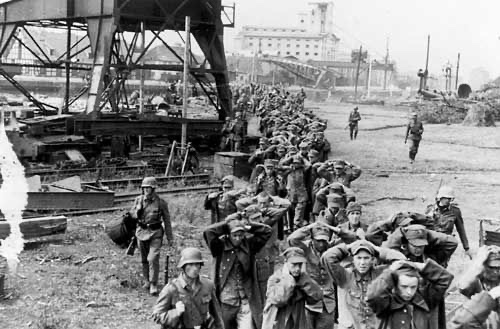
The remnants of the men of Westerplatte in September 1939

🌓 Rise and Shine!! 🥱

Even I, a definite morning person, thoroughly dislike Daylight Savings Time (DST).😒And I don’t know anyone who enjoys is. Why do it–to only change it back in a few months? I did a little digging to find out when this started, and who had this bright idea, and found some interesting information.

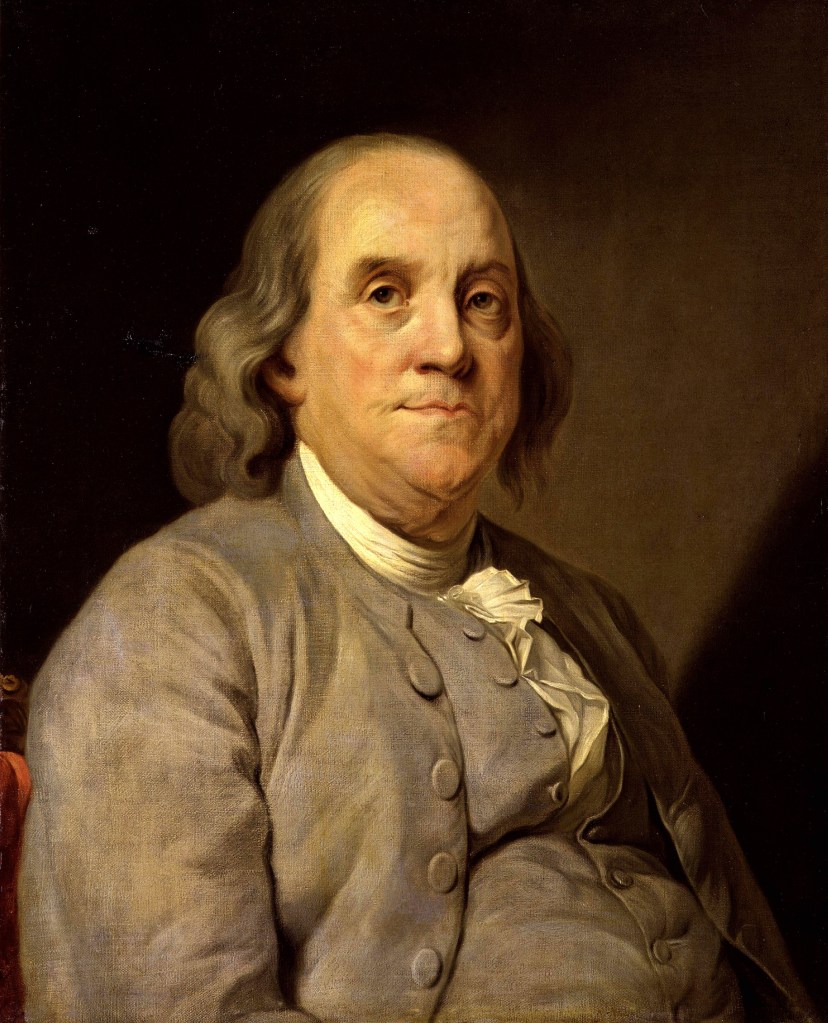
Benjamin Franklin

Some say that it began with Benjamin Frankin and his proverb in Poor Richard’s Almanac, “Early to bed and early to rise makes a man healthy, wealthy, and wise.” Pragmatically, he thought that shifting daylight an hour would save candles. It never took hold. Fast forward to 1895. George Hudson, a New Zealand entomologist wrote a paper for the Wellington Philosophical Society suggesting a two-hour shift would be very helpful for scientific study. He wrote a similar paper on 1898, but that, too, never took hold. Ten years later, William Willett, a businessman/builder in the UK, and more importantly to him, an avid golfer, suggested that an additional hour of daylight would allow golfers to play after work. He actually convinces Robert Pearce, a member of the Liberal Party in Parliament, to try to pass a bill allowing the change, but it failed.

What really caused the shift was World War I. In an effort to save coal, Germany and Austria-Hungary, the Central Powers, turned the clocks ahead one hour on April 30, 1916. Great Britain followed in May, as did France. Russia made their change in 1917, and in 1918, after joining the Allies, the US changed as well. Most nations changed back after the war. In the US, Congress tried to pass a bill to repeal it, but President Woodrow Wilson vetoed it. Congress passed it again, Wilson vetoed it again, but Congress overrode it the second time. It stayed that way until World War II. Again, European nations changed to DST in 1939, while the US changed in early 1942 and it stayed that way until 1945. Since then, we’re changed to DST at different time through the years.

Yes, as kids it’s nice to be able to play outside longer when school’s out–but who wanted to go to bed at regular time during school? And Mr. Willett is probably smiling down from heaven when people can play golf after work. But particularly since the 1970s there has been growing evidence that DST is not a good idea. Some serious research started during the energy crisis. The theory was that more sun in the evening would save electricity. At best it’s a wash and there’s some indication that it may actually be wasteful. Face it, the earth moves on its axis and there’s going to be just so much daylight and so much darkness every day, year in and year out. Does it matter If you turn on the lights so you can get ready for work, or turn it on earlier in the evening? You still need to turn on the lights (or Franklin’s candles) sometime during those 24 hours.

Chronobiologists have done significant work and have come to the conclusion that even small shifts in time can have inadvertent effects on the human body and brain. An eight-year study at the prestigious Mayo Clinic has found that the time shift has caused problems for medical personal’s sleep deprivation (they work long hours to begin with and that doesn’t help) Journals such as Open Heart and the Journal of Clinical Medicine have found a noticeable increase in Acute Myocardial Infarctions–aka heart attacks😱. There are also studies from the American Economic Journal Applied Economics showing an increase of at least 30 traffic deaths in the days immediately after “springing forward.” (interesting, no similar problems happen when “falling back”) as well as general accidents that cost roughly $275 million dollars. And if that’s not enough, apparently the shift in clocks cause a one-day loss of $31 billion in the US stock market.

Both Hawaii and Arizona don’t follow Daylight Savings Time, and momentum has been growing to end it once and for all. Fifteen additional states have passed their own laws ending it–Arkansas, California, Delaware, Florida, Georgia, Idaho, Louisiana, Maine, Ohio, Oregon, South Carolina, Tennessee, Washington State, Wyoming and Utah. However, that needs the OK from the Department of Transportation, which in turn requires an act of Congress. And recently Senator Marco Rubio developed a BIPARTISAN bill to do just that. The “Sunrise Protection Act” includes Democratic Senators Whitehouse, Wyden and Markey, and Republican Senators Rubio, Blunt, Rick Scott and Hyde-Smith. I’m keeping all fingers crossed that they pass it. 🤞🤞🤞

Review of THE VOLUNTEER

Captain Witold Pilecki

I’ve been a military historian for 45 years, and in that time I’ve read only a handful of books as powerful as Jack Fairweather’s The Volunteer—the story of Captain Witold Pilecki, who fought in the Polish-Soviet War (1919-1920). During the inter-war years he rebuilt his family’s property that was destroyed in World War I, and became an important leader of the community. He also was a reserve officer in the Polish 19th Infantry Division that was called up on August 26, 1939. On September 1, 1939, the Germans started barreling east toward Warsaw, and 17 days later the Soviets lumbered west toward the Vistula. Poland surrendered on September 28, 1939, and the Government went into exile in Great Britain.

At that point, most men tried to return to their families. However Fairweather suggests Pilecki held a different perspective. As much as he loved his wife and children, he also loved his country and he felt that he had an inner duty to defend it. So rather than going home, Pilecki and a friend set up the Secret Polish Army in Warsaw. The following spring, Pilecki entered discussions with the more mainstream Underground Home Army. Early that summer, the Underground began hearing that an old Polish Army barrack in the town of Oswiecim—the Germans called it Auschwitz—was being used as a concentration camp for Polish political prisoners. The Underground wanted to find out what was going on there, and if possible to set up an Underground cell. Though several members suggested it to Pilecki, no one would order anyone to go on such a dangerous mission. Witold thought long and hard but ultimately concluded that he would do what was right. On September 18, 1940, he packed a few belonging and calmly waited for the German raid that the Underground knew was on its way. That started a 2 1/2 year odyssey into the hell that was Auschwitz.

Using memoirs, diaries, letters, books, interviews, newly-opened papers from the post-Polish communist archives and, most fascinatingly, Witold’s own information smuggled out of the camp to the Underground, Fairweather has described Pilecki’s astonishing journey. The starvation, torture, beatings, freezing winters, and rampant disease became routine. Slowly he built a small Underground. Their most important work was keeping meticulous records of when people entered the camp, and when and how they died. Very occasionally family members managed to pay for a Polish prisoner to be released. Whenever possible they took the information out of the camp with them and managed to get it to the Home Army. From there couriers would get it to the Polish Government-in-Exile in Britain. Initially the Government could not believe what was happening in the camp. It was far fetched. They needed corroboration. Pilecki and his Underground had to be exaggerating. And then came the Final Solution.

Pilecki and the other inmates were set to building new barracks, infirmaries, other odd buildings and crematoria. Then came the trains—first a trickle, then a stream and then a floodgate. The Underground also learned about Zyklon B—the gas used to exterminate millions of people. The Underground continued keeping records, periodically getting it to Warsaw and on to London. By now it had become clear that Palecki’s information was correct and the Government-in-Exile was trying to convince the Allies to bomb Auschwitz.

By spring of 1943, Pilecki concluded that there was little more he could do in Auschwitz. He’d barely survived typhus, and knew that he simply wouldn’t last much longer. He had the same internal discussion that he’d had before volunteering for the camp, and ultimately decided that he could do more with the Home Army then in the camp. He and two friends made their escape an on August 25 Pilecki was back with the Home Army in Warsaw. One of his first tasks was to put together what is called Witold’s Report—an extremely accurate paper providing the number of people who arrived at Auschwitz, and those who were killed.

In November 1943, Pilecki became part of the secret anti-Soviet unit of the Home Army, the NIE, for it was clear that the Soviets had their eyes on Poland. Soviets, Bolsheviks—to Pilecki communists were communists. He’s fought them before and he would do it again. And if there had been any doubts about the Soviets, the fact that they patiently waited just across the Vistula in August and September 1944, allowing the Germans to destroy what was left of Warsaw made it crystal clear. Rather than being taken by the Soviets at the end of the Warsaw Uprising, Pilecki surrendered to the Germans, and was finally liberated by the US 12th Armored division in April 1945.

As soon as he was liberated, Pilecki joined the Intelligence Division of the the Polish II Corp then based in Italy under General Anders. During his down-time, he began a book on his time in Auschwitz. Sadly, toward the end of the war, Poland came under Soviet jurisdiction. However, for the time being the Polish Forces-in-Exile carried on. Anders ordered Pilecki to return to Warsaw to report on the Soviet situation. He arrived in Warsaw in December 1945 and started to put together an intelligence network. Apparently someone informed on him in the summer of 1946. Though Anders told him to leave, Pilecki refused and continued to provide intelligence to the Forces-in-Exile until he was arrested on May 8, 1947. He was interrogated and tortured for months, but refused to give up any serious information. On March 3, 1948, the first show trial began—he was presented with a whole host of charges, and sentenced to death on May 15. Witold Pilecki was shot ten days later.

The show trial was just a part of the campaign to replace the Home Army and the Government-in-Exile with the Lublin, or Polish People’s Republic. Immediately after the fall of the communist Poland in 1990, Pilecki and hundreds of others were rehabilitated. He was posthumously awarded the Order of Polonia Restituta and the order of the White Eagle, the highest Polish decoration. As Fairweather has shown us throughout the volume, Pilecki looked beyond himself, his family and friends, and tried to do what was needed for his country. It is a fascinating, horrifying, and ultimately an uplifting book that adds Witold Pilecki to the Polish Pantheon with Kazimierz Pulaski, Tadeusz Kosciusko and Ignacy Jan Paderewski.

This coming Monday, January 27, will be the 75th anniversary of the liberation of Auschwitz. Only those who were there can possibly understand what happened, but it is imperative that we remember.