I know the world turns on its axis once every 24 hours, but sometimes it seems to go faster. Between the pandemic, lock-downs, protests, riots, wild fires, hurricanes, and the election, no sooner do we learn what’s going on, than the next problem is front and center. It was nice to find out that something good actually happened! It was on the radio, TV and online on August 13, but since then you really have to look for any additional information. What was it? The US brokered a deal between Israel and the United Arab Emirates (UAE). That is a BIG deal–the third time since 1948 that a Middle Eastern nation will be work with Israel rather than against it.

From 1948 until 1978, there was continuous tension in the Middle East, punctuated by the Suez Crisis (that makes me feel old)–the 6 Day War (1967) and the Yom Kippur War (1973). The Geneva Peace Conference of 1977 stalled after months of negotiations. What stunned everyone was when President Anwar Sadat of Egypt told his parliament that if invited, he would speak to the Israeli Knesset. He did get an invitation from Israel, via the US, and at the end of November, 1977, Sadat spoke to the Israeli parliament. Both nations had their own reasons for discussions–that’s for another time–but by the middle of 1978 President Jimmy Carter invited both men to come to Camp David to broker a peace.
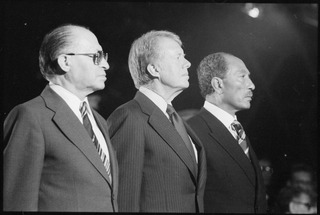
Some people consider President Carter to be a rather mild, sensitive man. Maybe. But his is an outstanding mediator! From September 5 to the 17th, Carter did a kind of shuttle diplomacy, walking from cabin to cabin, discussing, cajoling, bargaining–doing whatever he needed to to keep both men talking. By the 10th day they had arrived at an impasse. In a “Hail Mary” attempt, Carter took them to the Gettysburg National Military Park where they spend more than two hours learning about the actions. The carnage of Gettysburg wasn’t lost on the men. They signed “A Framework for the Conclusion of the Peace Treaty between Egypt and Israel,” on September 17th, and finalized the treaty at the White House in March 1979. It was not a perfect treaty, but it was an enormous breakthrough in Middle East peace.

It was fifteen years before there was another peace agreement. Shortly after the first Oslo Accords (1993) King Hussein of Jordan discussed the possibility of some type of relationship with Israel with both Hosni Mubarak of Egypt (go for it) and Hafaz Assad of Syria (forget it). In the end, the King felt it was time to try to make a formal peace with Israel. Again the US provided the venue where King Hussein, Yitzak Rabin and President Bill Clinton signed a non-belligerent pact at the White House on July 25, 1994. Three months later they signed the final Jordan-Israel Peace Treaty at the border near Wadi Araba on October 26th. Egypt was pleased with the treaty. Syria simply ignored the whole thing. However, 20 minutes before the signing, Hezbollah, the Iran-backed terrorist group based in Lebanon, launched rockets and mortars into several Israeli settlements in Galilee. That had become a standard problem, so as the Israelis moved into more secure areas, they took their radios with them so they could listen to that historic event.
That brings us to 2020. For over a year before Covid-19 raised it’s ugly head, the US had been working behind the scenes with both Israel and the UAE to put together a working arrangement for both countries. On August 13, President Trump spoke with both Prime Minister Benjamin Netanyahu and Crown Prince Mohammed bin Zayad al Nahyan of the UAE to “sealed the deal.” Known as the “Abraham Accord,” it opens full diplomatic relations between both parties. Why? Several reasons. It turns out that there has been a lot of commerce in the recent past between both countries, which had to be done through third parties. (What a huge waste!) Much more concerning is the fact that the UAE, along with Saudi Arabia and a number of other Arab states, are Sunni Muslims, as opposed to Iran, which is Shia. This has caused seriously strained relations in much of the Middle East. The UAE believes it is in their best interests to work in the open with Israel.
Both parties have not wasted any time. On August 16, they opened telephone service between the UAE and Israel. They are working to establish commercial flights, and are in talks with Saudi Arabia to arrange for overflight. Israel and the UAE have signed agreements between more than 40 tech companies in both nations to work together to help defeat Covid-19. They are also working to set up a “chamber of commerce” or another professional organization to expand bilateral enterprises, and talks regarding trade, tourism, health, aviation and energy are all moving along quickly. At the same time, a number of other countries such as Bahrain and Oman are looking into the possibility of working with Israel on some level. Having a continuing improvement in relations throughout the Middle East would be welcome on almost every level. It will also put pressure on both Iran and the Palestinian Authority to finally start negotiations in earnest. Hopefully we’ll start seeing updates on page one soon.
 Historical Lense