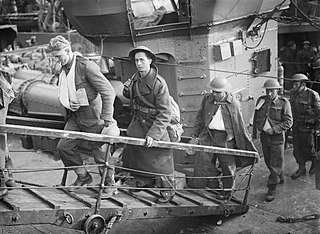
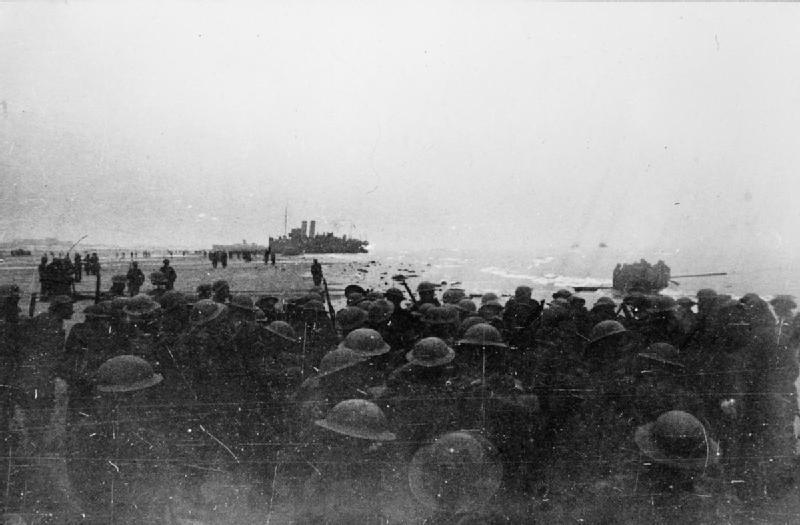
A friend and I were talking the other day. She’s a “non-historian” and asked me if I could suggest any movies about World War II that are both good movies, and good history. Well, I’ve got a long list, but I suggested the film Dunkirk. (I should add that the pictures below were taken in 1940, not by the film camera crews.)
First, let me give you the two minute history lesson so we’re all up to speed. Though World War II started when Hitler rolled into Poland on September 1, 1939, nothing happened in Western Europe. In fact, people in the UK and France were calling it the “Phony War” until May 10, 1940. Then all hell broke loose. German Army Group B invaded the Netherlands, moving south-west toward France. On the 14th, other German troops broke through the Ardennes and turned west to basically force the French and the British Expeditionary Force (BEF) to fall back toward the English Channel, not at Calais but toward Dunkirk. Then, suddenly, the Germans stopped in their tracks. Von Rundstedt and von Kluge wanted to take three days to consolidate their forces and then make one last push, forcing the Allies to surrender. Surprisingly, Hitler agreed to it.
The British were also surprised but didn’t waste any time. Three days bought them more time to get as many men as possible back home. They would have to leave most of their materiel—everything from trucks to artillery and mortars. Most men came back with their pistols, rifles, a few machine guns and the clothes they were wearing. But you can build more weapons—you can’t build more men. From May 27 to June 4, 213,000 Britons, and 123,000 French, Poles, Belgians and Dutch, went to sea on everything from destroyers to ferries, fishing boats, commercial vessels and pleasure boats that came from as far as the Isle of Man and Glasgow–861 vessels in all. Of those, 243 were sunk, usually from bombing runs from the Luftwaffe.
I had a little time this weekend so I binge-watched the movies again–yes, movies. The first Dunkirk was released in 1958. It’s black and white, which actually adds to the almost palpable tension seen throughout the battle and evacuation. The 1958 version is shown from two perspectives. It starts with a British corporal who takes what’s left of his squad through the Nazi-held French hedgerows to the Dunkirk beaches. There they, and thousands of others, wait for ships which they pray will come. We watch them deal with periodic German Stukas strafing across the beaches, Wehrmacht artillery barrages, and Luftwaffe bombardments. On the other side of the Channel we see that people are quickly realizing that appeasing Hitler has failed. A “hot” war has replaced the Phony War. Navy ships, particularly British and Canadian destroyers would bring back large numbers of men, but that wasn’t enough. Hundreds of small boats, many requisitioned by the Navy and many others whose skippers went on their own, set sail for the 45-mile trip to Dunkirk. Many troops did board the destroyers, but watching thousands of men waiting chest-high in the water holding their rifle above their head for hours is wrenching–and historically accurate. Interspersed throughout the movie is actual footage taken by both the British Army and Navy. It’s a powerful and haunting film.
Then on to Dunkirk (2017). The color in this film is magnificent. Again, it follows men trying to get to the beaches–through German rifle, machine gun and mortar fire. And once on the beach, more Stukas, artillery and bombs–and there’s no place to take cover on a beach. You can feel the desperation of men waiting to get off–most resigned and following orders, a few trying to find any possible way out. We also look at Dunkirk from the perspective of those at home, where they realized that it was up to them to get the men back. Here too, we can see the thousands of men who managed to get off the beach to destroyers. In addition, by following one man with his teenaged son and the boy’s friend, we begin to understand what it was like at sea. A shell-shocked soldier (known as PTSD today) who they pick off a capsized vessel, men they pull out of the sea who were covered in oil when their ship exploded–a significant metaphor for so much of the evacuation. What is new to this film as what happened in the air. Focusing on several members of the Luftwaffe and RAF Spitfires, it sounds as though you’re sitting right behind the cockpit, hearing and seeing everything. It’s is a fortaste of the coming Battle of Britain which began on July 10, 1940.
A fitting end to the evacuation of Dunkirk, though not seen in either film, was Churchill’s speech on the evening of June 4, part of which we all remember…“We shall fight on the beaches, we shall fight on the landing grounds, we shall fight in the fields and the streets, we shall fight in the hills; we shall never surrender…”
If you’re interested in learning more about Dunkirk, you might enjoy Walter Lord’s The Miracle of Dunkirk or Julian Thompson, Dunkirk: Retreat to Victory

 Historical Lense
Loved it! Makes me want to go watch the new one again, and the original one for the first time!
LikeLike
I’m glad you enjoyed it. You gave me a great idea—will probably do a film every 6 weeks or so—it was fun for me too!
LikeLike