About ten days ago I turned on the radio and opened the door to get my newspapers, and both my eyes and ears left me surprised. Seriously surprised–and seriously annoyed. 😤Apparently back in August the Chinese military launched a hypersonic low glide missile. What was so irksome was the fact that it appears that US intelligence hadn’t known about it until just days before it was announced in both the radio and newspaper (and TV news later). If that’s the case, and I really hope it’s not, then I can only ask what the %(#^ has our Intel been doing???
What is a hypersonic vehicle? It’s one which moves at 5+ times the speed of light. In this case, the vehicle was in low-earth orbit, went around the earth, and missed its target by 20 miles–and easy tweet to get it right the next time. That is extremely concerning because at this point in time, it’s virtually impossible to stop such a vehicle. Both the US and Russia have been working on hypersonic vehicles, but they are both far behind the PRC. It should definitely be a wake-up call, similar to what happened with Sputnik in 1957. I have a feeling that we need a Sputnik 2.0 right now!
So what was Sputnik? In April 1957, the US and USSR agreed to the International Geophysical Year (April 1957-December 1958). Eventually 67 nations took part. That summer, President Eisenhower received a briefing in which he heard that the Soviets were working on the first artificial satellite. After serious internal discussions the US quietly began Project Vanguard. The Russians, however, were farther along, and actually scaled back their work in order to launch Sputnik (which means Satellite) first.
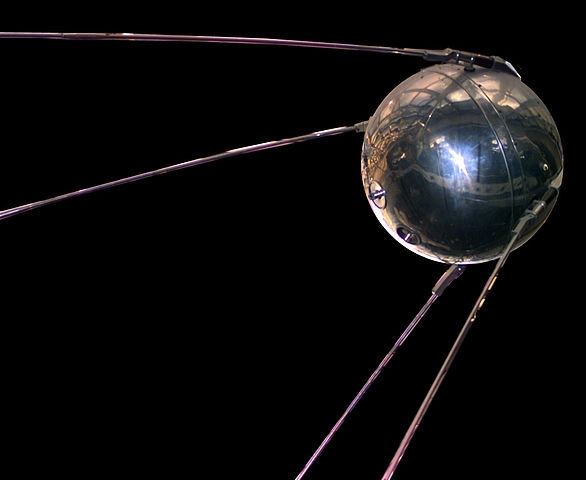
On October 4, 1957, the vehicle launched from Site 1/5 in Kazakh SSR (now known as Baikonur Cosmodrome). It was a spherical metal structure with four radio antenna attached to the exterior. Stations across the USSR would track radar, optical instruments and communications to gain a great deal of information. It would orbit the earth every 98 minutes, and would do so for 21 days, until the batteries died on October 26. At that point, Sputnik would continue to orbit in silence until January 4, 1958, when it burned up during reentry.
Very shortly before the launch, the Soviets enlisted amateur radio operators around the globe to listen for Sputnik as it flew across their area. They were told to listen for a constant “Beep. . .Beep. . .Beep.” Many people joined in, including the American Radio League, and the ham radio station at Columbia University. The Soviets also told certain groups that they might be able to see Sputnik as it passed certain areas in the early evening. Canada’s Newbrook Observatory was the first to photograph Sputnik in North America, and the USAF Cambridge Research Center, Westinghouse Broadcast and the Smithsonian Astrophysical Observatory go videos of Sputnik as it crossed Baltimore.
Sputnik was massive wake-up call in the US, and the Space Race was on. The US cranked up their work with the new Vanguard rockets–the first one failed in December 1957, the second one failed in February 1958. The third Vanguard finally got into orbit in March 1958. That was only the beginning. In short order NASA was up and running, and by July 1969 the US had landed on the moon.
Beyond that, most Americans–everyday Americans–wanted to know why we were so far behind, and what to do about it? Besides things like NASA, schools immediately began changing their curriculum from standard reading, writing and arithmetic to a LOT more math and science for everyone–whether you enjoyed it or not. And that happened rapidly. Where I lived, things changed over the summer of my kindergarten and first grade.
Not as many girls were involved in math and science during the Space Race, though I do have girlfriends who went on to get degrees in biology, math, chemistry and physics. Today there’s a real push to provide STEM (science, technology, engineering and math) for our students, much the same way we shifted to the sciences 60+ years ago. after Sputnik Given the current use of technology and the internet, STEM is incredibly important today. But I think finding out about the Chinese hypersonic low glide missile is an ever more important wake-up call to the US. First, we should immediately improve our intelligence and second, either immediately go full-bore on our work on hypersonic vehicles–or start learning Mandarin.
 Historical Lense
Nice post. Though I expect you mean the “speed of sound”, given that it’s impossible to move at even 1 times the speed of light 😅
LikeLike